actuellecd
  • This website is also available in English.

Blog

3585 results
  • 444
  • 445
  • 446
  • 447
  • 448
  • 449
  • 450
  • 451
  • 452
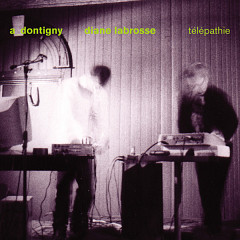
  • Télépathie, A_dontigny, Diane Labrosse in Real Tokyo

    “Review”, Andreas Stuhlmann, Real Tokyo, July 1, 2003
    Tuesday, July 1, 2003 Press

    After months of silence, and just in time for their showcase at this year’s Mutek 03, Montréal-based label No Type has unveiled another bunch of fine releases. For one that represents the experimental electronic end of the label’s palette, A_dontigny (computer) and Diane Labrosse (sampler) have teamed up for a sonic dialogue in which telepathy might in fact have played a part. The four pieces on this album sound as spontaneous as they seem to be compositions that have been worked out over years. While A_dontigny usually creates walls of noise with his morceaux_de_machines project, Labrosse is known as a former member of art rock bands, and from collaborations with several Tzadik artists. Considering this, Télépathie sounds rather quiet, and with subtle rhythms and melodies mysteriously born out of the duo’s equipment, it’s an outstanding title in the label’s list of albums that convince with originality and high tension. (4.5/5)

    … subtle rhythms and melodies mysteriously born out of the duo’s equipment… an outstanding title…

    Prairie orange in Octopus

    “Critique”, Steven Hearn, Octopus, July 1, 2003
    Tuesday, July 1, 2003 Press

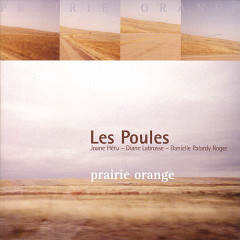
    Les Poules, c’est Joane Hétu, Diane Labrosse et Danielle Palardy Roger. Les Poules jouent respectivement au saxophone alto, à l’échantillonneur et aux percussions. Les Poules viennent de Montréal. Les trois Poules ont de la voix, c’est sûr. Elles ont également de l’imagination! Ce disque d’atmosphère, méditatif et incisif, répond à de premiers méfaits, il y a quinze ans, dans Les Contes de l’amère loi. C’est de la musique improvisée, assurément. Ce qu’il y a en plus dans la basse-cour? Quinze ans de recherche, d’expérimentations, de tâtonnements éclairés, de dévouement sans faille à une musique exigeante et inventive. Quinze ans de collaboration avec des musiciens ou artistes qui ont considérablement enrichi leurs vocabulaires sonores, précisé leurs saveurs bruitistes, leurs manières de structurer un propos musical, de construire des pièces introspectives et souvent abstraites. Les voix ne disent plus de textes écrits mais sont devenues des instruments à part entière. L’attention, accrue, est portée sur les textures, la couleur, le potentiel musical du son… Nos trois Poules, qui ont désormais l’habitude de travailler sur des projets de danse, des pièces radiophoniques, des pièces de poésie, des films, ont gagné en épaisseur… Aussi, ce disque possède tour à tour des accents lyriques et incongrus, harmoniques et dissonants, structurés et anarchiques, doux et énervants.

    … dévouement sans faille à une musique exigeante et inventive.

    Nous perçons les oreilles in Cadence

    “Review”, Michael Rosenstein, Cadence, July 1, 2003
    Tuesday, July 1, 2003 Press

    Montréal stalwarts Joane Hétu (as, vcl) and Jean Derome (as, flt, perc, vcl) combined song forms, ragged improvisation, and playful theatrics for uneven results. Derome augmented his alto and flute with his usual bag of bells, birdcalls, toys, and even a megaphone for contrasting textures to Hétu’s unpolished alto and cracked, squeezed, and choked singing. There was always a sense of personal play to their set but, too often, it carne off as forced theatrics. The presentation of the Edmonton duo of Laura Kavanaugh (video, sampler, electronics) and lan Birse (electronics) was diametrically opposite to the raw theatricality of Derome and Hétu.

    Unstable Friends, Chants rupestres, L’âme de l’objet, Le barman a tort de sourire, Les Fleurs de Léo, Compil zouave, Duo déconstructiviste, Bavards, Grain, Muets, Bob, Bruire, Michel F Côté, Klaxon Gueule in actuellecd.com

    “Michel F Côté”, David Turgeon, actuellecd.com, June 29, 2003
    Sunday, June 29, 2003 Press

    As we begin this series of articles on various catalogue-related themes, why not start with the hardest artist to pin down from the Ambiances Magnétiques collective: prolific and eclectic drummer Michel F Côté.

    A late arrival to the Ambiances Magnétiques roster (joining in 1988), Côté readily put himself on the fringe of various geometrically variable groups. He could be heard for the first time in the debut Bruire album, Le barman a tort de sourire, a surprise box with no less than 14 guest musicians. Bruire is Côté’s very poetic project-group, in which he plays with the language of avant-garde, song and ambient music. This album launched a trilogy which continued in an increasingly mature vein with Les Fleurs de Léo, to end with the unforgettable L’âme de l’objet. This travelling in three steps has given us the chance to hear collaborators such as Geneviève Letarte, Jerry Snell, René Lussier, Ikue Mori, Claude St-Jean and Jean Derome, all of whom helped to feed our drummer’s fertile imagination.

    More than six years passed before a new Bruire project could be heard, this one a very different beast: Chants rupestres, an improv quatuor with Jean Derome, Normand Guilbeault and Martin Tétreault. In fact, during these six years, Côté had been working on other projects which were increasingly more… deconstructed. The first sequels of this could be seen in a collaboration with Diane Labrosse, a slightly obscure CD purposely entitled Duo déconstructiviste. And if the first (double) album from his new project Klaxon Gueule, Bavards, was to sport a fairly recognisable “rock” energy, this project would soon see Côté at his most abstract.

    The least we can say is that the release of Muets, a shiny minimalist jewel completely at odds with Bavards, would be a surprise to most listeners. One thing was for sure though, this new CD, released in 1999, was certainly more in phase with its era than the Duo déconstructiviste which was, in retrospect, perhaps too much in advance on its time. But this change was also due to the aesthetic evolution of doublebassist Alexandre St-Onge who, from a relatively “classical” playing, was to suddenly turn to a rather more conceptual approach towards his instrument. Côté and guitarist Bernard Falaise were thrilled to follow their bandmate in this new direction. Their latest album, Grain (recorded with Sam Shalabi and Christof Migone), confirmed this tendancy while pushing it even further into sophistication, making this work one of Côté’s most accomplished of his discography.

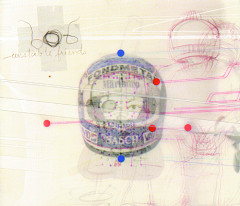
    But the drummer did not stop there and reappeared where no one was expecting him. Thus, with Éric Bernier and Guy Trifiro, he created a new group, Bob, whose new disc, Unstable Friends, just came out. Under some fairly deviant and attractive cover artwork, a return to the bizarre “pop” music from Bruire’s beginnings is taking shape! We also heard through the grapevine that a new project called Mecca Fixes Clock (in which we can recognise the composer’s initials!) which could be described as orchestral ambient. Is Côté returning to his first loves?

    If it isn’t so easy to give an overview of Michel F Côté as a musician, then that might be because his work goes beyond just music. In fact, one can often hear our protagonist at the theatre and in performance art, with such creators as Robert Lepage and Catherine Tardif. This aspect of his work finds its echo on Compil zouave, so far the only disc released under the composer’s name. We should also mention Côté’s previous involvement as a radioshow host at Radio-Canada amongst others, and his writing for contemporary arts magazine Esse.

    Michel F Côté may best be seen as a kind of barometer of Ambiances Magnétiques’ creative activity throughout the years: from the song-form experiments of the 1980s through the peculiar lyrical impro-composition which was the signature sound of the AM catalogue in the 1990s, to continue with a more extreme form of improvisation, based on the physical existence of the instrument.

    Unison Rituals in AllMusic

    “Review”, François Couture, AllMusic, June 19, 2003
    Thursday, June 19, 2003 Press

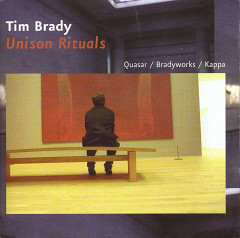
    Released only a few months after Twenty Quarter Inch JacksTim Brady’s recording debut for Ambiances Magnétiques, Unison Rituals brings together five pieces for ensembles small and large. While the previous album focused on Brady’s work in the studio (with multitracking and electroacoustics), this one comes back to modern composition. Each piece features the note cycles and complex patterns of displaced accents that give his music such an immediately recognizable sound. Some find in these elements influences from Steve Reich and Philip Glass, which is undeniable, but Brady often steps out of this canvas. Escapement includes a soulful soprano sax solo during a surprisingly melodious bridge section. Two Chords Less Than a Blues moves back and forth between overlapping note cycles from the piano and tenor sax and trashy percussion breaks. But the highlight of the set is Double Helix, for piano, percussion, cello and saxophones. Beginning at dizzying speed, spinning its hermetic cycles like strands of DNA, the piece eventually cools down to leave room for some exquisite interplay between piano and cello and lead into the prettiest coda Brady has written yet. These three pieces are performed by his Bradyworks} ensemble. The album opens on the title sax quartet interpreted by Quasar. Its quirky interlocking lines and hiccuping accents are strongly reminiscent of Rova’s work — so is the quality of Quasar’s delivery. The last piece, Sound Off, was originally written as an outdoor piece for a mass band of 100 saxes, trumpets and trombones plus eight bass drums. This version, lasting only a quarter of the duration of the original, features 42 instruments (the big band Kappa). Brady explores stunning drone and dissonance effects that lead up to an unexpected major chord that is taken apart and sent back to the atonal magma. In short, Unison Rituals is Brady’s most impressive album since Revolutionary Songs in 1996.

    Brady’s most impressive album since 1996.

    Asymétries in AllMusic

    “Review”, François Couture, AllMusic, June 19, 2003
    Thursday, June 19, 2003 Press

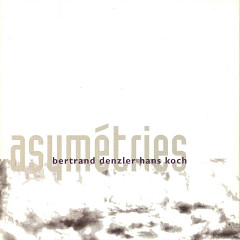
    This album doesn’t come from an expected outlet — after all, Bertrand Denzler and Hans Koch appear to have no ties to the Ambiances Magnétiques collective prior to this CD — but it stands as a peak in the discography of both of these Swiss improvisers. Denzler (Hubbub, Chamaeleo Vulgaris) and Koch had been going down a path of gestural abstraction, digging ever deeper within themselves and the materiality of their instrument (here respectively tenor sax and bass clarinet, Koch also plays soprano sax) to find unheard sounds and develop a new musical vocabulary. Their search parallels that of John Butcher, Wolfgang Fuchs and Axel Dörner. Working as a duo, they apply this new vocabulary in conversation, articulating squeaks, burps and key clicks into an eery jungle-at-nightfall soundtrack. Tongue stabs, multiphonics and circular breathing represent only the tip of the iceberg of their extended techniques. The set is short (37 minutes), but thoroughly captivating. The highly challenging nature of this album is balanced by a wide diversity in textures and dynamics. Asymétrie 1 sees both musicians alternately listening minutely and stubbornly ignoring each other over 17 minutes of subdued pyrotechnics and brilliant creativity. But the highlight is Asymétrie 3, full of fluttering tongues and clattering fingers. The duo’s direction is less clear in the last piece, but it represents a minor flaw considering what came before it. In Asymétries, Denzler has pushed his art further into abstract, so-called non-idiomatic improv. It is one of his most difficult records.

    In Asymétries, Denzler has pushed his art further into abstract, so-called non-idiomatic improv.
  • 444
  • 445
  • 446
  • 447
  • 448
  • 449
  • 450
  • 451
  • 452