Taking on the œuvre of Charles Mingus is a major challenge for any band, especially one led by a bass player. Not only, as in all jazz repertoire efforts, does the group have to avoid slavish imitation, but Mingus’ work also has to be presented with the sort of cocksure aggression that characterized the man himself.
Many musicians have tried to defy these odds, though few have been very successful. There are the various versions of the Mingus Big Band – Sue Mingus, Prop. – that with a bit too much fealty to the bassist’s widow, manage to perpetuate the bassist’s memory with unexpected versions of some of his better and lesser-known work.
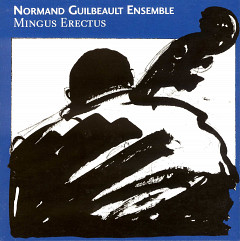
Then there’s this left field entry. Organized by Montréal bassist Normand Guilbeault, it features a cross-section of that city’s musique actuelle players in a rare foray into unhyphenated jazz. Perhaps that’s why there’s freshness to these tunes – some of Mingus’ Greatest Hits – that have been played by many over the past four or five decades, and very frequently in the 26 years since the bass man’s death.
Musique actuelle is defined by its practitioners as music of today. Performed, it can have as many references to ProgRock, electronica, movie themes, contemporary, so-called serious music and traditional chansons as jazz and improv. Jean Derome, who plays alto and baritone saxophones and flute here, is involved in many of those mutant forms, yet turns in a surprisingly nuanced and jazzy take on Mingus. At times you could swear the solos are coming from altoist Jackie McLean or baritonist Pepper Adams, some of the legendary bassist’s favored sidemen. MDMD, the one non-Mingus composition here, is Derome’s as well, and cleverly slips in among Chazz’s work without a ripple. Drummer Claude Lavergne and trumpeter and flugelhornist Ivanhoe Jolicoeur have also been mainstays of musique actuelle over the years as has clarinetist Mathieu Bélanger, who brings outstanding atypical textures to this CD, with his standard and alto clarinet excursions on passages usually confined to saxophone reeds.
Of course the compositions’ overriding visualization comes from leader Guilbeault, who has involved himself in this repertoire for about 15 years, and recorded an earlier Mingus tribute a decade ago. Montréal-born, he’s one of the few musique actuelleers with a straight jazz background having played with such local heroes as guitarist Nelson Symonds and drummer Bernard Primeau. He has also worked with Québécois singers, on major projects conceived of by Derome, guitarist René Lussier and percussionist Michel F Côté, his own Parkerouac, wedding poetry and jazz and Riel, a musical about a 19th Century government-executed French-Canadian firebrand.
From inception, the eight tracks of Mingus Erectus balance on the Guilbeault’s rhythmic smarts. But his underpinning is flexible enough to allow Bélanger, Jolicoeur and especially Derome a 21st Century latitude with the tunes. Thus pieces may include multiphonic shout choruses plus sudden shifts of tempo and pitch without every losing the foot-tapping beat. Bélanger’s horn often sounds Québécois street band slurs and glissandi as much as traditional blue notes. Mixing his note-bending with brassy plunger work, Jolicoeur alternately brings to mind Ted Curson and Roy Eldridge, two trumpeters from different generations who recorded with Mingus. This is especially apparent on Conversations, where contrapuntal lines from the horns evolve from call-and-response to individual statements, including the trumpeter’s cascading triplets. All the while Guilbeault keeps up the ostinato, sometimes double-strummed.
On a shrill, almost piccolo-sounding flute, Derome’s cunning enlivens Tijuana Gift Shop, as harmonic convergence with the snorting trumpet lines and near-Dixieland clarinet glisses brings even more of a Latin tinge to the tune. Using a harsh vibrato and a hard reed, Peggy’s Blue Skylight becomes a baritone saxophone feature for Derome, with his stomping vibrato matching the powerful polyphonic bass work and contralto, contrapuntal coloring from the clarinetist.
Another highpoint appears with a recasting of 1959’s Fables of Faubus as 2005’s Fable of (George Dubya) Faubus. Retaining the circus-like mockery of the original –, a barb launched at Arkansas’ then segregationist governor – the Ensemble widens the sarcasm to lambaste the American president’s excursion into Iraq. It’s a technique Mingus often followed himself, taking on Richard Nixon, Nelson Rockefeller and other politicians later in his life.
However, it’s a bit surreal to hear “No more stupid wars” and “Boo George Bush with your evil plan” shouted out in a heavy a Québécois accent. But the instrumental work is at the same high level as the initial recording of the piece and its subsequent recording with Curson and Eric Dolphy. Bélanger’s mellow, chalumeau tone keeps the tune moving forward, as the others provide a wavering countermelody. Derome double-tongues his alto saxophone reed and Jolicoeur growls timbres from deep inside his horn. One of the few Mingus tributes that approaches the passion and commitment of the honoree, Mingus Erectus inculcates a desire to hear Guilbeault and company in other contexts.

![Ensemble SuperMusique (ESM) [Photo: Céline Côté, Montréal (Québec), November 2023]](https://res.electrocd.com/image.php/image/e/ensemblesupermusique__13515.jpg?width=n2&cropratio=1:1)