actuellecd
  • This website is also available in English.

Blog

3585 results
  • 159
  • 160
  • 161
  • 162
  • 163
  • 164
  • 165
  • 166
  • 167
  • La Formule Xyz in The Squid’s Ear

    “Heard In”, Wyman Brantley, The Squid’s Ear, November 15, 2011
    Tuesday, November 15, 2011 Press

    Musicians who let drones do most of the talking for them might learn a thing a two from Martel, Tetrault, and Lauzier. Complex drone washes can be beautiful in themselves, to be sure. But developments in the shape of the sound — the “composition,” for lack of a better term — in drone musics can be glacial at best. The listener can ironically feel almost coerced to enter that hypnotic state that best lends itself to enjoying steady drones.

    The pieces on La formule XYZ perhaps highlight a strategic element that may seem missing when you are in the mood for something more engaging: the use of figure/ground contrasts. What do I mean by this? Listen to track one x= (R) z, for example. A sound complex is established at the beginning of the piece and it is held pretty much static throughout, making it function as a drone. At the beginning, this drone is the “figure,” the main voice of the piece. However, as the piece advances, other sound events and sound complexes occur “on top of” this drone. As they happen, they momentarily become figure, and the static elements serve as ground. Later, though, the original drone also returns as figure occasionally, as the other sound events stop or otherwise lose our attention. Through this use of figural interplay, the drones tend to retain their effectiveness and attraction as musical events. Their ability to capture our interest is continually recycled and renewed.

    Mind you, this is noisy stuff. Consider the instrumentation: Pierre-Yves Martel: feedback, static; Martin Tetrault: pick-up, equalizer; Philippe Lauzier: soprano saxophone, bass clarinet, prepared amplifier.

    This should give readers some indication of the sense of the term “drones” used above. The tones and timbres here can be quite saw-toothed. This is post-industrial music, to be sure. Yet, on the harshness continuum, the aesthetic is much closer to your Nakamuras than your Merzbows.

    Aside from this group’s effectiveness as an ensemble, it really should be noted how well they work as an electroacoustic ensemble specifically. Track four (sparing you its Braxtonian title) is a great example. While Lauzier uses a purely acoustic instrument, soprano saxophone, the piece retains the machine-like aesthetic of the more electronically voiced tracks. Part of this is surely due to Lauzier’s playing (and his magnificent amplified bass clarinet on track six is a stand-out aspect of this recording). But it is also testament to the solid studio skills of those involved in making this disk: the balance of the three musicians is perfect throughout. The mix is upfront with minimal processing, providing a level of detail that suits this trio best.


    the balance of the three musicians is perfect throughout

    Jean Derome in Downbeat

    “Review”, John Murph, Downbeat, November 14, 2011
    Monday, November 14, 2011 Press

    At Largo — the festival’s unofficial headquarters in the city’s Saint-Roch downtown district — multi-reedist Jean Derome paid homage to Strayhorn with an energetic performance that alluded to Lovano’s formative years in Cleveland. Derome focused on the alto saxophone but showed equal wherewithal on the baritone saxophone and bass flute. He fronted an extremely agile band — pianist François Bourassa, bassist Normand Guilbeault and drummer Pierre Tanguay — who brought their restive urgency to the forefront. Much of the performance’s delight came from Derome’s devil-may-care flair and finesse with Strayhorn’s material. While the sets didn’t rely upon unnecessary whimsy, the musicians brought inventive vigor to warhorses like Take The ‘A’ Train and Passion Flower. Occasionally, Derome shared the front line with vocalist Karen Young, who evoked Billie Holiday with the improvisational guile of Betty Carter. She meshed and contrasted deftly with Derome’s vinegary timbres on the saxophones and flutes, hitting high points on poignant readings of Strange Feeling, Imagine My Frustrations, Something To Live For and an encore performance of Lush Life. […]

    Like many Québécois jazz musicians, Derome and L’Orchestre d’Hommes are shamefully under-recorded, but such unforgettable performances will have festival attendees returning to Quebec to encounter other rare treasures.

    Like many Québécois jazz musicians, Derome and L’Orchestre d’Hommes are shamefully under-recorded, but such unforgettable performances will have festival attendees returning to Quebec to encounter other rare treasures.

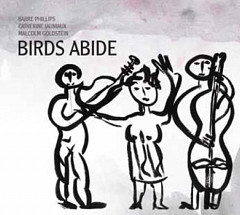
    Birds Abide in Le son du grisli

    “Disques”, Luc Bouquet, Le son du grisli, November 7, 2011
    Monday, November 7, 2011 Press

    À Victoriaville, le 22 mai de l’année dernière, Barre Phillips, Catherine Jauniaux et Malcolm Goldstein avaient jugé utile de n’être qu’eux-mêmes et rien qu’eux-mêmes.

    Sur scène, les voici donc investis, sourds aux distractions extérieures et sensibles aux sollicitations de chacun. Oui, unis et liés par cet art du délestement qu’ils n’ont plus à prouver mais à maintenir et à renouveler (ne change rien pour que tout soit différent disait tonton JLG dans ses Histoire (s) du cinéma). Alors, ils partagent, se rebellent, se suivent, s’opposent sans se disperser.

    Les histoires amorcées par Catherine Jauniaux avortent ou sont rendues incompréhensibles par le phrasé fissuré de la chanteuse. Qu’importe: le tableau a déjà changé de teinte. Maintenant, ils tressent et détressent, rompent ou entretiennent l’unisson. Parfois, d’une mélopée incertaine surgissent les traces d’un chant ancestral. Parfois, le violon est maître alors que la contrebasse n’est que d’accompagnement ou de soulagement. Mais toujours d’écoute. Parfois duo, presque toujours trio. En résumé: poignant.

    En résumé: poignant.

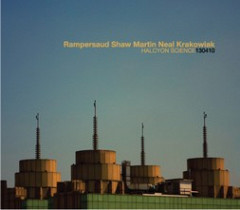
    Halcyon Science 130410 in The WholeNote

    “Something in the Air: Brass-y Women Stand Up and Stand Out”, Ken Waxman, The WholeNote, no. 17:3, November 5, 2011
    Saturday, November 5, 2011 Press

    Enhanced freedom in music over the past 60 years has involved more than the addition of new instrumental techniques and compositional strategies. Recasting of gender roles has also taken place. No longer are women instrumentalists expected to play traditionally delicate female instruments such as violins or flutes; or those where they sit demurely such as the piano, harp or cello. This change is most obvious in improvised music, where the number of women who stand up to play has multiplied exponentially. Many have chosen to become brass players, adapting their skills to apparatuses which demands power and stamina.

    Take Toronto trumpeter Nicole Rampersaud for instance. The high-quality improvising she exhibits on Halcyon Science in the company of saxophonist Evan Shaw, drummer Jean Martin, bassist Wes Neal and percussionist Tomasz Krakowiak doesn’t distinguish in any way between her talents and those of her colleagues. During seven group compositions, the quintet vaults back-and-forth from high-energy anthems to more cerebral explorations with equal skill. Take me To Your Leader is an example of the latter, as clattering friction from Krakowiak’s noise-makers evolves in stacked counterpoint alongside Shaw’s irregularly squeezed vibrations plus the mouthpiece suckles and tremolo emphasis of Rampersaud. Her rubato slurs and valve squeaks intersect perfectly with the baritone saxophonist’s tongued percussiveness as Martin’s ratamacues, pops and drags presage harmonizing vamps and a final quivering dissolve. Meantime the title tune and Dirigible move with a chromatic gait. The former resembles an Eric Dolphy line, with repeated climaxes interrupted by mid-range honks from Shaw and stuttering pitches from the trumpeter. Dirigible stacks timbres so that space between Rampersaud’s staccato and heraldic tone and Shaw’s juddering tempos are obvious. Still a near-bugle call on the trumpeter’s part in the final sequence signals a slowdown to barely there flutter tonguing on her part, accompanied by the reedist’s smooth obbligato, until together they dovetail into muted tones framed by drumstick-rubbing friction from the two percussionists.

    Enhanced freedom in music over the past 60 years has involved more than the addition of new instrumental techniques and compositional strategies.

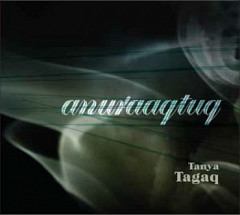
    Anuraaqtuq in Downtown Music Gallery

    “Review”, Bruce Lee Gallanter, Downtown Music Gallery, November 4, 2011
    Friday, November 4, 2011 Press

    Although Ms. Tagaq is a Inuit throat singer from the northern region of Canada, this doesn’t begin to explain her exhilarating and incredibly intense performance at the Victoriaville Festival in May of 2010. I had caught her once at the Guelph Fest in a more intimate improv situation but her Victo debut was something else altogether. She wisely chose two of Canada’s best improvising musicians to collaborate with: violinist Jesse Zubot (Vancouver-based & head of the Drip Audio label) and drummer Jean Martin (Toronto-based & cofounder of Barnyard records). Both visually and vocally, Ms. Tagaq was a bit over-whelming as she delivered her own strange, animalistic vocal sounds and danced like a demon in flames. It was a spectacle no one who attended will soon forget. Tanya’s uses her voice in odd ways, twisting and bending it into shapes not so easy to describe. Snarl opens with just Tanya moving between two different vocal characters or inflections: a young woman with higher more fragile voice and an older woman with a breathing problem or hoarse witch-like quality. Slowly Jesse adds fractured strings and Jean adds subtle percussion, as the trio blends and builds the into a tight frenzy, casting their own spell over the attentive audience. Ms. Tagaq’s throat-singing is much different from the Mongolian throat-singing that most of us have heard in the past, giving it an exorcist sort-of quality. Mr. Martin adds eerie electronic samples on Plush and perhaps he is the one who adds echoes or manipulates Tanya’s voice adding another layer or two. Being present at this concert, I was somewhat overwhelmed by the visual content and loud volume, but listening to the disc I hear more of the connection between the players and the overall music display or picture. Tanya often sounds as if she is playing different characters, from a crying little girl to a scary old lady. Jesse and Jean do a fine job of adding their own sympathetic interaction selectively and at times just laying out while Tanya creates another voice or presence. Like all CD’s on the Victo label, the sound is superb and well-balanced. At times it hard to tell that Ms. Tagaq is making those sounds herself, they are completely captivating and sound like the language of a friendly alien.

    It was a spectacle no one who attended will soon forget.

    Anuraaqtuq in Monsieur Délire

    “Listening Diary”, François Couture, Monsieur Délire, November 2, 2011
    Wednesday, November 2, 2011 Press

    Exiting the venue back in May 2010, we all knew we had just witness something incredible, magical. Then, time took its toll, and we started doubting; we caught other shows by the artist, and we doubted again, Finally, this CD arrived and, well, it was real, we DID witness a moment of pure magic, a moment this record faithfully preserves. Anuraaqtuq is the first recording by Tanya Tagaq’s trio in its incarnation since 2009. With drummer Jean Martin and violinist Jesse Zubot, the Inuit singer completely eschews her previous pop records to dive headfirst into ultra-emotional free improvisation. She screams, cries, yelps and orgasms, transmuting the most atavistic human emotions into a spellbinding song. And that particular night, she reached new heights before an audience that, unlike what she was used to, was taking it all in and asking for more. A communion the likes of which I have rarely witnessed — and whenever I did, it was always at FIMAV and nowhere else.

    She screams, cries, yelps and orgasms, transmuting the most atavistic human emotions into a spellbinding song. And that particular night, she reached new heights…
  • 159
  • 160
  • 161
  • 162
  • 163
  • 164
  • 165
  • 166
  • 167