actuellecd

Blog

3585 results
  • 158
  • 159
  • 160
  • 161
  • 162
  • 163
  • 164
  • 165
  • 166
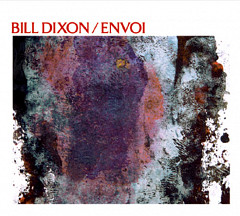
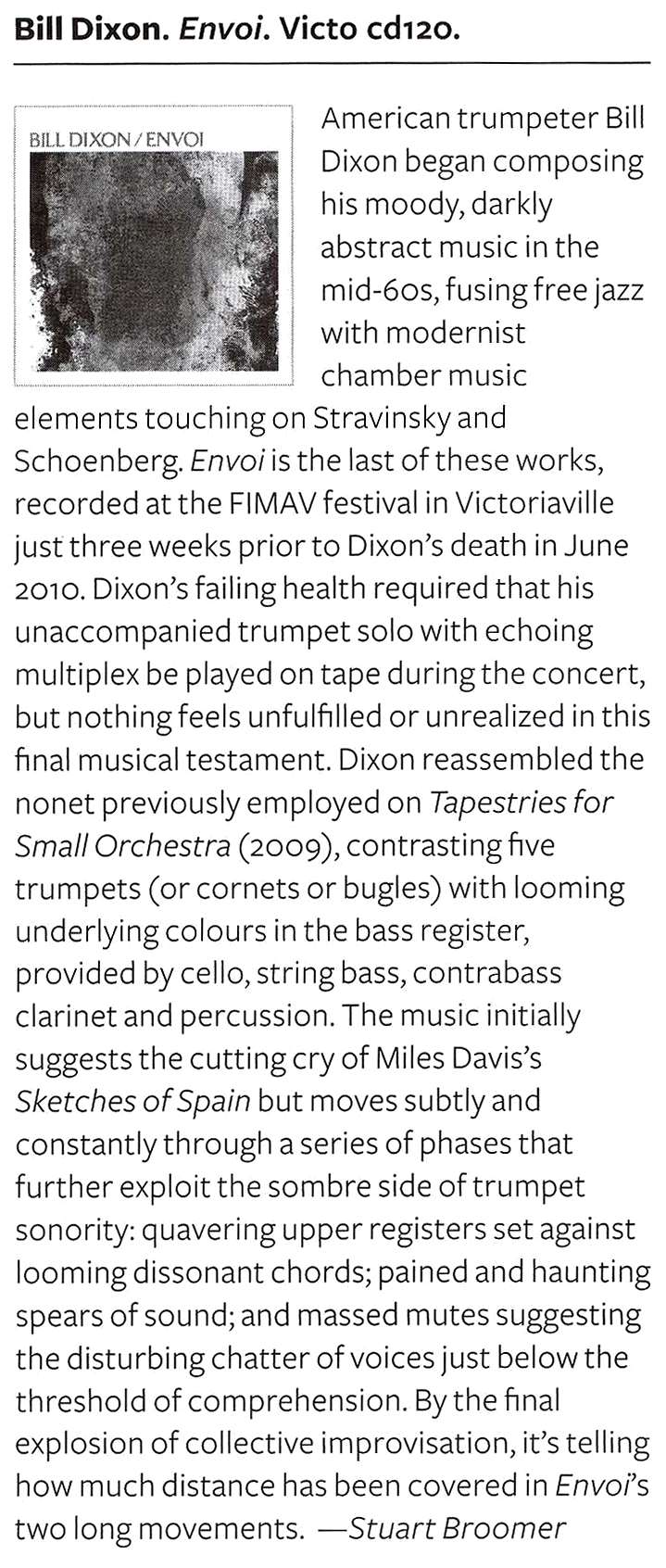
  • Envoi in Musicworks

    “Review”, Stuart Broomer, Musicworks, no. 111, December 1, 2011
    Thursday, December 1, 2011 Press
    By the final explosion of collective improvisation, it’s telling how much distance has been covered in Envoi’s two long movements.

    Solitary Pleasures in Jazz à crédit

    “En bref, quelques albums en journal d’écoute”, Maxime Bouchard, Jazz à crédit, November 30, 2011
    Wednesday, November 30, 2011 Press

    Intrigante proposition que celle-là. Du spoken-word, très proche de la poésie du quotidien, petites vignettes supportées par une orchestration simple de musique électronique et acoustique. La voix est juste, posée, pénétrante, la musique post-industrielle, rêche… très bon!

    La voix est juste, posée, pénétrante, la musique post-industrielle, rêche… très bon!

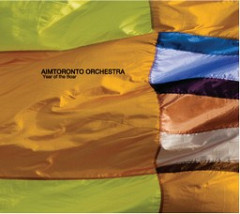
    Year of the Boar in Jazz Word

    “Review”, Ken Waxman, Jazz Word, November 30, 2011
    Wednesday, November 30, 2011 Press

    Spurred by the world-wide conduction projects of Butch Morris and their results, improvising ensembles in Europe and North America have been organized to advance the concept of playing free music on a larger scale.

    Although there are notable orchestras in expected places such as London, New York and Berlin, often the most remarkable, and certainly the most original, large group interpretations come from bands in smaller centres. Working with a group of like-minded musicians in his hometown, for instance, British pianist/electronics manipulator Pat Thomas has composed dissimilar pieces for the Oxford Improvisers Orchestra (OIO) on this CD. Involving voices, non-Western instruments, a tribute to a Jazz master and a literal violin concerto, each moves in a different fashion. Toronto’s AIM Toronto Orchestra (AIMTO) on the other hand plays pieces by four different composers on its seven-track CD. However under the direction of artistic director/soprano saxophonist Kyle Brenders, who penned the two lengthiest pieces, a harmonic uniformity exists.

    Odd for someone who studied with Anthony Braxton, Brenders AIM Toronto Orchestra compositions, unlike his Jazz-inflected small group work, appear to avoid Jazz influences in favor of tropes from notated music and elsewhere. For example, a piece such as Thru and Through, shoehorns wordless vocalizing from Christine Duncan, Scruggs-style banjo-picking from Rob Clutton into an exposition initially stated by quivering strings, harmonized woodwinds and stacked brass extrusions. Meanwhile tenor saxophonist Christopher Willis advances the theme as three percussions clank and clip alongside. With brief sequences parceled out among many orchestra members, it’s Simeon Abbott’s piano passages which mark important transitions, making room at different intervals for Steve Ward’s trombone guffaws, Rob Pilonen’s flute harmonies and Nicole Rampersaud’s trumpeting grace notes. As the often polyphonic work advances, it’s the restated solo variants which reference the initial narrative rather than showier tutti passages that impress.

    Similarly Follow Line Flow Line Follow is built up from concentric orchestral timbres that foreshadow the contrapuntal divisions among the vocalist’s nonsense syllables plus swelling and vibrating slurs and pumps from the horns. Single variations involve bass clarinet lines, cymbal cracks, bell ringing and tough guitar scrubs, with a later combination finally modulating into a languid climax that trades previously inchoate hocketing and expanding runs for popped vibrations and near silences.

    Meanwhile the opening Year of the Boar brings a Jazz sensibility to the proceedings. Yet ironically or not, its composer, guitarist Justin Haynes, isn’t featured on the disc. Operating off a steady vamp with heavy syncopation from dual drummers Nick Fraser and Joe Sorbara, the tune encompasses a swing section, and a lyrical alto solo from Evan Shaw. […]

    Both the OIO and AIMTO attempt particular sound variations to re-define — or perhaps it’s to define — the parameters of large improvising ensembles. Although not everything tried is successful, the spirit of experimentation expressed by both will go far to make similar-sized groups viable as the shape of 21st Century music unfolds.
    Both the OIO and AIMTO attempt particular sound variations to re-define — or perhaps it’s to define — the parameters of large improvising ensembles.

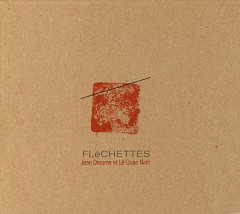
    Fléchettes in Le son du grisli

    “Critique”, Guillaume Belhomme, Le son du grisli, November 29, 2011
    Tuesday, November 29, 2011 Press

    Les fléchettes que décochent Jean Derome (flûte, saxophone alto, appeaux et petits instruments) et Lê Quan Ninh (grosse caisse environnée) délivrent un poison qui saisit en un rien de temps.

    Derome avait pourtant prévenu du danger: maugréant d’abord avant de se ranger à l’opinion vindicative de son partenaire: Lê Quan Ninh qui vitupère, frappant fort ou faisant rugir sa grosse caisse à force de caresses multipliées. Ce sont ainsi des râles tenaces et des drones insistants que le percussionniste dépose au second plan.

    Contraste: maintenant Derome siffle. À l’alto, il défend une intensité bruitiste qui annule et remplace la gentillesse de son usage des petits instruments, que les graves profonds de Ninh avalent de toute manière. À la flûte, Derome évoque alors Prokofiev avant que sonne l’instant d’une autre saillie: sifflements, grognements que domptera un lot de baguettes sèches. Le bois dont on fait les fléchettes cédera sous les effets de derniers tremblements. Le souvenir, ravissant, est d’engourdissement.

    Les fléchettes que décochent Jean Derome et Lê Quan Ninh délivrent un poison qui saisit en un rien de temps.

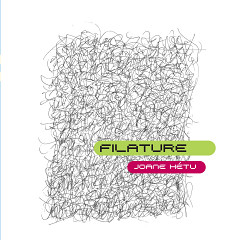
    Filature in Monsieur Délire

    “Listening Diary”, François Couture, Monsieur Délire, November 22, 2011
    Tuesday, November 22, 2011 Press

    It took five years for Filature to transit from stage to record. Meanwhile, Joane Hétu’s sound theatre has evolved toward much more stripped-down forms. On the path that has led Hétu from Musique d’hiver to La Femme territoire, Filature represents a turning point, a crossroads where her past, present and future approaches have met. The piece integrates text, dance, and video art (the last two aspects are missing on the CD) — a path on which she would later travel much further — but it is based on the artist’s past life as a weaver. The text tells this experience, an experience that also provides the very structure of the work: Chaîne, a first movement performed only by the men (Fabbro, Derome, Guilbeault, Tanguay, Venba); Trame, a second movement performed by the women (Auclair, Gignac, Hétu, Labrosse, Roger); and Motif, a movement performed by all. The male component is metrical, repetitive, grounded; the female component is aerial, creative, whimsical; the final movement combines it all — and seems to bring together all of Hétu’s background, from Wondeur Brass and Justine to Nous perçons les oreilles, by way of Musique d’hiver. A dense, synthetic work, though still accessible and showing its rock-in-opposition roots.

    A dense, synthetic work, though still accessible and showing its rock-in-opposition roots.

    Lieux imaginés in Le Devoir

    “Critique”, Yves Bernard, Le Devoir, November 18, 2011
    Friday, November 18, 2011 Press

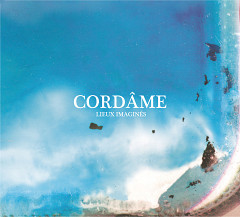
    Après avoir fait paraître deux disques avec des invités, les membres de ce trio à cordes reviennent à l’essence de leurs compositions: une musique livrée avec contrebasse, violon, violoncelle, grande sensibilité et lyrisme, à la croisée du jazz, du classique et des musiques du monde, mais qui n’est ni l’un ni l’autre. Dans plusieurs pièces, le leader Jean-François Mailloux transmet son impression de villes qu’il n’a pas visitées. Vancouver révèle sa douceur avant son intensité. Madrid dévoile le déchirement rythmique au bout des doigts. Madagascar est plus sautillante; Kisarazu, plus orientale; Buenos Aires, passionnée mais adoucie; Santiago, doucement nostalgique; Veracruz, calme et non frénétique; Riga, en respiration lente. Ainsi va la vie imaginée. Preuve que les tableaux sonores n’ont pas besoin d’être des portraits réalistes. Et les rêveries de Cordâme sont très enveloppantes.

    Ainsi va la vie imaginée. Preuve que les tableaux sonores n’ont pas besoin d’être des portraits réalistes. Et les rêveries de Cordâme sont très enveloppantes.
  • 158
  • 159
  • 160
  • 161
  • 162
  • 163
  • 164
  • 165
  • 166