actuellecd
  • This website is also available in English.

Blog

3585 results
  • 142
  • 143
  • 144
  • 145
  • 146
  • 147
  • 148
  • 149
  • 150
  • Hemlock in Cult#Mtl

    “Today’s Sounds”, Lawrence Joseph, Cult#Mtl, October 30, 2012
    Tuesday, October 30, 2012 Press

    After 18 years of existence, bassist and composer Nicolas Caloia’s Ratchet Orchestra qualifies as a Montréal free jazz institution, despite sparse recordings and performances. The unit has grown exponentially over the years, from humble quartet beginnings to the current 31 member outfit. Musique actuelle stalwarts like flutist Jean Derome, clarinetist Lori Freedman and drummer John Heward all contribute here, and just about every other member also leads important ensembles in their own right.

    The Ratchet’s first quartet CD from 1994 covered Christian Wolff’s Burdocks, providing some early clues into Ratchet philosophy. Burdocks is a non-hierarchical piece of distinct components using only minimal music notation, from which a collective work can be assembled. Which more or less describes the nine cuts here, cleverly constructed with composed parts lying alongside improvised lines, so that strong readers seamlessly mesh with the less formally schooled.

    While there is much freedom, it never descends into chaos. There is a strong sense of composition and structure throughout, although more Sun Ra than Count Basie. Each song is built around a memorable theme, and care is taken in orchestration, not just during the ensemble parts, but also backing each solo. Like Ra, the stylistic range spans big band history from ’40s swing to avant swarm.

    Winnow starts things off with a mysterious but sweet series of chords, followed by melancholic winding sax and growling trumpet solos which lead back to the theme. Dusty begins with a clocklike rhythm, but soon gives way to a distorted bent note guitar solo that kicks the band into swirling overdrive around a demented clarinet solo. This exemplifies the variety not just between, but also within, each song.

    The 24 possible permutations of the words in the phrase “kick that habit man,” (“kick that man habit,” “habit that kick man,” etc.) are each stated exactly once within Kick. That track provides some comic relief and is the only track with vocals, but the Ratchet keep things moving throughout. Classical lushness and avant garde edginess coalesce into a sharp-witted yet delicate set, one of the year’s best releases.

    Classical lushness and avant garde edginess coalesce into a sharp-witted yet delicate set, one of the year’s best releases.

    Vivaces in The Squid’s Ear

    “Heard In”, Massimo Ricci, The Squid’s Ear, October 24, 2012
    Wednesday, October 24, 2012 Press

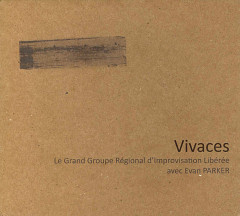
    Those who get thrilled in recalling orchestral masterpieces such as Strings With Evan Parker (Emanem) will find something quite flavorsome to chew here, though not on an identical level of artistic strength. GGRIL is a collective from Rimouski, Québec, described as the “home big band” of the Tour de Bras label. Exclusively composed of musicians of different ages and experience based in the Lower St. Lawrence region, over the years the ensemble has played with several leading lights of the improv landscape. This particular set was taped in April 2011 after a brief clinic led by the English master of swirling reeds.

    Whereas the concert starts with a completely free piece — Semis — in which the players waste no time in finding contrapuntal stratagems by reducing the toe-dipping procedures to the required minimum, the subsequent tracks Bouturage and Marcottage are directed, respectively, by Parker and violinist Raphaël Arsenault. Still, the music remains entirely conceived on the spot, showing a wealth of veins and colors and an idiosyncratic sense of humor (a gorgeously wacky tuba solo — courtesy of Gabriel Rivest — at the beginning of Bouturage is my overall favorite snippet of the entire disc). Electric guitars and bass furnish the action with the right quantities of charged rush when needed; a couple of accordions warrant substrata of folk echoes that sound preposterous and suggestive at once.

    The attendance of guest trombonist Scott Thomson adds fuel to the fire in the “melodically bizarre” department, thus balancing the more overt tendency to seriousness dictated by two violins, a clarinet and an acoustic bass. A propulsive consistency is not missing, and — judging by the bursts of audience laughs sporadically heard — a theatrical component must have been applied during the exhibition. Parker’s soprano and tenor work just fine without exceeding any limit as he immerses himself in the improvisational ebb and flow with flexible modesty. A few attentive spins and you’ll see that there are some values to remember in this totally respectable release.

    A few attentive spins and you’ll see that there are some values to remember in this totally respectable release.

    Érick d’Orion in Le Devoir

    “Plus que juste un peu”, Sylvie Nicolas, Le Devoir, October 16, 2012
    Tuesday, October 16, 2012 Press
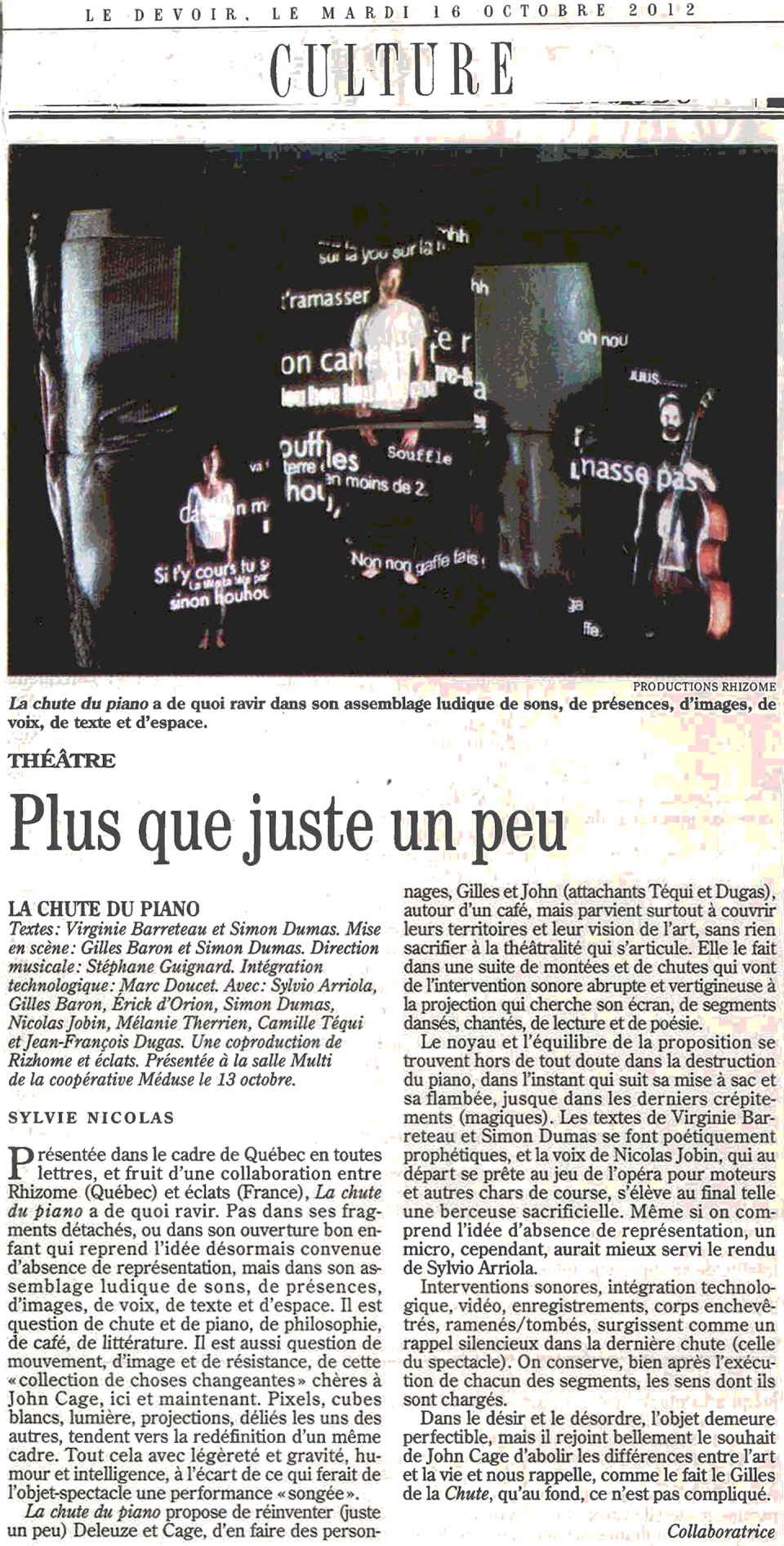
    La chute du piano a de quoi ravir dans son assemblage ludique de sons, de présences, d’images, de voix, de texte et d’espace.

    Érick d’Orion in Info-Culture

    “Critique”, Info-Culture, October 13, 2012
    Saturday, October 13, 2012 Press

    Existentialisme ou surréalisme? Bien difficile à dire.

    La pièce La chute du piano présentée à la salle Multi de la coopérative Méduse a intrigué la centaine de spectateurs samedi soir le 13 octobre.

    Un heureux mélange pluridisciplinaire et multimédia d’une durée d’environ 45 minutes.

    Il est très difficile d’en tirer une conclusion. Par contre nous pouvons dire que le jeu et le texte des comédiens se limitent au strict minimum. Les textes étant récités par une voix dite ‘off’. La mise en scène est astucieuse. Les projections vidéos sont surprenantes et prenantes. Les effets sonores sont adéquats. On nous a dit que «nous avions des oreilles pour voir» et que même si «une question est bonne, il ne faut pas la gâcher en lui donnant une réponse».

    Chacun doit faire sa propre évaluation de ce spectacle. Ou était-ce une représentation?

    Synopsis

    Il est question d’un piano qui chute, d’une auteure qui chute, d’un chanteur qui se tient sur un point élevé, d’un danseur étendu par terre. Il est question d’un philosophe et d’un musicien qui discutent du projet de faire un spectacle dont le sujet (et le titre) serait la chute du piano. Ce philosophe et ce musicien, Gilles et John, sont des personnages inventant le spectacle qui est en train de se faire par des personnes réelles. C’est l’envers. L’endroit étant le plateau où les artistes se tiennent, où les images et les scènes — faites de poésie et de pixels — se font et se refont jusqu’au point d’impact, la chute du spectacle.

    Éclats et Rhizome proposent un projet hybride entre poésie, danse et musique. Une collaboration franco-québécoise, une rencontre interdisciplinaire autour des figures du philosophe Gilles Deleuze et du compositeur John Cage.

    La mise en scène est astucieuse. Les projections vidéos sont surprenantes et prenantes.

    Hemlock in Exclaim!

    “Reviews — Improv & Avant-Garde”, David Dacks, Exclaim!, October 9, 2012
    Tuesday, October 9, 2012 Press

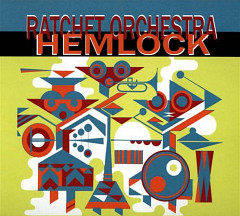
    If you make music in Montréal, there’s a good chance you know one of the 30-odd members of this behemoth, irregularly convened by Nicolas Caiola. Since 1997, he’s gradually figured out how to make the most of all the possible instrumental colours and playing styles of each member, and it’s never sounded better (on record) than on Hemlock. How lucky to have at one’s disposal an entire flock of flutes playing with a gaggle of strings and several bass-oriented saxophones, as on Yield. The ascending notes of Hemlock — part 1 gather another strange collection of instrumental colours into wild fanfare, which leads into the deep, dark groove of the song’s second part. Every track yields a sumptuous variety of music that continues to reference the warped big band charts and sounds of Sun Ra, as they always have, while at the same time realizing the potential of this large group of talented musicians. With Hemlock, Rachet Orchestra have finally found their sound, and it’s splendid. (9/10)

    With Hemlock, Rachet Orchestra have finally found their sound, and it’s splendid. (9/10)

    À chacun sa miniature in Circuit

    “Critique”, Chantale Laplante, Circuit, October 1, 2012
    Monday, October 1, 2012 Press

    Depuis 2005, les membres du Quatuor Bozzini, entourés de compositeurs chevronnés agissant à titre de mentors, accueillent et accompagnent de jeunes compositrices et compositeurs dans un Composer’s Kitchen. Cinq ans plus tard, le Quatuor Bozzini a invité les trente et un compositeurs ayant participé à ces rencontres annuelles, à composer une courte pièce afin de célébrer l’expérience du Composer’s Kitchen, à la fois «atelier, laboratoire, salle de jeu et cours de maître», selon la définition donnée sur le site du quatuor.

    Le Quatuor Bozzini a atteint une renommée internationale bien méritée par son talent et sa persévérance dans la programmation d’un répertoire musical ancré dans la recherche et l’expérimentation. À cet égard, le Composer’s Kitchen semble témoigner tout autant de cette démarche tournée vers l’exploration musicale, que celle de son implication dans la communauté. En effet, chaque édition regroupe six compositeurs venus à Montréal des quatre coins du pays, pour approfondir de l’intérieur le genre quatuor à cordes dans une atmosphère intime caractéristique de la musique de chambre.

    Le disque À chacun sa miniature est en fait doublement ancré dans la communauté, le Quatuor Bozzini ayant pour ce projet lancé un appel au public afin de soutenir chacun des compositeurs et ainsi recueillir les commandites de cent membres de la communauté, mélomanes, compositeurs, professionnels de tous horizons. Le succès de cette campagne de financement a permis au quatuor de créer un fonds de dotation permanent dédié aux commandes d’œuvres et au soutien des activités du Composer’s Kitchen, afin d’assurer sa pérennité.

    L’aventure du Composer’s Kitchen aura fait mouche, car pour la 8e édition du mois d’avril 2012, il a été présenté dans un format élargi en collaboration avec le Huddersfield Contemporary Music Festival, accueillant un mentor et des compositeurs du Royaume-Uni. Dans un deuxième temps, les œuvres achevées des jeunes compositeurs seront présentées en novembre à Huddersfield, dans la cadre du festival. Une autre édition (Atelier niveau baccalauréat) a également lieu à Vancouver en août 2012.

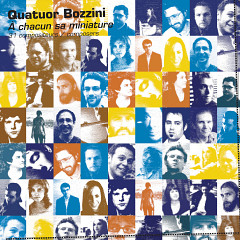
    En attendant de pouvoir entendre les œuvres de ces nouvelles cuvées, nous avons accès à un enregistrement aux qualités acoustiques impeccables des trente et une miniatures de trente et un compositeurs qui témoignent, en écho à l’aspect mosaïqué de la pochette, d’une grande diversité de styles et, par ricochet, du dynamisme des jeunes forces à l’œuvre. Longue vie au Composer’s Kitchen pour sa complicité avec la communauté et les efforts investis pour que soient entendues et diffusées ces voix multiples.

    Le Quatuor Bozzini a atteint une renommée internationale bien méritée par son talent et sa persévérance dans la programmation d’un répertoire musical ancré dans la recherche et l’expérimentation.
  • 142
  • 143
  • 144
  • 145
  • 146
  • 147
  • 148
  • 149
  • 150