actuellecd
  • This website is also available in English.

Blog

3585 results
  • 106
  • 107
  • 108
  • 109
  • 110
  • 111
  • 112
  • 113
  • 114
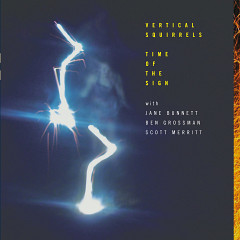
  • Time of the Sign in Revue & Corrigée

    “Chronique”, Pierre Durr, Revue & Corrigée, June 1, 2015
    Monday, June 1, 2015 Press

    Cette formation porte-t-elle vraiment judicieusement son patronyme? Parce que, contrairement à ce qu’induit son nom (écureuil) dans son acceptation symbolique, elle est plutôt dépensière… Dépensière en énergie, en dynamisme, en vitalité. Il est vrai que l’animal est vif…

    Ces Vertical Squirrels sont originaire de l’Ontario, d’une ville située à une soixantaine de kilomètres de Toronto (Guelph) et vivent à quatre: un guitariste percussionniste (Daniel Fischlin), un claviériste (Ajay Heble), un bassiste complétant son jeu avec des instruments inventés (Lewis Melville), élément qui titille déjà nos oreilles! — et un percussionniste, (Ted Warren). Mais dans leurs pérégrinations, il leur arrive de se mouvoir en bande, au point de combler leurs prestations avec des invités, en l’occurrence quatre, pratiquant les vents, la vielle à roue, l’ukulélé, et quelques gadgets électroniques.

    Time of the Sign est leur 3e réalisation, après Hold True (accroche-toi) et Winter’s gate parus tous les deux en 2010, le premier sur le label du collectif montréalais, le second chez Barcode Free Music. Alors que Hold True (accroche-toi) abordait davantage les rivages d’un rock flamboyant, parfois répétitif et croisé avec des accents de jazz improvisé, sur le présent enregistrement l’apport des invités, la volonté de mettre davantage l’accent sur l’improvisation et le travail collectif en change l’approche. La musique joue davantage sur le registre de la transe, d’une transe libre, ponctué par les accords et les rythmes des claviers, avec une propension à véhiculer une musique aux accents festifs d’un krautrock davantage acoustique, et un ensemble plus proche d’une suite qu’une série de pièces plus individualisées comme précédemment. Le tout s’achevant sur des réminiscences de cornes de brume, au milieu des flux et reflux de vagues…

    Seven ElectroAcoustic Septet in Point of Departure

    “Moment’s Notice”, Greg Buium, Point of Departure, no. 51, June 1, 2015
    Monday, June 1, 2015 Press

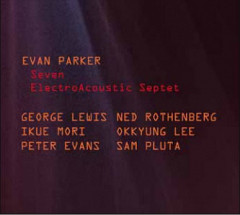
    Year by year Evan Parker’s electro-acoustic ensemble — a project he initiated more than two decades ago — seems to take on a more powerful place in his body of work. It is among improvised music’s irreplaceable groups — as ICP still is or as Albert Ayler’s trio once was. Parker’s ensemble has forever altered the way we hear music. Once documented exclusively by ECM — five groundbreaking discs from 1996 to 2007 — Parker’s psi label released Hasselt in 2010, and, now, Victo produces Seven, a live recording (and debut) of the ElectroAcoustic Septet at the 2014 Festival International de Musique Actuelle de Victoriaville.

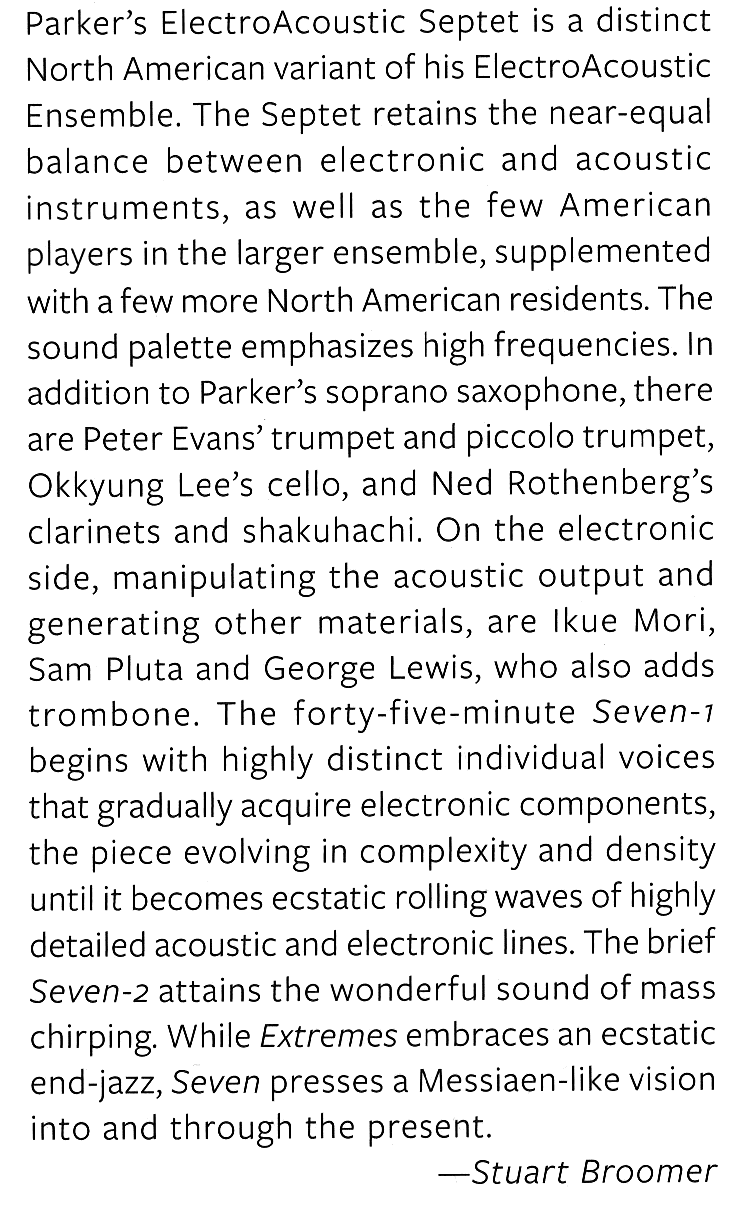
    If the group’s configuration has shifted over the years, growing to 18 pieces at Lisbon’s Jazz em Agosto in 2010 — a performance that, for many, ranks among the high-water marks of early 21st century creative music — Seven readjusts things once again. On the acoustic side, Ned Rothenberg (clarinets, shakuhachi) and Peter Evans (trumpets) remain; Ikue Mori returns on electronics. Now Sam Pluta (electronics) is added, along with Okkyung Lee (cello), and George Lewis (trombone and electronics). Remarkably, it was back in 1980 that Parker and Lewis first worked together, on a series of European dates captured by Incus Records.

    Apart from Parker himself, this is an American band — a lovely artifact from the Englishman’s recent New York residencies at the Stone. Here, in small-town Quebec, he reconstitutes the electro-acoustic project for the first time without bass and percussion (Paul Lytton had been ever present until now). Yet the group’s moorings remain: the mirroring, of acoustic instruments and their electronic counterparts; the intricate network of voices, where collective improvisation is tied to line and timbre, where a profound sense of each player’s sound (tone, attack, breath, etc.) echoes, refracts, and ignites another’s.

    Still, Seven stands apart. It is by turns searing and savage, hypnotic and contemplative. It is a supremely realized set of music — two brave, meticulous, and wonderfully alive improvisations. The record demands repeated, and varied, listening: on headphones, or filling up the room. The disc brings different delights every time; the balance — the performance itself and Victo’s exquisite production — is ideal. You might spend time, say, zeroing in on Rothenberg’s role on “Seven-1.” His work outlines the spine of this 46-minute event, tagging its beginning, middle, and end — on shakuhachi, the Japanese bamboo flute, with these gorgeous, airy, poised declarations, or on bass clarinet, down low, boring out the bottom end. Parker’s entrance comes when you’re already acclimated to the date. Lee’s pizzicato lines meander, then these terrific sweeps of sound, an electronic cascade, measured, hushed, Evans’s color. In “Seven-2” the trumpeter’s role is more prominent: he jumps in and out of the ensemble in a series of wildly controlled acrobatics.

    But the overarching spirit is always Evan Parker’s: in parceled spirals, the drama of circular breathing, waves (gyres?) turning and pushing and cycling, bird calls, long tones, fantastic effects that, together, give you the sense of seven souls breathing. That, to me, is the most extraordinary aspect of this disc: the importance of space, of something beyond simple notation. At its very highest peaks, Seven is absolute music of the rarest kind. Whether the instruments are blown, bowed, plucked, or processed, you feel the essence of these sounds — as you might register a wisp of wind, or the pulse of a human breath.

    The record demands repeated, and varied, listening: on headphones, or filling up the room.

    Seven ElectroAcoustic Septet in The WholeNote

    “Review”, Ken Waxman, The WholeNote, no. 20:9, June 1, 2015
    Monday, June 1, 2015 Press

    Just as international improvisers sometimes find a more welcoming atmosphere for their sound experiments in Canada than at home, so too have Canadian record labels become a vehicle to release notable free music sessions. Attesting to this openness, two of the most recent discs by British saxophone master Evan Parker are on Canadian imprints. But each arrived by a different route. One of the triumphs of 2014’s Festival International de Musique Actuelle de Victoriaville in Quebec, this performance of Seven by Parker’s ElectroAcoustic Septet (Victo 127) are available on Victo, FIMAV’s affiliated imprint. Consisting of one massive and one shorter instant composition, Seven literally delineates the electro-acoustic divide. Trumpeter Peter Evans, reedist Ned Rothenberg, cellist Okkyung Lee and Parker make up the acoustic side, while varied laptop processes are operated by Ikue Mori and Sam Pluta, with George Lewis switching between laptop and trombone, with his huffing brass tone making a particular impression during a contrapuntal faced-off with Parker’s soprano saxophone during Seven-2. At nearly 46 minutes, Seven-1 is the defining work, attaining several musical crests during its ghostly, meandering near time-suspension, allowing for full expression of instrumental virtuosity, dynamic flutters, flanges and processes from the laptoppists accompany, comment upon or challenge the acoustic instruments. Alternately wave forms loops and echoes cause the instrumentalists to forge their reposes. Plenty of sonic surprises arise during the sequences. Undefined processed-sounding bee-buzzing motifs for example are revealed as mouth and lip modulations from Evans’ piccolo trumpet or aviary trills from Rothenberg’s clarinet. In contrast the electronics’ crackles and static are often boosted into mellower affiliations that sound purely acoustic. Eventually both aspects meld into a climax of bubbly consistency with any background-foreground, electro or acoustic displays satisfactorily melded. More percussive Seven-2 has a climax involving fragmented electronics pulsating steadily as first Evans, then Rothenberg and finally Parker spill out timbres that confirm formalism as much as freedom.

    Seven-1 is the defining work, attaining several musical crests during its ghostly, meandering near time-suspension…

    Invisible Backgrounds in Weird Canada

    “Review”, Jesse Locke, Weird Canada, May 29, 2015
    Friday, May 29, 2015 Press

    Philippe Battikha of Corse and La Part maudite steps out for an avant-serenade on this mournful solo offering. The granular tones and careening curlicues of his trumpet drift in slow-mo flow through soundscapes of bustling street corners, Super 8 camera whirr, and less recognizable squishes. Double bass saws through Beyond You while Time For New Hands casts a pall over haunted pianos, righteous vocals samples, and the soothing ASMR of rain on a windowsill.

    Philippe Battikha of Corse and La Part maudite steps out for an avant-serenade on this mournful solo offering.

    Hello, I Must Be Going in Downtown Music Gallery

    “Review”, Bruce Lee Gallanter, Downtown Music Gallery, May 22, 2015
    Friday, May 22, 2015 Press

    Although Fred Frith and Evan Parker are both British and come from around the same scene/generation of Europe’s finest free improvisers, this set was only the their third duo performance. Both of these men are master improvisers and this disc/set captures them at their best. He are is excerpt from my review of the concert, “Evan played mostly soprano sax and Fred often had his guitar on his lap with a table filled with objects: an e-bow, chopsticks, an ashtray, paintbrush, etc. Each of these men have their own vocabulary of sounds so they took their time to work their way through a variety of sounds and textures. It helps to actually see what Mr. Frith is doing since he has so many odd/unique ways to play his guitar. At one point, Fred repeatedly tapped on his strings, using his fingers and/or a chopstick shoved between the strings on the neck. The effect was most hypnotic with Evan also playing circular lines, both men weaving their strands together. As Fred would alter his approach to his guitar being held in his hands or on his lap. Evan, who is one of the masters of circular breathing, would also alter his sound to bring the two closer together into a similar exploratory zone. As the set progressed, the exchange got quicker and closer as if they were finishing each other’s sentences. This was one of those magical sets where everything works just right, the blend of ideas seamless.

    This was one of those magical sets where everything works just right, the blend of ideas seamless.
  • 106
  • 107
  • 108
  • 109
  • 110
  • 111
  • 112
  • 113
  • 114