actuellecd

Blog

86 results
  • 3
  • 4
  • 5
  • 6
  • 7
  • 8
  • 9
  • 10
  • 11
  • Platanus in Different Noises

    “An Elusive Semi-Hush”, Bob Osborne, Different Noises, April 15, 2026
    Monday, May 4, 2026 Press

    Much of the music on this weeks offering has a quiet ambience which offers a healing solace in these crazy times. There is some noisy stuff as well, to shake things up, plus the usual selection of current featured releases and old favourites.

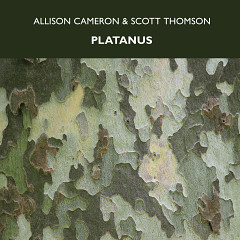
    An abstract affair, chronicling the duo of noted Toronto-based composer-improviser Allison Cameron and Montréal’s Scott Thomson (on trombone). The woozy, intangible space they construct spontaneously together is thoroughly compelling; Thomson’s formidable timbral command pairs beautifully with Cameron’s unusual instrumentation which showcases the Crackle Synthesizer (a more flexible sibling to the Crackle Box) but also employs other keyboards (audibly the Casio SK-1) and tapes. What they produce collectively resists easy description and that’s precisely what makes it so resonant. Their elusive semi-hush feels as like something was piped in from another reality. The release is dedicated to the memory of Nobuo Kubota, the extraordinary Canadian improviser and intermedia artist who passed away in September of 2025 at the age of 93. The duo had played as a trio with Kubota, and the aforementioned Crackle Synthesizer in fact used to belong to the elder artist.

    The woozy, intangible space they construct spontaneously together is thoroughly compelling

    Le sourire in Papatamus Redux

    “Review”, Abe Goldstien, Papatamus Redux, April 12, 2026
    Monday, May 4, 2026 Press

    Except for his 2014 Monk Work release, the majority of Jean Derome’s discography has focused on his own compositions. That began to change in 2019 when his band, Somebody Special, issued their first recording of Stave Lacy compositions. Derome along with bassist Normand Guilbeault, pianist Alexandre Grogg, drummer Pierre Tanguay and vocalist Karen Young continue that tradition on Le sourire. Rather than simply covering tunes primarily from Lacy’s Rushes, Packets and Futurities recordings, the band adds their own unique voices to 11 tunes with lyrics from authors Anna Akhmatova, Samuel Beckett, Robert Creeley, Bob Kaufman and Judith Malina, With her eclectic background in everything from classical to world music and jazz to musical theatre, Young brings a new sensibility to lyrics once sung by Irene Aebi. Check out her warbling and chirps on The Cuckoo or her soaring solo on Sands, 2: Jump. Although Derome could have easily played Lacy’s parts on soprano sax, his flute playing literally breaths new live into tunes such as Sands, 3: Fall, Love and Politics and I Heard the Indian Sage. On other selections, such as The Smile, Morning Joy and As Usual he switches to the alto saxophone. Grogg’s solos run the gamut from rhapsodic on Heaven to complex on As Usual. Throughout the entire session, Tanguay and Guilbeault provide the glue that holds the often-jagged rhythms and harmonies of Lacy’s music together, leaving room for Derome, Young and Grogg to explore the possibilities. At a time when many musicians are satisfied simply recreating the music of the masters, it is refreshing to hear Derome’s Somebody Special reminding us of the power, beauty and adaptability of pieces Lacy composed more than 40 years ago. As a matter of fact, Lacy composed over 600 works during his lifetime. So, hopefully we have not heard the last from Somebody Special.

    BOTTOM LINE: Steve Lacy’s earliest recordings from the late 1950s recast the music of Thelonious Monk. So, it only seems fair that Jean Derome’s Le sourire recast the music of Steve Lacy! The chantlike phrasing, jagged structures and art song lyrics for which Lacy was known are in good hands with Derome and the group that takes its name from the Lacy tune Somebody Special.

    It is refreshing to hear Derome’s Somebody Special reminding us of the power, beauty and adaptability of pieces Lacy composed more than 40 years ago.

    Platanus in Эксперимент

    Platanus: A Sonic Tribute to Nobuo Kubota by Allison Cameron and Scott Thomson”, Эксперимент, March 17, 2026
    Monday, May 4, 2026 Press

    The experimental music landscape of Canada finds a new, deeply resonant anchor in Platanus, a collaborative duo recording by composer-improviser Allison Cameron and trombonist Scott Thomson. Released via the esteemed DAME (Distribution Ambiances Magnétiques Et cetera), the album is a woozy, intangible journey into a “semi-hush” reality that defies easy description.

    Dedicated to a Legend

    Platanus is dedicated to the memory of Nobuo Kubota, the extraordinary Canadian intermedia artist and improviser who passed away in September 2025 at the age of 93. The connection to Kubota is both spiritual and physical: the duo once performed as a trio with the “inspiring polymath,” and a key instrument on this record — the rare Crackle Synthesizer — was a personal gift from Kubota to Cameron.

    This instrument, a deluxe variation of the STEIM Cracklebox, places the human body directly into the circuitry, creating unpredictable and raw electronic textures that Kubota himself once pioneered.

    A Masterclass in Timbral Chemistry

    The album thrives on the unique synergy between its two creators:

    Allison Cameron: A fixture in Canadian experimental music since the 80s, Cameron is celebrated for her “quirky kaleidoscopy” of instruments. In Platanus, she blends the Crackle Synthesizer with the toy-like sounds of the Casio SK-1 and tape loops, creating liminal spaces that interrogate the listener’s attention.

    Scott Thomson: A trombonist with formidable timbral command, Thomson is a key figure in the Montréal and Toronto improvisational scenes (and current director of FIMAV). His ability to produce unusual, vocal-like tones on the trombone makes him the perfect foil for Cameron’s electronic abstractions.

    Beyond Convention

    Rather than following the high-energy tangles of traditional free jazz, Platanus unfurls in a state of “restless quasi-stasis.” It is a quietly potent recording that doesn’t so much defy conventions as slide between them, feeling as though it were “piped in from another reality.”

    A masterclass in timbral chemistry

    Le sourire in Эксперимент

    Jean Derome & Somebody Special: A Playful and Bold Homage to Steve Lacy in Le sourire”, Эксперимент, March 17, 2026
    Monday, May 4, 2026 Press

    Jean Derome, a cornerstone of the Québécois experimental scene and a founding father of the iconic Ambiances Magnétiques label, returns with a masterful new recording: Le sourire. Performed by his all-star ensemble, Somebody Special, the album is a deep, charismatic dive into the eccentric songbook of the legendary soprano saxophonist Steve Lacy.

    Reimagining a “Genius” Legacy

    Following the success of their 2019 debut, Derome and his quintet continue to explore the sophisticated and often avant-garde repertoire of Steve Lacy (1934—2004). Known for setting diverse literary texts to music, Lacy’s work is notoriously difficult to capture, yet Derome approaches it with a perfect blend of reverence and “Deromean” playfulness.

    Le sourire features settings of texts by literary giants such as Samuel Beckett, Anna Akhmatova, Robert Creeley, and Judith Malina. The music glides between boisterous energy and tender candor, remaining firmly rooted in jazz while constantly pushing its boundaries.

    A Montréal All-Star Lineup

    To bring this vision to life, Derome (on alto sax, bass flute, and vocals) has assembled a “who’s who” of Montréal’s finest:

    Karen Young: The legendary vocalist who effortlessly navigates Lacy’s complex melodies with veteran agility.

    Alexandre Grogg: Providing dense, elegant, and bold piano work.

    Normand Guilbeault (bass) & Pierre Tanguay (drums): Derome’s longtime trio partners who provide the swinging, angular foundation.

    Between Tradition and the Unknown

    Jean Derome, a recipient of six prix Opus Awards, has spent 50 years defying categorization. In Le sourire, one can hear fleeting echoes of Eric Dolphy, Ornette Coleman, and even the mischievous songcraft of Carla Bley. Yet, the result is irrefutably original — a taut, charismatic variant of jazz that “strives to astonish in the noblest sense of the word.”

    In Le sourire, one can hear fleeting echoes of Eric Dolphy, Ornette Coleman, and even the mischievous songcraft of Carla Bley. Yet, the result is irrefutably original — a taut, charismatic variant of jazz that “strives to astonish in the noblest sense of the word.”

    Le sourire in Salt Peanuts

    “Review”, Eyal Hareuveni, Salt Peanuts, April 20, 2026
    Friday, May 1, 2026 Press

    Canadian. Montréal-based reed master and composer Jean Derome & Somebody Special quintet is his second tribute to American, Paris-based idiosyncratic soprano sax player Steve Lacy (1934-2004), and especially to his original pieces influenced by and borrowing poetic texts. Le sourire is Derome’s second tribute to Lacy’s literary compositions, following Somebody Special (Ambiances Magnétiques, 2019), leading the same quintet of vocalist Karen Young, who sings in English and French, pianist Alexandre Grogg, double bass player Normand Guilbeault, drummer Pierre Tanguay, and Derome on alto sax, bass flute, and vocals.

    Lacy’s music paid homage to the innovative music of Sidney Bechet and Thelonious Monk, and he was one of the most original interpreters of Monk’s music, as well as artists like painter Mark Rothko and writer Samuel Beckett. But throughout the years, Lacy’s approach, called by him «materialist#, morphed into freer, multidimensional, singular textures, particularly in his work with partner-vocalist Irene Aeby or pianist Frederic Rzewski.

    Derome, like Lacy, interpreted Monk’s music. But describes himself as «trained in almost every school but trapped in none». He has eclectic musical interests and wrote music for films, theatre, and dance. Derome’s Somebody Special traces Lacy’s thoughtful evolution, the unique, often eccentric tonal ideas, and the surrealist textures, with an inventive, passionate interplay and captivating elegance. Canadian trombonist Scott Thomson, who contributed the liner notes, mentions that Lacy lived the Georges Braque aphorism that he had also set to music: «Limited means engender new forms, invite creativity, develop style». Jean Derome & Somebody Special sound as subscribing to this wise, inspiring aphorism.

    Le sourire features eleven pieces of Lacy, all dedicated to artists who influenced Lacy, paired with poems that shed more light on Lacy’s multifaceted, poetic vision that masterfully ties music, images, and texts. Young and Derome deliver these poems in a commanding, often theatrical manner, fully surrendering to the poetic spirit and aware of the lyrical nuances and Lacy’s clever musical games. The album’s booklet offers the poems of Robert Creely, Anna Akhamatove, Samuel Beckett, Judith Malina, and Bob Kaufman, with other pieces dedicated to Jean Paul Sartre, William Shakespeare, Arthur Miller, Allen Ginsberg, and Irving Berlin, as well as painters Marc Chagall, Bob Thompson, and Piet Mondrian.

    Perhaps the anarchistic poems of Malina best capture Lacy’s artistic spirit, faithfully followed by Jean Derome & Somebody Special. In I Heard the Indian Sage, dedicated to Ginsberg, she concludes: «Three is love / Because we are crazy / And want to be happy / forever». And in Love and Politics, dedicated to Arthur Miller, she tells about a boat trip to Cyprus, where she saw Aphrodite’s head, and told her that she is an anarchist who does not vote, and told her that «There are so many things we should discuss / the power of unnecessary kings / the sexual oppression of which Sappho sings… / but she sank out of sight». The last piece, Heaven, adapting Creely’s poem, and dedicated to Berlin, charges this beautiful album with a sober realization: «If life were easy / and it all worked out, / what would this sadness / be about. // If it was happy / day after day, / what would happen / anyway».

    Derome’s Somebody Special traces Lacy’s thoughtful evolution, the unique, often eccentric tonal ideas, and the surrealist textures, with an inventive, passionate interplay and captivating elegance.

    Platanus in Jazz & Rock

    “Kritik”, Dylan C Akalin, Jazz & Rock, March 16, 2026
    Friday, May 1, 2026 Press

    Das Montréaler Avantgarde-Label Ambiances Magnétiques erweitert seinen Katalog um zwei bemerkenswerte Neuerscheinungen, die am 17. April 2026 auf CD und digital erscheinen werden. Beide Produktionen werden über den traditionsreichen Vertrieb DAME (Distribution Ambiances Magnétiques Etcetera) zugänglich gemacht und spiegeln eindrucksvoll die künstlerische Bandbreite des Labels wider: vom literarisch inspirierten Jazz bis zur radikal offenen Improvisation.

    Platanus: Klangräume zwischen Elektronik und Posaune

    Deutlich abstrakter präsentiert sich die zweite Veröffentlichung des Labels. Platanus dokumentiert die Zusammenarbeit der in Toronto lebenden Komponistin und Improvisatorin Allison Cameron mit dem Montréaler Posaunisten Scott Thomson.

    Gemeinsam erschaffen sie ein schwebendes, beinahe körperlos wirkendes Klangfeld, das sich vollständig aus spontaner Improvisation entwickelt. Thomsons ausgeprägtes Gespür für Klangfarben und Timbres verbindet sich dabei mit Camerons ungewöhnlicher Instrumentierung. Eine zentrale Rolle spielt der Crackle Synthesizer, ein flexiblerer Verwandter der experimentellen Crackle Box. Darüber hinaus kommen weitere Keyboards — hörbar etwa ein Casio SK-1 — sowie Tonbandmaterial zum Einsatz.

    Das Resultat ist eine Musik, die sich einfachen Kategorien entzieht und gerade dadurch eine starke Sogwirkung entfaltet. Die fragile, halb entrückte Klangwelt wirkt mitunter, als würde sie aus einer anderen Realität in den Raum hineinströmen.

    Das Album ist dem kanadischen Improvisationskünstler und Intermedia-Pionier Nobuo Kubota gewidmet, der im September 2025 im Alter von 93 Jahren verstarb. Cameron und Thomson hatten zuvor häufig gemeinsam mit Kubota musiziert; der auf der Aufnahme verwendete Crackle Synthesizer gehörte ursprünglich dem verstorbenen Kunstler.

    Beide Alben erscheinen am 17. April 2026 auf CD und in digitalen Formaten. Vorbestellungen werden in Kürze über die Plattformen des Labels möglich sein.

    Mit Le sourire und Platanus unterstreicht Ambiances Magnétiques einmal mehr seine Rolle als wichtiger Motor der nordamerikanischen Improvisationsszene — zwischen literarisch inspiriertem Jazz und radikal offener Klangforschung.

    The result is music that defies easy categorization and, precisely because of this, exerts a powerful pull. The fragile, almost ethereal soundscape sometimes seems to flow into the room from another reality.
  • 3
  • 4
  • 5
  • 6
  • 7
  • 8
  • 9
  • 10
  • 11