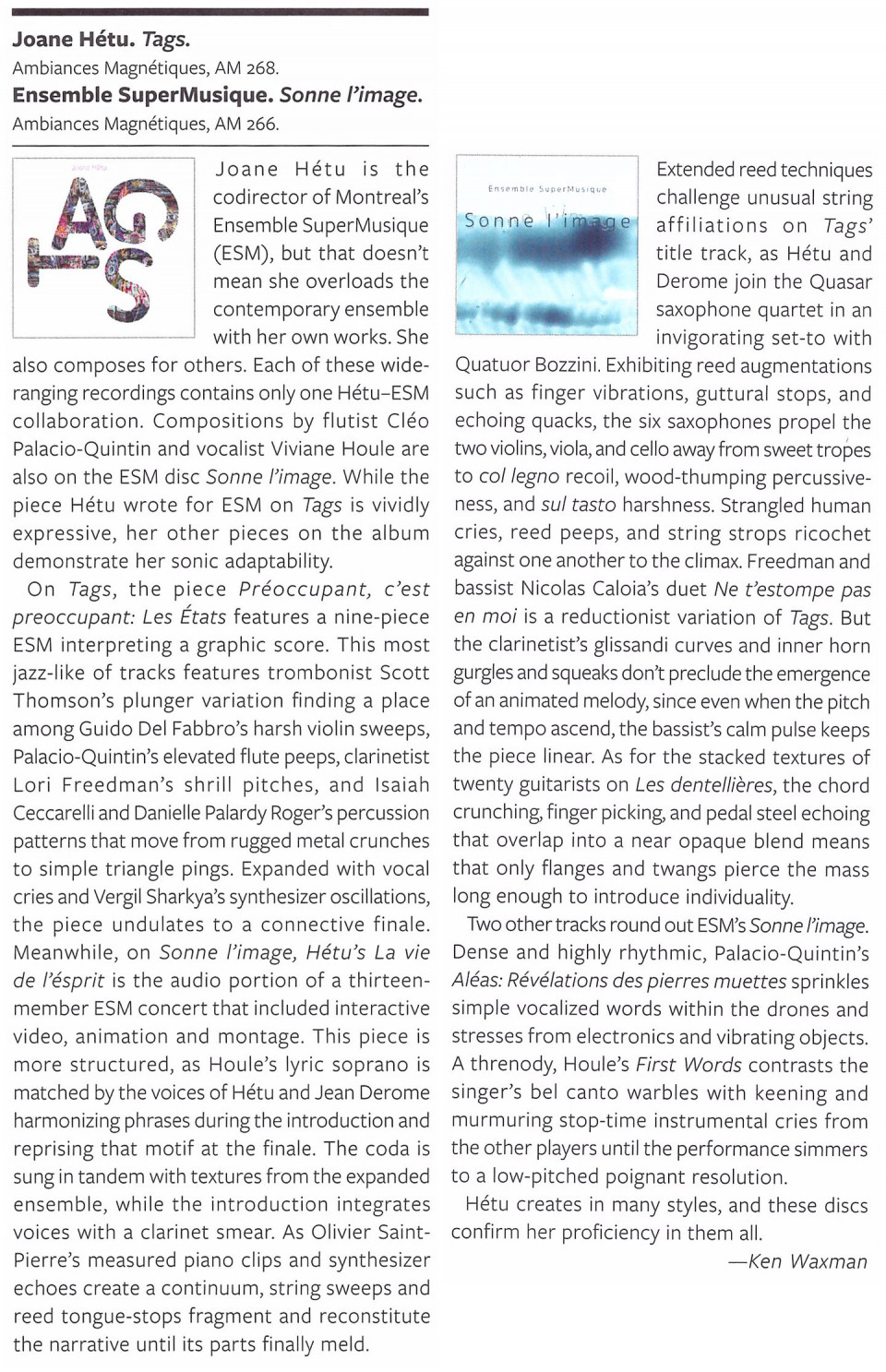
Sonne l’image, Tags in Musicworks
“Review”, Ken Waxman, Musicworks, no. 142, June 1, 2022
Friday, June 3, 2022
Press

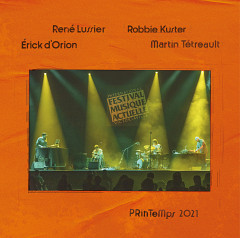
A notable blend of noise and nuance, this Québécois quartet soars through seven live improvisations without ever fraying the sonic thread that holds them together. Veterans in this context, René Lussier (guitar and daxophone) and Robbie Kuster (drums) add just enough squeezed-string elaborations or percussion backbeat to project their identities, while electronic impulses from Érick d’Orion’s computer and rumbles from Martin Tétreault’s turntable produce a sustainable drone. This waveform continuum is perforated often enough that surprise textures from vinyl-sampled vocal mumbles and gurgles, synthesized outer-space-like crackles and horse whinnies, or acoustic string flanges and relentless backbeats are clearly heard.
The adjoining tracks Celle qui suit l’autre and L’avant dernière give Lussier space to demonstrate guitar prowess as he moves through folksy runs, bottleneck Blues, cranked up arena-Rock resonations, and microtonal string plinks. At one point, an unexpected interlude of live sampled guitar accompaniment is heard over Kuster’s rugged backing and consistent buzzes. The computer’s backwards-running flanges reach a crescendo on L’autre, joined by singular drum smacks, metallic turntable platter screeches, guitar string slaps, and processed inhuman cries as the exposition is fragmented into a mid-point climax. Reconstituted on subsequent tracks, the performance concludes with Pis la dernière as emphatic drones are succeeded by muffled vocal samples, isolated guitar plinks, and a final descending electronic buzz. As engaging throughout as it is logically concluded, this session personifies the imagination and delicacy needed to maintain an hour-long electroacoustic parity.
Members of Hétu’s string section commonly opt for a percussive approach to playing arco, which creates a consistent textural effect that beautifully complements the fragmented phrasing of the soloists. These explorations of instrumental function give the music a more nuanced relationship between melodicism, texture and speech than would be otherwise present, creating greater optionality to the realization of Hétu’s compositions. The most impressive aspect of
Using no overdubs but minimal looping and timbral effects, the seven selections on Montrealer
Prime instance of this is the extended 320003, where string shakes and slurred fingering means the staccato introduction on flattened strings is succeeded by bell-pealing shakes, double bass-like low-pitched resonations and organ-like tremolo pulses. These sway the exposition forward into a single line to a buzzing conclusion. Slogan, the slightly longer first track, sets the scene, as bobbing fuzztones and high-voltage shakes rumble along before splitting into pressurized sound loops on the bottom and single-string stings on the top. Both tones are audible as they intersect and slide into one another for a percussive climax.
With pointed stops and starts, Falaise uses varied motifs to define the tunes, including string rubs that drone across the sound field for warmer expositions, or pointillist below-the-bridge scratches for tougher interface. Galop does just that as well, with knob-twisting and effects-pedal-pressure launching tones every which way until all subside into a connective drone.
Sol – G in English – is the fifth note of the C Major scale. Yet
American-born composer and longtime French resident,
Dwelling on mathematic sequences and permutations of a limited core musical material, in
Performed senza vibrato,