actuellecd

Blog

43 results
  • 1
  • 2
  • 3
  • 4
  • 5
  • 6
  • 7
  • 8
  • Ensemble SuperMusique (ESM) in Avant Music News

    “AMN Review”, Irwin Block, Avant Music News, May 24, 2021
    Thursday, May 27, 2021 Press

    The final concert was in many ways a testimonial to the growth and continued vigor of experimental and improvised music in Quebec: In parallel with this festival, which began in 1983, the Montréal-based collective Ensemble SuperMusique was established by three women at a time when avant-garde music was male-dominated. It was launched by Joane Hétu (alto sax, voice), Diane Labrosse, (sampler), and Danielle Palardy Roger (percussion, voice).

    They were among the 16 musicians on stage to perform four new compositions that are part of Le fleuve, in tribute to the majestic St. Laurent River that flows through Quebec to the Atlantic Ocean. One piece featured prose declaring that empowering women could make the world a better place. Of the four compositions, saxophonist Jean Derome’s was the most musically rich and complex. The final work by Joane Hétu, which she directed and narrated, was her most accomplished in a long career of pushing musical boundaries — operatic in scope with unexpected instrumental flourishes and shifts, and a fitting end to this year’s impressive lineup.

    The final work by Joane Hétu, which she directed and narrated, was her most accomplished in a long career of pushing musical boundaries — operatic in scope with unexpected instrumental flourishes and shifts, and a fitting end to this year’s impressive lineup.

    Bernard Falaise in Avant Music News

    “AMN Review”, Irwin Block, Avant Music News, May 24, 2021
    Thursday, May 27, 2021 Press

    Electric guitarist Bernard Falaise, a veteran of many avant groups, filled in with a solo. With an array of pedal-activated devices, he sounded like a small ensemble — ringing bells and going from high tones to bass sounds as he plucked his guitar sitting flat over his knees. He plucked and scraped, extracting a cornacopia of sounds from his axe before ending in a flurry of notes.

    Falaise then joined up with Jean Martin (drums and electronics) and Pierre-Yves Martel (electric bass, steel lap guitar, electronics) for an engaging and varied improv session, starting minimally, then deepening and broadening, with a dreamscape evolving into a wall of sound, then fading out, and devolving into something less dense, with scattered single notes. Martel added melodic content when he switched to the steel lap guitar, the music propelled at one point by strong rhythm and counter-rhythms, a balanced and well-developed program of sonic explorations.

    … a balanced and well-developed program of sonic explorations.

    Synergie et parasitisme in PAN M 360

    “Critique”, Luc Marchessault, PAN M 360, May 15, 2021
    Wednesday, May 19, 2021 Press

    Un jeune compositeur-improvisateur montréalais trace patiemment sa trajectoire électroacoustique, du cégep de Saint-Laurent au Conservatoire de musique de Montréal, du festival des musiques numériques immersives Akousma à la très courue galerie d’art Greenhouse de Berlin, du festival de musiques improvisées Oooh de Londres au festival Impro Währing de Vienne. Il s’appelle Dominic Jasmin. Son champ d’expérimentation est vaste. Son mode opératoire est à la fois simple et complexe: créer des sons ou repérer du déjà-créé, façonner cette matière — s’il y a lieu —, puis la conjuguer à la composition spontanée. Dans son studio-labo, il combine des sons produits par des objets, leur fait subir un traitement logiciel, puis y juxtapose des sons de synthés et d’instruments acoustiques. La musique qui en résulte constitue, selon les mots de Dominic, du «bruit avec une forme» ou de «l’expressionnisme-maximaliste».

    Dominic vient de faire paraître Synergie et parasitisme, un album comprenant quatre longues pièces. L’étiquette Mikroclimat, dirigée par les musiciens et compositeurs Joane Hétu et Maxime Corbeil-Perron, lui sert de rampe de lancement. Dominic Jasmin s’est servi, comme canevas, d’enregistrements provenant des collections d’amis-artistes berlinois. Il a remixé et fusionné tout ça, puis y a appliqué une couche d’improvisation synthétique et divers instruments acoustiques. Ainsi, on entend le violon de Jeanne Côté sur Ça va bien, la première pièce. La guitare de Pietro Frigato résonne sur Il sole, la pietra e l’ombra (Le soleil, la pierre et l’ombre). Sur Dieselfahrradparade (Parade de vélos au diesel?) figurent la clarinette et le saxo d’Edith Steyer. Enfin, Psicosis telepática comporte la voix de Lorena Izquierdo Aparicio et la batterie de Samuel Hall (à ne pas confondre avec le protagoniste misanthrope de la chanson de Bashung), ainsi que les ajouts électroniques d’Eric Bauer.

    Corneille (le dramaturge, pas le chanteur) a écrit «À vaincre sans péril, on triomphe sans gloire». Les musicophiles gagnent à écouter Synergie et parasitisme.

    Les musicophiles gagnent à écouter Synergie et parasitisme.

    Entièrement unanimes in Jazz Word

    “Review”, Ken Waxman, Jazz Word, May 6, 2021
    Monday, May 17, 2021 Press

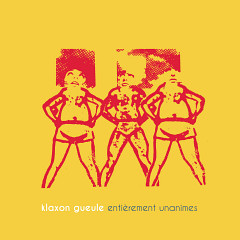
    While this session may at first appear to be a traditional guitar (Bernard Falaise), electric bass (Alexandre St-Onge) and drums (Michel F Côté) creation by Montréal’s Klaxon Gueule, the addition of synthesizers and a computer means it relates as much to metaphysics as to music. That’s because programming alters the sound of each instrument, blending timbres into a pointillist creation that brings in palimpsest inferences along with forefront textures.

    A track such as Continuum indifférencié for instance, features a programmed continuum with concentrated buzzing that moves the solid exposition forward as singular string slides, piano clicks and drum ruffs are interjected throughout. In contrast, la mort comme victoire malgré nous finds voltage impulses resembling a harmonized string section moving slowly across the sound field as video-game-like noise scraping and ping-ponging electron ratchets gradually force the exposition to more elevated pitches. Although aggregate tremolo reverb frequently makes ascribing (m)any textures to individual instruments futile, enough timbral invention remains to negate any thoughts of musical AI. Singular guitar plucks peer from among near-opaque organ-like washes on Société Perpendiculaire and a faux-C&W guitar twang pushes against hard drum backbeats on toute la glu.

    During the CD’s dozen selections, the trio members repeatedly prove that their mixture of voltage oscillations and instrumental techniques can create a unique sonic landscape that is as entrancing as it is expressive.

    During the CD’s dozen selections, the trio members repeatedly prove that their mixture of voltage oscillations and instrumental techniques can create a unique sonic landscape that is as entrancing as it is expressive.

    Entièrement unanimes in The WholeNote

    “Review”, Ken Waxman, The WholeNote, May 6, 2021
    Friday, May 14, 2021 Press

    While this session may at first appear to be a traditional guitar (Bernard Falaise), electric bass (Alexandre St-Onge) and drums (Michel F Côté) creation by Montréal’s Klaxon Gueule, the addition of synthesizers and a computer means it relates as much to metaphysics as to music. That’s because programming alters the sound of each instrument, blending timbres into a pointillist creation that brings in palimpsest inferences along with forefront textures.

    A track such as Continuum indifférencié for instance, features a programmed continuum with concentrated buzzing that moves the solid exposition forward as singular string slides, piano clicks and drum ruffs are interjected throughout. In contrast, la mort comme victoire malgré nous finds voltage impulses resembling a harmonized string section moving slowly across the sound field as video-game-like noise scraping and ping-ponging electron ratchets gradually force the exposition to more elevated pitches. Although aggregate tremolo reverb frequently makes ascribing (m)any textures to individual instruments futile, enough timbral invention remains to negate any thoughts of musical AI. Singular guitar plucks peer from among near-opaque organ-like washes on Société Perpendiculaire and a faux-C&W guitar twang pushes against hard drum backbeats on toute la glu.

    During the CD’s dozen selections, the trio members repeatedly prove that their mixture of voltage oscillations and instrumental techniques can create a unique sonic landscape that is as entrancing as it is expressive.

    During the CD’s dozen selections, the trio members repeatedly prove that their mixture of voltage oscillations and instrumental techniques can create a unique sonic landscape that is as entrancing as it is expressive.

    Record Release in Vital

    “Review”, Frans de Waard, Vital, no. 1280, April 13, 2021
    Monday, April 19, 2021 Press

    The work of Christof Migone has found its way to these pages quite a lot over a very long period and in almost all of them, there is a conceptual edge. There is also a whole body of work that didn’t make it to these pages, such as a series of seven 7inch records that he released between 2015 and 2019. This double CD contains a selection of those records, twenty-two tracks in total, out of thirty-five to be found on the original records. A quick look at the times for some of these pieces, going way over eight minutes, which is what normally fits on a 7” record, struck me as rather odd. These pieces, eleven in total, are re-edited for this compilation. On the website of Squint Press (Migone’s label), you can find a description for this project: “Normally, a record release celebrates the culmination of a recording project. Like a book launch, it marks the moment where a work leaves the artist’s hands and seeks an audience. Record Release is a project that reverses that process and includes the act of releasing as part of the recording process itself. Record Release involves using the raw material used to manufacture vinyl records which comes in small pellets. These lentil-sized bits of petroleum product come in this form because they are easily transportable and manipulable before they get melted and stamped with grooves of sound. This is a sound project which focuses on one of the standard physical support materials of sound and utilizes these tiny units of potential sound in a gestural manner to produce not only audio material but also images, video content and a slew of data related to the process of dissemination involved.” The blank record becomes the sound material and looking for a description of each of the seven records, you can read and see how it all worked; Migone’s website is pretty extensive in that respect. And two CDs filled with music to the maximum length is also something extensive. Migone works a lot with loops and repetitions of his sound material, which aren’t always to trace; at least, not from just playing them. His take on the whole notion of improvisation, musique concrète and electro-acoustics. While I found some of these pieces very good, or perhaps, the majority of them, I must admit that at one point I was pretty loaded with this kind of sonic information, with pieces becoming a blur; shorter pieces or one CD would have been sufficient for me, no matter how much I enjoy the music.

    … I found some of these pieces very good, or perhaps, the majority of them…
  • 1
  • 2
  • 3
  • 4
  • 5
  • 6
  • 7
  • 8