actuellecd

Blog

96 results
  • 1
  • 2
  • 3
  • 4
  • 5
  • 6
  • 7
  • 8
  • 9
  • String Quartet No. 3; Unhörbare Zeit in The Guardian

    “Jürg Frey: Third String Quartet CD review — an audaciously fragile performance”, Kate Molleson, The Guardian, December 17, 2015
    Thursday, December 17, 2015 Press

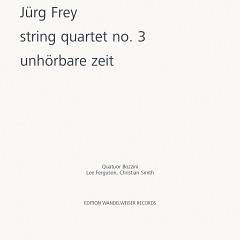
    Swiss composer Jürg Frey said recently that all good music should be felt in some part of the body, and that his music is intended to be felt just inside of the ear drum. It’s a neat image from the master of calm instrumental textures — a Wandelweiser group composer who explores silence as much as sound and writes egoless music that feels as though it’s always existed. Montréal’s Bozzini Quartet gave a virtuosically still performance of his Third String Quartet at this year’s Huddersfield Contemporary Music festival, and the group’s recording of the half-hour piece is beautiful for the up-close, quiet, grainy realness of the string timbres, every bow hair and every arm quiver audible. It’s an audaciously fragile performance. Also on the disc is an earlier Frey work, Unhörbare Zeit (Inaudible Times), made of danker chords and even longer open vistas.

    The group’s recording of the half-hour piece is beautiful for the up-close, quiet, grainy realness of the string timbres

    The Squiggle Game in Revue & Corrigée

    “Chronique”, Cyrille Lanoë, Revue & Corrigée, December 4, 2015
    Friday, December 4, 2015 Press

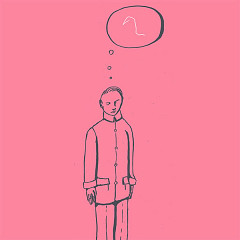
    Direction Montréal avec les labels Atrito Afeito et & Records. […] On change complétement de registre tout en restant à Montréal avec le label & Records. Un label (qui semble ne plus exister) où l’on retrouve un catalogue garni de musiciens et/ou formations déjà bien implantées sur les vingt cinq dernières années ou plus, dans les scènes jazz, impro et jazz-rock: Klaxon Gueule, Philippe Lauzier (voir en fin de chronique), Fortner Anderson (dont on a déjà parlé), Martin Tétreault, Alexandre St-Onge, Sam Shalabi (qui joue ici) ou Michel F Côté (qui produit ici). L’artiste Alexander MacSween s’est inspiré de ce qu’allaient devenir les titres, les durées, la pochette (par Fabrizio Gilardino), pour composer cet album à qui il a remis l’interprétation aux musiciens Corinne René (marimba, vibraphone, percussions), Nicolas Caloia (contrebasse, korg) et Sam Shalabi (guitare électrique et électroacoustique). Alexander MacSween quant à lui est aux samplers, claviers, voix et batterie entre autres. Onze titres qui tournent autour du jazz-rock, ou rock tout court, avec parfois des incursions proches de Robert Wyatt sur Crocodiles, ou Him (projet de Doug Sharin) sur That Gum You Like qui ouvre le disque. D’ailleurs certaines plages un peu world rappellent toujours Him, sur Scarsdale par exemple. Et qui ouvre l’album à des sonorités pour cette deuxième partie du disque, avec une touche «impro» qui ne s’écoutait pas au début. Avec plus de place pour les cordes. Définitivement ma partie préférée, qui rejoint (un peu) le disque dont vous lirez les quelques propos dans notre numéro papier 106 à sortir prochainement, de Philippe Lauzier avec Éric Normand. Avec pour ma part une légère préférence pour ce dernier par rapport à ce Squiggle Game, qui reste néanmoins particulier et intéressant.

    L’artiste Alexander MacSween s’est inspiré de ce qu’allaient devenir les titres, les durées, la pochette (par Fabrizio Gilardino), pour composer cet album…

    Seven ElectroAcoustic Septet in Le son du grisli

    “Chronique”, Guillaume Belhomme, Le son du grisli, December 1, 2015
    Tuesday, December 1, 2015 Press

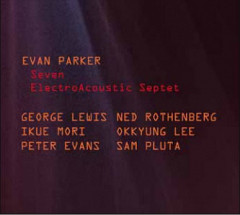
    Sur la pochette de ce disque, lire cet aveu d’Evan Parker: «Mon art de la composition consiste à choisir les bonnes personnes et à leur demander d’improviser.» Au 30e Festival de Musique Actuelle de Victoriaville, le 18 mai 2014, le saxophoniste donnait un concert en compagnie de Peter Evans (trompettes), Ned Rothenberg (clarinettes et shakuhachi), Okkyung Lee (violoncelle), Ikue Mori (électronique), Sam Pluta (électronique) et George Lewis (électronique et trombone). «Ceux-là sont les bonnes personnes», précisait-il.

    C’est l’électronique qui se chargea d’abord d’arranger l’espace que l’ElectroAcoustic Septet aura tout loisir d’explorer: une forêt de sons brefs sous laquelle ont été creusé combien de galeries. Les musiciens s’y rencontreront, à deux, trois ou davantage, dans un jeu de poursuites ou au gré de conversations affolées. Ainsi aux notes hautes d’Evans et Lee, Rothenberg répondra ici par un motif grave et ramassé; ailleurs, aux imprécations de l’électronique (dont les effets ne se valent pas tous), les souffleurs opposeront un alliage autrement expressif…

    Mais à force de frictions, le terrain s’affaisse parfois et les plafonds de la galerie menacent. Et quand les vents ne retrouvent pas le chemin de l’air libre (ici le soprano de Parker, là le trombone de Lewis), les secondes peuvent paraître longues, aussi longues qu’elles sont bien remplies.
    «Mon art de la composition consiste à choisir les bonnes personnes et à leur demander d’improviser».

    Musiques de chambres in Wired for Sound

    “Review”, Chris Meloche, Wired for Sound, November 28, 2015
    Saturday, November 28, 2015 Press

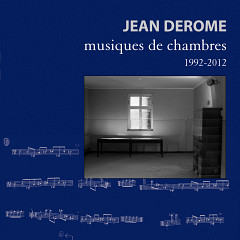
    With Musiques de Chambres 1992-2012, Jean Derome presents works different to the usual jazz-based releases that we’ve heard over the years. In this context, he presents several works in a more classical style but featuring instrumentation more associated with jazz.

    Four of the compositions feature ensembles of four to eight players. Of those, one features eight flutes and another four saxophones. One work features Lori Freedman on solo bass clarinet and another is a duo with Derome on bass flute and alto saxophone along with Lori Freedman on clarinet and bass clarinet.

    All of the works feature top-notch arrangements featuring stellar musicianship. While these pieces may not be what you would generally associate with Jean Derome, they should be considered an essential listen if you are a fan of his past work.

    All of the works feature top-notch arrangements featuring stellar musicianship.

    Volume 2 in The Sound Projector

    “Rivers of the World”, Ed Pinsent, The Sound Projector, November 22, 2015
    Sunday, November 22, 2015 Press

    Highly unusual performance record of drones, hums and growly toots by Sainct Laurens, a duo of players, in the form of their album Volume 2 (ETRC019) on the Canadian label E-Tron Rec. Montreal players Pierre-Yves Martel and Philippe Lauzier thrive in a marginal sidebar of free improvisation, clearly wanting nothing to do with those energetic sort of players who sweat it up, blart it out, and skitter about with their free-form blurts in manic passion-fuelled bouts. Instead, these two introverts exude a form of rigid control; every note they make seems to be surrendered reluctantly, and at some cost to their own physical comfort. They’ll only make an utterance if the occasion demands it, like two abstemious Quakers at a prayer meeting. They almost seem to be exploring each musical encounter anew, rather than setting out in advance knowing what they will discover.

    Second noteworthy element is the unusual choice of instrumentation, which includes a viole de gambe, a bass clarinet, found objects, and amplifier feedback. Only the woodwind half of the act (Lauzier, who also blows an alto and soprano sax) allows this release to be at all recognisable as free improv, and hence gathered in the “jazz” racks at the local record store. There also seems to be something going on with prepared strings, so that one of them (Martel most likely) comes across as a low-key avant-garde miniature Gamelan ensemble, with muffled percussive blows. Their slightly stilted method, combined with their unusual sound, makes the album a winner for me; when they reach the sweet spot of unearthly tone blends, it’s near-delirious. The pair have come our way before on the album La Formule XYZ in 2012, where they did with Martin Tétreault to great effect. From 9th February 2015.

    Their slightly stilted method, combined with their unusual sound, makes the album a winner for me; when they reach the sweet spot of unearthly tone blends, it’s near-delirious.
  • 1
  • 2
  • 3
  • 4
  • 5
  • 6
  • 7
  • 8
  • 9