actuellecd

Blog

96 results
  • 1
  • 2
  • 3
  • 4
  • 5
  • 6
  • 7
  • 8
  • 9
  • String Quartet No. 3; Unhörbare Zeit in 5:4

    “Review”, Simon Cummings, 5:4, November 19, 2015
    Thursday, November 19, 2015 Press

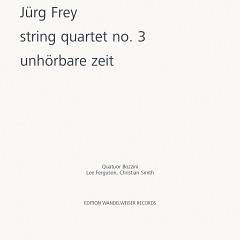
    Spending significant amounts of time with the music of Jürg Frey, as i have been doing lately, feels akin to reading a large chunk of the New Testament. There’s very much the sense that one is engaging with not merely the diverse whims of creativity, but multifarious facets of an intricate set of beliefs. It’s often said that composition has more decisions about what not to do than anything else (the same, of course, can be said of religion, with its emphasis on proscription) and in every moment of Frey’s music this is abundantly clear. It’s as clear as it is because in each piece Frey excludes a very great deal, establishing soundworlds within which only a few things can happen. Rhythm, pitch, timbre, articulation, dynamic, development, structure—essentially every aspect of compositional potential is strictly defined and confined, the resultant music playing out within those tight boundaries. In the case of String Quartet No. 3, imminently available on Wandelweiser’s own label, the music unfolds via regularly spaced chords, delivered calmly and flatly, at times dispersing into episodes of overlapping, drawn-out pitches. A triadic sensibility acts like an undercurrent, permeating and conditioning the variety of patterns and behaviours into which the piece settles. Around halfway through, a washed out chorale of sorts briefly emerges, followed immediately by a descending Lydian scale over an F major chord. Not everything has this clarity; the opposite is found in a rather entrancing section later on when all pitch content becomes strained and vague, a process that seems to leave a permanent stain even when normality is restored. The second work on the disc, Unhörbare zeit (‘inaudible time’), delimits the players—the quartet plus two percussionists—still further and is all the more engrossing for it; weak chords and even weaker solitary notes are held (‘dragged’ feels a more appropriate word, considering how they sound), the percussion colouring them with either low rumbles or something akin to a slowly rotating stone lathe. These form the restricted behaviour of the entire 35-minute piece, the only other aspect being periods where to a greater or lesser extent the music is swallowed up in silence. This latter aspect is important to Frey who, with direct reference to the title, refers in his programme note to “working with audible and inaudible durations that appear partly simultaneously and partly consecutively.” Unhörbare zeit is thereby created by juxtaposing these limited sounds and elements, as though they were the only ones that existed in the whole world. New sounds do creep in: granular and wind-like sounds can be heard towards the end, plus — most striking — what appears to be a set of tuning pipes, nicely mingled, but not blended, into some repeating chords (the pipes obtruding due both to their pitch within the triad, an added 6th, and their timbral difference), before the piece closes in a mesmerising kind of microtonally-challenged hocket.

    … the music unfolds via regularly spaced chords, delivered calmly and flatly, at times dispersing into episodes of overlapping, drawn-out pitches.

    String Quartet No. 3; Unhörbare Zeit in The Watchful Ear

    “Review”, The Watchful Ear, November 19, 2015
    Thursday, November 19, 2015 Press

    I should mention that should anyone ever ask which five albums I would choose to be stranded with upon a desert island, Jürg Frey’s first volume of string quartets, recorded by Quatuor Bozzini and released on the Wandelweiser label back in 2004 would make the cut. Containing Frey’s first two quartets, written in 1988 and 2000, the music on that disc remains one of a very small handful of Wandelweiser releases I return to repeatedly. The monochrome, minimal beauty of that music has a lasting appeal for me, connecting as it does my personal love for the string quartet form, the almost guiltily hidden romanticism of Frey’s composition and the austere outer curtain that much Wandelweiser music of that period presented us with. This new release then has been, to say the least, much anticipated around here.

    There were ten years between the completion of Frey’s second string quartet and his embarkment on the four year period it took him to write his third. In the intervening years the Swiss composer’s prolific output highlights a gradual but evident shift away from the sparse, silence enveloped expanses and muted greys of his earlier work towards a subtly more complex, perhaps more familiarly musical palette. If the analogy of a time-lapse captured pupae opening gradually to reveal its hidden splendour is to be of any use here however it should be noted that Frey’s most recent work is no garishly coloured butterfly, rather the soft colours and quiet fragility of the understated moth perhaps apply as he has stretched his wings to reveal a degree of beautiful subtlety currently unparalleled. The third string quartet, played here again by the Bozzini’s with only one personnel change since that earlier release is perhaps the piece of music that epitomises Frey’s later works perfectly. It is a simply stunning half an hour of music.

    Whilst the third string quartet takes in many ways the traditional form of two violins, cello and viola, Frey chooses not to follow the classical approach of splitting the work into four distinct movements, instead following the example of Nono, Lachenmann and others and retaining the piece in one section, lasting thirty-two minutes and taking up the first half of this CD. The third quartet is slow music, as was the second, and much of Frey’s catalogue of work. If the architecture of Jürg Frey’s composition here is built with an acute attention to harmonic layering and the warmth of softly glowing colours shimmering beneath earthy tones then it is through the glacial pace of the music that we as listeners are afforded the chance to take in such details. So as the opening chords, richly formed from carefully chosen dry slithers of gentle tone immaculately in time with one another slide past us they seem to do so with an intense solemnity and a stillness that belies the fact that this could be Frey’s most musical and silence-free work yet. The opening third of the piece is just hauntingly beautiful. The horizontal strokes of the opening gradually give way to a more blurred mass of low register washes which themselves dissolve into a more structured series of bars offering melody sculpted from layered harmonic pitch but still with a sense that it will all just slip out of earshot at any moment. Around the halfway point of the piece a pattern of gradually rising chords begins that form a distinct section within the quartet- lifting the music up from its morose, shadowy, yet highly beautiful opening movements and pouring a soft light into the work that fuels the entwined pitches and allows for the shadow of the breathy near-silences that follow and the more densely coloured swathes of the closing passages.

    It is actually really difficult to pin down Jürg Frey’s third string quartet into any simple categories. It serves as the most fully realised recorded example yet of how his music has slowly evolved out of the austere landscape of the early Wandelweiser pigeonhole into something that is literally blossoming, albeit at slow speed, into complex, colourful and yet always incredibly subtle and refined music. Frey’s work has always exuded a strong sense of humility that matches his personality. In his liner notes he explains;

    “The music gets its vitality and its radiance, not from gesture and figuration, but in quiet presence — everything is there: colours, sensations, shadows, durations. The music is silent architecture.”

    These few words describe the work better than mine ever could. There is indeed everything here, and the quiet and assuming can be peeled back to find an incredible depth of detail and a melodic, even classically romantic warmth presented through music that is quite intoxicatingly beautiful as it hovers close to its own disappearance.

    The string quartet is accompanied by a further work, the thirty-five minute Unhörbare Zeit, an older work written between 2004 and 2006 performed by the Bozzini Quartet alongside two percussionists, Lee Ferguson and Christian Smith. Unhörbare Zeit has been reworked for different instrumentation a couple of times, the piece seemingly beginning life as a quartet for flute, clarinet, trombone and cello, probably to be performed by members of the Wandelweiser collective, and then morphing into a double quartet for strings and four trombones before finally the version heard here. Its another lovely work, but this time one that nicely bridges the gap between the silence strewn austerity of earlier works and the fluid beauty of the new string quartet. The piece consists of long soft, deep pitches of varying length that mostly never overlap, though each chord in itself is the result of carefully tuned layered composition. The playing here is quite remarkable. Each of the pulses of sound start and finish so smoothly its as if they were digitally adjusted, and the smoothness of each held tone is such that they sound handcrafted in post-production, but to be clear, they aren’t. Here and there the string tones are met by shorter percussive sounds, but everything is very restrained, controlled, with the silences providing the perfect negative space for the moments of immaculate sound to be placed amongst them. Its a study in controlled pacing, faultlessly perfect musicianship and a wonderfully arranged sense of compositional refinement. Unhörbare Zeit provides a more structured form of beauty, the straight lines of the neat lawns placed alongside the glorious rosebeds of the third string quartet’s lyricism. The quartet is the star of the show here, but the choice of piece to pair with it is a discerning one. Overall this is a wonderful release of music from a composer currently producing music that somehow manages to tick every box at once for me. Rarely is music so gorgeously listenable also so explorative, rarely does music with one eye of music’s traditions sound so thoroughly modern. This is out there on its own.

    Rarely is music so gorgeously listenable also so explorative, rarely does music with one eye of music’s traditions sound so thoroughly modern. This is out there on its own.

    Paso Doble in Vital

    “Review”, Dolf Mulder, Vital, no. 1005, November 3, 2015
    Tuesday, November 3, 2015 Press

    A duo work of two improvisers. Eguiluz (voice) comes from originally from Mexico. Diamantakiou, playing upright bass, is originates from Marseille (France). They started their collaboration in 2012 in Montreal, where both have their base. Diamantakiou is also member of the ensemble Rubedo’ro, led by Eguiluz. As a duo they take themes from jazz standards as a starting point for their free improvised excursions. For their first release Paso Doble they made recordings in February-March 2014 in the studio, using themes from Mingus, Ellington and Bach. Their improvisations breathe a delicate and fragile atmosphere. They are full of subtle movements and gestures. Beautifully sung by Eguiluz who has a characteristic and recognizable voice. Also the playing by Diamantakiou is fine. A rich and solid work.

    A rich and solid work.

    John Cage: Four in La Folia

    “Review”, Grant Chu Covell, La Folia, November 1, 2015
    Sunday, November 1, 2015 Press

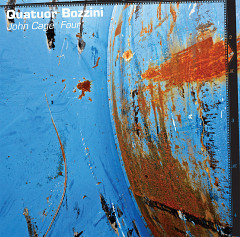
    As a collection, Cage’s string quartets permit an ensemble to explore different ways of collaborating. The String Quartet in Four Parts was written just before Cage’s plunge into chance. It’s traditionally notated and organized akin to the micro and macro structures Cage explored in his early percussion music. The Bozzini pivots expertly between delicate antique and dissonant chords. Thirty Pieces and Four are from the same decade, however are separated by a divide. Thirty Pieces consist of essentially 120 one-minute solos delivered four at a time. Each player prepares independently and in performance they coordinate as little as possible and spread themselves at far distances around the audience. It’s an accidental quartet; modern, aggressive, and lightly sprinkled with extended techniques and microtones. Four operates at a low threshold with neutral singularities. Chords and coincidences are expected but details are unpremeditated. Tones appear, unornamented, nearly expressionless and ugly. There’s a passage starting around 22:13 hinting at Mozart’s Dissonant. Here the Bozzinis demonstrate their impressive range, playing together, apart and indifferently.

    Here the Bozzinis demonstrate their impressive range, playing together, apart and indifferently.

    Musiques de chambres in The Squid’s Ear

    “Review”, Massimo Ricci, The Squid’s Ear, October 27, 2015
    Tuesday, October 27, 2015 Press

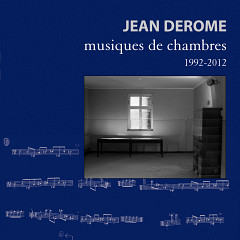
    Jean Derome — a veritable stalwart from the Quebecois scene since the early 70s — does not seem particularly interested in being hailed as the designer of epochal masterpieces, at least judging by the mathematical spirit-cum-playful twists conveyed by large chunks of Musiques de chambres 1992-2012. We often perceive the hand of a composer intent in establishing a somewhat stretchable relationship between instructions/scores and performers willing to extract essential juices from substances that do not appear exactly “juicy”. Indeed, most of this stuff exploits graspable rhythmical cells and superimposition of rather restricted melodic materials, the whole not infrequently comparable to out-and-out exercises with a few intriguing traps and unforeseen spurts. The latter characteristics differentiate it from the kind of poor man’s minimalism peddled by those who want to sanctify the name of lowercase at all costs.

    Derome plays in just two of the six cycles. Apart from Les jumeaux — a duo with clarinetist Lori Freedman — the record comprises series of mainly short-ish pieces, in any case lasting less than five minutes. All things considered, this fragmentariness is a plus. Ideas are expressed with conciseness and, in a way, detachment; the heart may not skip beats because of emotional turmoil, however the instruments resonate beautifully in (mostly) ample spaces. Never for a moment does inertia or boredom set in; as simple as a compositional choice might look, one follows plots and patterns with a degree of interest to see what the deal is. In general, nothing truly extraordinary happens; but we do get caught. Selected sketches possess a generous drive that lets forget about the lack of genuine harmonic complexity (Cinq études pour figures). Some of them show a propensity to contrapuntal spiciness (read: challenging use of close voicing inside discordant constitutions), the flute octet Les cheminées — featuring the Alizé Ensemble — representing perhaps the best example. A couple of snippets from the saxophone quartet Rouge — executed by Quasar — could hypothetically suggest an association with Gilbert Artman’s Quad Sax (the “distilled” version of Urban Sax: go get their lone release now if you missed it).

    Though my favorite Derome is still the fabulous reedist who swaps blows with René Lussier in Les granules, or enriches Lars Hollmer’s Looping Home Orchestra in Door, Floor, Something, Window, I am always glad to know what he is doing. You should be equally curious; intelligence is a rare thing in today’s music: either you like the results or not.

    I am always glad to know what he is doing. You should be equally curious; intelligence is a rare thing in today’s music: either you like the results or not.

    Invisible Backgrounds in Revue & Corrigée

    “Chronique”, Cyrille Lanoë, Revue & Corrigée, October 4, 2015
    Sunday, October 4, 2015 Press

    Un disque atmosphérique, une trompette atmosphérique, des plages sonores forcément atmosphériques. De l’artiste on en connait peu. Sinon qu’il vient de Montréal et qu’il joue ou a joué dans des formations plutôt free rock qui se tiennent (dont La Part Maudite). Trompettiste maintenant vous vous en doutez. En solo il propose avec Invisible backgrounds plusieurs cordes de son arc en matière d’ambiances créées. Avec non pas autant, mais dix plages disons, variées. L’entame est jazzy, en volutes. Il y va même de l’utilisation (piochée à la BBC, quand je vous parle d’utilisation) du field recording sur luna negra. Montréal est entre autres connu pour ses groupes post-rock issus de la nébuleuse Constellation (Godspeed you! Black emperor, Silver Mt Zion…). Principalement développé sur time for new hands de belle manière, avec pour ma part des influences à aller cher chez Mogway ou les français de Madrid, en plus bien sûr des influences de chez Constellation citées plus haut. Un piano, une voix enregistrée, type pasteur, et cette trompette volante. Le titre qui a le plus retenu mon attention est celui qui suit, super 8. Des grosses sine wave en rotative, avec une fin abrupte appréciable. Tout est dans le titre: tout est mécanique. Court mais bon. Je me répète mais l’exercice du solo n’est pas aisé. Philippe Battikha, sans rien révolutionner, apporte de la fraicheur à des titres qui pourraient pourquoi pas s’échapper des morceaux les plus calmes de Hint, ou encore d’un autre duo, Spaceheads. En beaucoup plus feutré mais tout autant agréable. Avec une personnalité dans les manipulations de bandes, de pédales d’effets, dans les invitations comme cette belle contrebasse sur beyond you. J’avais été assez déçu en 2012 par un disque de Sontag Shogun qui s’essayait à de tels essais. Préférez donc celui-ce, de très loin.

    Un disque atmosphérique, une trompette atmosphérique, des plages sonores forcément atmosphériques.
  • 1
  • 2
  • 3
  • 4
  • 5
  • 6
  • 7
  • 8
  • 9