actuellecd

Blog

162 results
  • 1
  • 2
  • 3
  • 4
  • 5
  • 6
  • 7
  • 8
  • 9
  • Damián Nisenson in La Scena Musicale

    “L’Off Festival de Jazz de Montréal: SoCalled/Nozen. The Beauty and the Beat”, Julie Berardino, La Scena Musicale, December 2, 2011
    Friday, December 2, 2011 Press

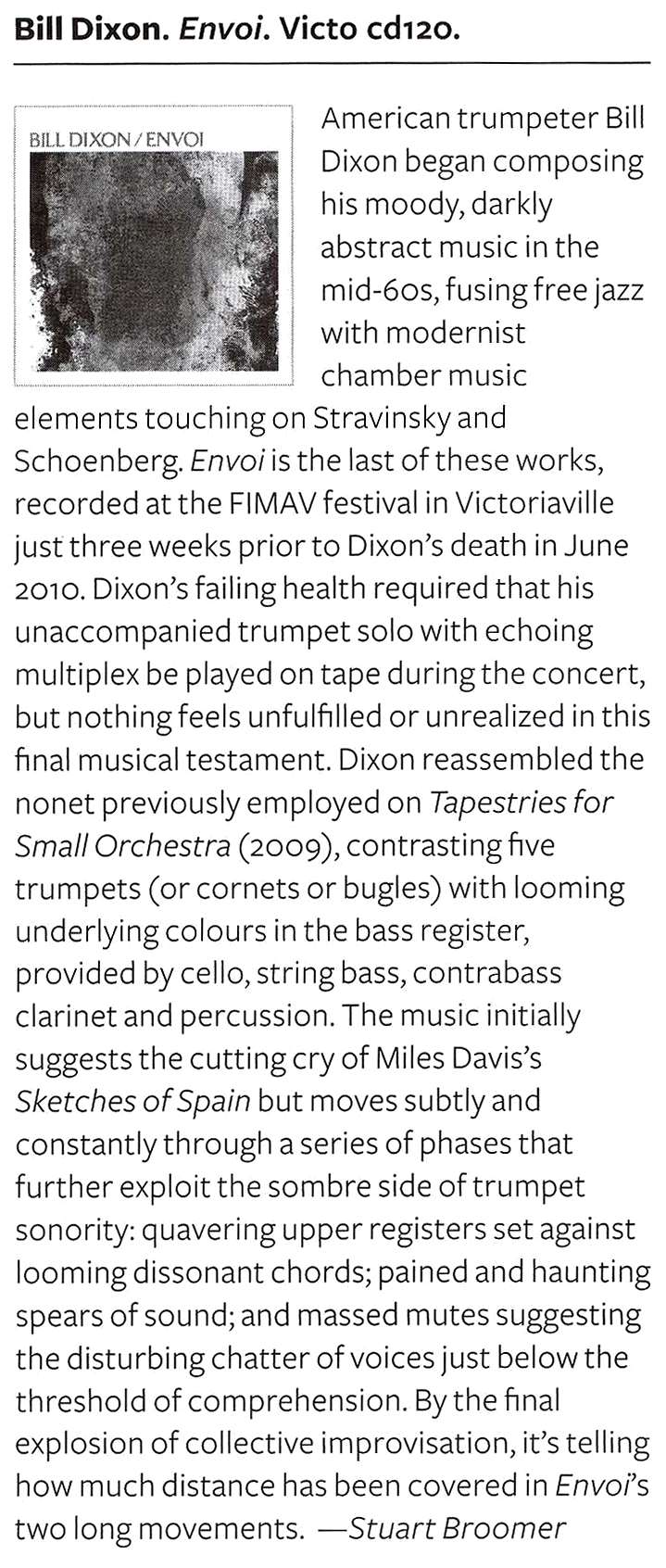
    Le saxophoniste Damian Nisenson et la coqueluche montréalaise SoCalled (voix, claviers, accordéon et échantillonneur) ont foulé les planches du Lion d’Or avec un bonheur palpable et une musique à la croisée du jazz, du hip-hop et du klezmer, afin de célébrer le Yom Kippur faisant, selon Nisenson, «ce qu’ils font de mieux: de la musique», et ce, au grand plaisir d’une foule essentiellement jeune et particulièrement enthousiaste. Les artistes, accompagnés de Bernard Falaise à la guitare électrique, Jean-Félix Mailloux à la contrebasse et, une fois de plus, Pierre Tanguay à la batterie ont fait preuve d’une bonne humeur et un charisme si fou qu’on ne peut leur pardonne d’avoir trop usé de tape-à-l’oreille, de progressions trop peu variées, augmenté d’une sonorisation élevée aux limites de l’ouïe humaine. La virtuosité de Nisenson, qui maniait deux instruments à la fois, en mettait malgré tout réellement plein les yeux. Certains moments étaient toutefois d’une sensibilité remarquable, notamment une ballade que SoCalled a interprété en yiddish, ou le rappel où les musiciens sont descendus dans la foule.

    Certains moments étaient toutefois d’une sensibilité remarquable, notamment une ballade que SoCalled a interprété en yiddish, ou le rappel où les musiciens sont descendus dans la foule.

    Trio Derome Guilbeault Tanguay in La Scena Musicale

    “L’Off Festival de Jazz de Montréal: Trio Derome Guilbeault Tanguay”, Julie Berardino, La Scena Musicale, December 2, 2011
    Friday, December 2, 2011 Press

    Jean Derome, égal à lui-même, prend le jazz au sérieux. L’appréciation de sa démarche artistique déjantée et intellectuelle exige effort et ouverture d’esprit. Le saxophoniste, qui se produisait en trio avec le contrebassiste Normand Guilbeault et le batteur Pierre Tanguay, a poussé à fond les limites des mélomanes en nous présentant des pièces issues de son album Danse à l’Anvers. Il les a entraînés avec audace à travers maints styles et époques, de Louis Armstrong au free jazz le plus débridé, des standards aux techniques les moins conventionnelles. Le musicien, toujours dans les règles de l’art, parle dans son instrument, sort les sons les plus stridents de son alto, explore l’atonalité. Il prend malgré tout le temps, avec humour et générosité, de guider en parole son public, lui offrant des aperçus judicieux de l’histoire et de la littérature jazz. On ne peut non plus passer sous silence sa maîtrise technique et de sa virtuosité enviable, particulièrement rafraîchissante au saxophone baryton, duquel il tire un son chaleureux. Somme toute, une excellente prestation. On regrette seulement un peu de ne pas l’avoir entendu à la flûte, son premier instrument!

    Somme toute, une excellente prestation. On regrette seulement un peu de ne pas l’avoir entendu à la flûte, son premier instrument!

    Ave <w> in The Squid’s Ear

    “Heard In”, Dave Madden, The Squid’s Ear, December 1, 2011
    Thursday, December 1, 2011 Press

    There is a 99% chance that Tiari Kese is in fact Michel F Côté; but let’s run with the mythology, as it’s as wistful as the music.

    Kese, a Bulgarian piano prodigy, began his career at age seventeen under the tutelage of Stockhausen, the latter composing a set of Klavierstücke just for him — and that’s Kese posing as Stockhausen on the cover of Sgt. Peppers Lonely Hearts Club Band. He later became a world-class interpreter of Satie and John Cage (Cage also wrote pieces specifically to be performed by Kese). However, he didn’t begin recording his works until meeting Côté who serves as a performer on, producer of Ave.

    And he also plays the French horn!

    Fittingly, Ave is a murky, organic concrète based on shadows and slight of hand. Kese’s source materials consist of various room ambiences strung together with juxtaposition, piano and trumpet (performed by Ellwood Epps) that come in and out of focus (turn up the music during moments of seemingly inactive sound clouds and track fade-outs or you will miss something) and Côté’s shimmering electronics, his penchant for overdriven microphones and the occasional thump; the percussion is less frantic than some of Côté’s œuvre, but acute and intense like the sounds one would make while trying to claw out of a box. On the fourteen-minute opener (Unit Vector In Vratsa), these elements weave together, Kese’s Debussy-esque planing (sic) and Côté’s mechanical piston sounds serving as signposts to tie the form together. Бойко Борисов is an intricate drone journey from light to bright to dark to midnight; the last word resembles the reverberation of a piano slam, though heard in slow motion. The hints of rudeness from the first work are exploited on Marge Brute Du Ƒ: accompanying each piano note and chord is a slightly delayed, highly screeching burst of feedback to counter Kese’s tender procession; counterpoint ensues, a dry reversed series of notes and a fog you have to squint your ears to enjoy enter the fold, and the ostinato ends carried by the synthetic child of acoustic keyboard and feedback parents. From here, the pieces fold over in a palindromic fashion, culminating with Reichmann Sum For S, a finale that pays homage to the opening theme, then filters it to the background to make room for a string quartet coda, everything eventually unraveling into a sighing, steamy hiss.

    From a horoscope blog: “A dream of playing the piano yourself predicts success in all your plans and hopes, unless the instrument was damaged or out of tune, in which case you can expect some difficulties and delays along the way. If you dreamed of hearing piano music beautifully played by someone else, it is a promise of better financial times ahead.”

    Difficulties, delays and success: per usual, Côté’s imagination turns out all these things.

    Difficulties, delays and success: per usual, Côté’s imagination turns out all these things.
    Envoi in Musica Jazz

    “Recensione”, Daniele Camerlengo, Musica Jazz, December 1, 2011
    Thursday, December 1, 2011 Press

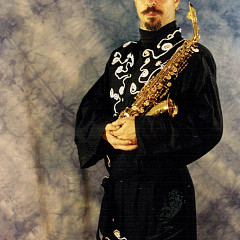
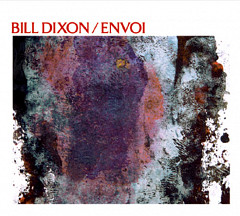
    L’ultimo intenso respiro di una grande figura musicale vissuta indebitamente nei bassifondi del mercato discografico d’elite. Un mese prima della sua scomparsa il trombettista Bill Dixon si è esibito all’ International Festival di Musique Actuelle di Victoriaville 2011, assieme a una impressionante formazione di ottoni. Lo scorrere musicale altalenante e dal possente impatto emotivo, diviso in due sezioni e con un breve epilogo, ripercorre le fasi creative della sua carriera, la sua tromba, come uno scandaglio dimensionale, ci fa rivivere le ricchezze e l’evoluzione del suo linguaggio sperimentale attraverso l’abbraccio avvolgente delle cangianti stratificazioni armoniche. La conduzione risalta la forza e la potenza dell’organico trombettistico di indubbio valore, sorretto a dovere dall’energica sezione ritmica composta da Ken Filiano e Warren Smith. Purtroppo i problemi di salute di Dixon si erano già manifestati, costringendolo a pre-registrare il solo. Emozionante il suo discorso debolmente sussurrato, ma saturo della sua profondità d’animo… Bye Bill.

    Envoi in Musicworks

    “Review”, Stuart Broomer, Musicworks, no. 111, December 1, 2011
    Thursday, December 1, 2011 Press
    By the final explosion of collective improvisation, it’s telling how much distance has been covered in Envoi’s two long movements.
  • 1
  • 2
  • 3
  • 4
  • 5
  • 6
  • 7
  • 8
  • 9