actuellecd

Blog

223 results
  • 27
  • 28
  • 29
  • 30
  • 31
  • 32
  • 33
  • 34
  • 35
  • Snipettes! in The Squid’s Ear

    “Op-Ed”, Phil Zampino, The Squid’s Ear, March 1, 2007
    Thursday, March 1, 2007 Press

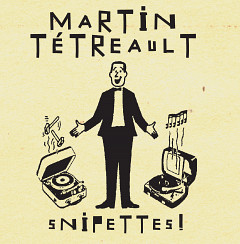
    Listening more to Tétreault’s Snipettes record. As I mentioned the other day, this is a reissue of a very limited set of 1992 cassette tape releases. To me, this is far more interesting than the more recent noise improv that Tétreault has been involved with. Here he created a virtual orchestra from a set of records. The title piece is my personal favorite, an unusual but wonderfully paced set of plundered parts, including Star Trek voice samples from actors other than Shatner and Nimoy, but more importantly, using a very eclectic mix of virtual instruments. It’s clear from listening to both works that Tetreault put a lot of careful consideration into the selection of source material and how the pieces were to be performed. It’s both remarkable and really entertaining. And inspiring me to play a lot of plunderphonics material on the radio show today…

    The title piece is my personal favorite, an unusual but wonderfully paced set of plundered parts…

    Dix situations précaires in The WholeNote

    “Review”, Tom Sekowski, The WholeNote, March 1, 2007
    Thursday, March 1, 2007 Press

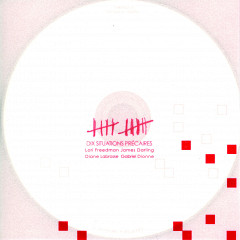
    One half of this new music quartet hails from the small city of Rimouski, while the other half hails the metropolis of Montréal (though one of these individuals actually spends a lot of time in Europe). Percussionist Gabriel Dionne along with cellist James Darling make up the Rimouski contingent, with two women — clarinettist Lori Freedman and Diane Labrosse on the sampler — make up the “big town” cluster. To be fair to all musicians involved, neither faction takes precedence. Even though Labrosse edited the session (which was recorded at a live setting back in September 2005), credit is shared equally amongst the players. Each one adds a specific flavour to the recording. Without one of these musicians, the session would fall flat; the soup wouldn’t have its unique taste. Knowing Freedman and Labrosse’s work, it’s rather surprising how subtle their approach is on this session. If anything, subdued is the word that pops into my head. Freedman still plays some lovely bass clarinet motifs, while Darling jumps in with wickedly innovative cello concoctions. Dionne’s percussive tandem is to walk a fine line between minimal percussion — just bells or scrapes on the cymbals and light strokes of the brushes. There’s no rhythm really to speak of, just broken-off percussive spews. In a few places, when Freedman turns it up a notch, she shines with unbridled clarinet fury. Her sounds appropriate squeaks of birds and people’s laughter. All the while, Labrosse samples individual sounds and serves these up in quite a delightful fashion. At times you’re not really sure who’s playing whom. Is it the sampler that’s running the show or the three other performers that are rallying up against the grain of technology? Sometimes her concoctions sound like wildly spruced up scratches, while at others they’re more foreign than human. Though subdued and largely on the quiet side of the spectrum, this wickedly satisfying recording has already found a regular slot in my CD player’s busy schedule.


    Though subdued and largely on the quiet side of the spectrum, this wickedly satisfying recording has already found a regular slot in my CD player’s busy schedule.
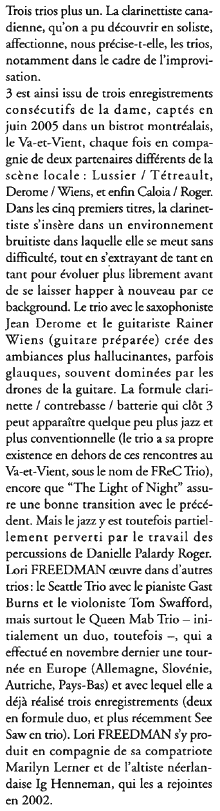
    Lieux-dits in Revue & Corrigée

    “Critique”, Pierre Durr, Revue & Corrigée, no. 71, March 1, 2007
    Thursday, March 1, 2007 Press

    Avec cet enregistrement, le label québécois accueille en son sein un musicien (batteur) dont on aura du mal à souligner les attaches culturelles. Né en Colombie-britannique (côte ouest du Canada) de parents russse et italien, sa musique s’inspire, nous informe-t-il, de ses voyages dans les Alpes et les Pyrénées françaises et catalanes, notamment à travers divers idiomes et langages de ces régions montagneuses (cela apparaît évident dans certains passages, et plus particulièrement dans Bruine, qui clôt l’enregistrement). La musique qu’il nous propose ici — avec l’appui de Jean Derome (saxophone alto et flûte), Francesco Lonzano (saxophones soprano et ténor), Steve Raegele (guitare électrique et effets) et Clinton Ryder (contrebasse) -relève toutefois d’un jazz un peu hors du temps, un peu mélancolique, sinon nonchalant, et par moment perverti par quelques pratiques instrumentales moins conventionnelles, également nourries par les théories musicales d’Olivier Messiaens. Lieux-dits est en ce sens une musique typiquement européenne.

    … un jazz un peu hors du temps…
  • 27
  • 28
  • 29
  • 30
  • 31
  • 32
  • 33
  • 34
  • 35