actuellecd

Blog

223 results
  • 10
  • 11
  • 12
  • 13
  • 14
  • 15
  • 16
  • 17
  • 18
  • Étymologie in Exclaim!

    “Music DVD Reviews”, Glen Hall, Exclaim!, September 1, 2007
    Saturday, September 1, 2007 Press

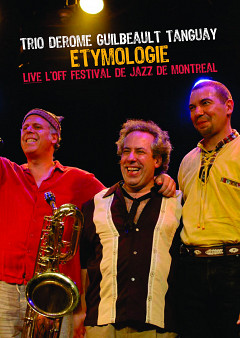
    Veteran collaborators Jean Derome (reedist), Normand Guilbeault (bassist) and drummer Pierre Tanguay have spent years evolving into a musical “organism,” an organic melding of the identities of the individuals into a seamless, distilled creative entity. And this DVD of their live performance at L’Off Festival de Jazz de Montréal captures them in situ in that most naturalistic jazz setting: the crowded club. The repertoire is drawn from compositions the group have long been exploring and the results show a deep understanding of the material. The performances are uniformly strong, with Derome’s alto, flute and baritone leading the way, displaying a formidable technical fluency, a deep emotional core and a profound respect for his musical forebears Eric Dolphy and Anthony Braxton. Some highlights include Guilbeault’s stunning arco solo in 245, Tanguay’s compellingly melodic Ed Blackwell-like stick work and Derome’s affecting flute playing on Fleurette Africaine and raucous alto on Miss Ann. Two problems with the disc: Derome’s remarks are mixed too low and the hyperactive editing is annoyingly distracting in spots. Besides that, this DVD is the next best thing to seeing the group live.

    The performances are uniformly strong…

    Geisteswissen­schaften in Startling Moniker

    “Review”, DaveX, Startling Moniker, August 21, 2007
    Tuesday, August 21, 2007 Press

    For quite some time now, there has been no shortage of art that has made comment on the increasing speed with which we are collectively bombarded with communication. Really, the issue has been approached from every conceivable angle — from Alvin Toeffler’s predictive Future Shock, to John Cage [and Lejaren Hiller]’s absurdist HPSCHD, to Negativland’s panicked track Quiet Please on Escape from Noise, to Satanicpornocultshop’s revelatory album Anorexia Gas Balloon; which embraced detritus as an aesthetic.

    It would also be easy to make the case that nearly the entire noise genre is a composite of reaction to (and acceptance of) this bombardment, at times rendering even Toeffler’s worst scenarios relatively tame.

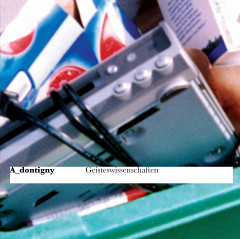
    Unless you’re living under a rock, this isn’t really fresh material. But of course, artists are products of their environment — so the question becomes, “how do I make this new?A_dontigny, half of morceaux_de_machines and a full fan of the underscore, seems to have found himself in such a position with his first solo album for the No Type label, Geisteswissenschaften. For those who aren’t aware, this mouthful of text is more or less the German translation of “Humanities,” as in the study of, etc…

    Much like such studied pursuits, attempting to nail down Geisteswissenschaften is equally futile. A_dontigny flirts at the edge of enough nearly-familiar material and structure to confound any sort of pigeon-holing, meaningful categorization, or understanding. It’s as if he is standing in a secret area of a Venn diagram, particularly in the impressively-crafted tracks featuring composer Paul Dolden. This is intricate music, filled with conflicting patterns which alternate from being ridiculously wrong to being surprisingly right.

    I don’t know if it was A_dontigny’s intent to create a document so laced with examples of our futile struggle for understanding in a world fraught with miscommunication, sheer multitudes of perception, and the odd monkeywrench; but nevertheless, that’s what I’m taking away from it. On a more positive note however, I am still heartened to find that where A_dontigny may see the impossibility of ultimate understanding, he is drawn to create regardless.

    In the end, this urge may be where the real redemption of Geisteswissenschaften comes about — acknowledging that no answer may appear, but that the question is worth asking.

    … acknowledging that no answer may appear, but that the question is worth asking.
    Pierre-Yves Martel in Voir

    “Jusqu’aux oreilles”, Réjean Beaucage, Voir, August 9, 2007
    Thursday, August 9, 2007 Press

    Le contrebassiste Pierre-Yves Martel est le petit dernier au sein du Quintette Mont-Royal et il s’apprête à donner ses premiers concerts en tant que membre de l’ensemble.

    On ne croise pas si souvent le Quintette Mont-Royal (QMR) dans nos salles de concert, mais on voit fréquemment ses membres jouer avec d’autres ensembles, que ce soit à la SMCQ, avec Les Enfants Terribles, Les Violons du Roy, Bradyworks, l’ECM, ou les orchestres symphoniques de Québec, de Sherbrooke, du Saguenay-Lac-Saint-Jean, etc. Devant trouver un nouveau contrebassiste, Marie-Hélène Breault (flûte), Marie-Julie Chagnon (clarinette), Shawn Mativetsky (percussions) et Catherine Meunier (marimba) se sont tournés vers Pierre-Yves Martel, un musicien originaire d’Ottawa (il s’y produit avec l’Orchestre du CNA, l’Orchestre symphonique d’Ottawa, l’ensemble Fusion, etc.) qui est très actif dans le milieu de la musique actuelle montréalaise depuis 2004.

    «Je fais toujours de l’orchestre et même à l’occasion de la musique ancienne à la viole de gambe, explique Pierre-Yves Martel, mais je suis très attiré par l’improvisation et le jazz. Dès mon arrivée à Montréal, ça a cliqué avec le milieu de la musique actuelle.» Son disque solo Engagement et Confrontation, paru l’année dernière chez Ambiances Magnétiques, donne un aperçu très convaincant de sa polyvalence, un atout indéniable pour le QMR, qui programme surtout des musiques de jeunes compositeurs. «Quand on m’a proposé de me joindre à l’ensemble, j’ai sauté sur l’occasion!» Les membres du QMR ont l’ambition de rendre la musique contemporaine attirante pour un public jeune et avide de nouvelles musiques.

    «Il y a dans notre répertoire des influences du rock ou des musiques du monde, de la batterie ou du tabla, poursuit le contrebassiste, et sans doute une volonté d’accessibilité, mais ça reste de la musique contemporaine». Les pièces interprétées lors du concert donné dans le cadre du festival Jusqu’aux oreilles sont toutes dues à des compositeurs d’à peine 30 ans (sauf Pulau Dewata, de Claude Vivier, arrangée par le QMR). On y entendra des œuvres de René Orea Sanchez (en création), Christien Ledroit (en création) et André Cayer. Le QMR donnera un tout autre programme lors de son passage au Festival international du Domaine Forget le 22 août. La 9e édition du festival Jusqu’aux oreilles propose 17 concerts du 9 au 19 août.

    Âmes soûles in Voir

    “Disques de la semaine”, Réjean Beaucage, Voir, August 9, 2007
    Thursday, August 9, 2007 Press

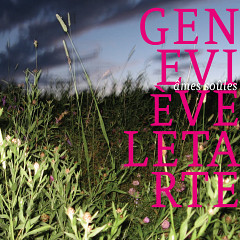
    Sept ans après Chansons d’un jour, qui arrivait lui-même 10 ans après Vous seriez un ange, voici le troisième disque sur lequel Geneviève Letarte chante et dit ses propres textes. Ce sont eux qui sont mis de l’avant, poussés par une voix qui ne s’égosille pas mais fredonne presque ces petits bouts de quotidien, ces demi-dialogues. Pour la composition, Letarte a reçu l’aide du contrebassiste Normand Guilbeault et du guitariste Claude Fradette. Ce dernier forme la charpente des pièces de façon très efficace, leur insufflant un fond country qui n’est pas désagréable du tout. N’empêche, l’ensemble sonne un peu daté, la voix retrouvant même parfois des inflexions à la Pauline Julien. Pour se faire raconter des histoires, simplement.

    Karusell Musik in Vital

    “Review”, Dolf Mulder, Vital, no. 588, August 6, 2007
    Monday, August 6, 2007 Press

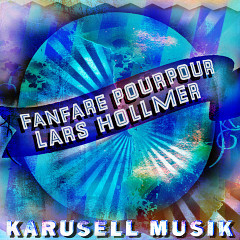
    In one word: this is a fantastic cd! Hollmer and Fanfare Pourpour would have fitted perfectly in the program of the resurrected RIO-festival last april in France. Between the dark — but more then excellent!! — music of Guapo, Présent and others, their positive and uplifting music would have been a great contribution. Why linking this Karusell with RIO? Well, Lars Hollmer with Samla Mammas Manna, was one of the groups involved in the RIO-network in the early 80s, as were Stormy Six, Étron Fou, Univers Zero, Henry Cow, etc. RIO had its function in creating a global audience for these groups. Now, so many years later, we can say this was a success. Accordionplayer Lars Hollmer made friends in Canada (Jean Derome, a.o.), and travels the world with his Accordion Tribe. But before that Hollmer made several great solo-albums in the 80s and 90s. From these lps come most of the compositions that we hear on Karusell Musik. Great tunes, all inspired on Swedish folk music. Jean Derome did a great job in arranging them for the fanfare. Fanfare Pourpour are some 20 musicians playing a diversity of wind instruments of course, but also several string instruments (mandoline, guitar, banjo, violin) plus percussion. And accordion not to forget, one of them played by Lars Hollmer himself who also sings on several pieces. The pieces were rehearsed and recorded with Lars Hollmer during a week in October 2006. They must have had a lot of fun, as the Fanfare gives way to a very joyous interpretation of Hollmer’s pieces. They embraced his music with great enthusiasm. For Hollmer it is the second time that his super melodic tunes are interpreted by musicians somewhere else on this planet. In 2000 he recorded with a group of japanese musicians (Global Home Project). Fanfare Pourpour has a history going back to the 70s, but since they are working together with musicians from the impro scene, they release every now and then a cd. The first one in 1999 (Tout le monde), the second one (Le bal) in 2004 with compositions by band members. And now the irresistible Karusell Musik, a very successful collaboration. Chapeau!

    In one word: this is a fantastic cd!

    Michael Oesterle: l’hiver monastique in Bad Alchemy

    “Kritik”, Rigobert Dittmann, Bad Alchemy, no. 55, August 1, 2007
    Wednesday, August 1, 2007 Press

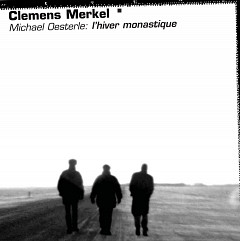
    2005 hatte sich schon Philip Gröning mit seinem Dokumentarfilm Die große Stille, den er in der Großen Kartause bei Grenoble drehen konnte, in eine klösterliche Welt versenkt, die völlig durch Kontemplation und Stille bestimmt wird. Der 1968 in Ulm geborene, 1982 nach Kanada ausgewanderte Komponist Oesterle hat ebenfalls, schon im Jahr 2000, mit L’hiver monastique«70 consolations harmoniques pour violon» ein Werk geschaffen, das ganz einer strengen mönchischen Ordnung unterliegt. Die Geige betet einen Rosenkranz aus 70 Akkorden. Repetitionen und Veränderungen fügen sich zu einer durchgehenden Kette, weil jeder Akkord mindestens eine, oft auch zwei Noten an den nachfolgenden weitergibt. Interpret ist der Freiburger Clemens Merkel, der seit seiner Übersiedlung nach Kanada im Quatuor Bozzini spielt. Die Aufnahme entstand 2001 in der Hôtellerie St. Norbert in Winnipeg, 1892 von Trappisten erbaut, inzwischen aber nur noch Kulturdenkmal. Schon die ersten Töne, so dissonant gemischt, dass sie so rau kratzen wie man sich Mönchskutten vorstellen mag, verbreiten eine Aura des Kargen, Fröstelnden, Monotonen, aber auch eine hartnäckige Konsequenz und Hingabe. Ihre Unschärfe lässt diese New Simplicity wie Alte Musik klingen, mittelalterlich, ländlich. Cages Chorals haben einen ähnlichen Duktus, nur dass Oesterle einen minimalistischen, geradezu Feldman’esk langen Atem für Wiederholungen mit ständigen Verschiebungen verlangt, bei gleichzeitig meist hohem Tempo. Call & Response-Motive tauchen auf, eine dünne, klägliche Stimme, der eine dunkle, bestimmtere antwortet. Oder umgekehrt? Die 70 Tröstungen erstrecken sich über 75 Minuten. Mir vermitteln sie keinen Trost, eher die Mahnung: Tempus fugit.

  • 10
  • 11
  • 12
  • 13
  • 14
  • 15
  • 16
  • 17
  • 18