actuellecd

Blog

199 results
  • 21
  • 22
  • 23
  • 24
  • 25
  • 26
  • 27
  • 28
  • 29
  • Ensemble SuperMusique (ESM), Joane Hétu in Le Devoir

    “Le tissage musical de Joane Hétu”, Frédérique Doyon, Le Devoir, March 15, 2006
    Wednesday, March 15, 2006 Press

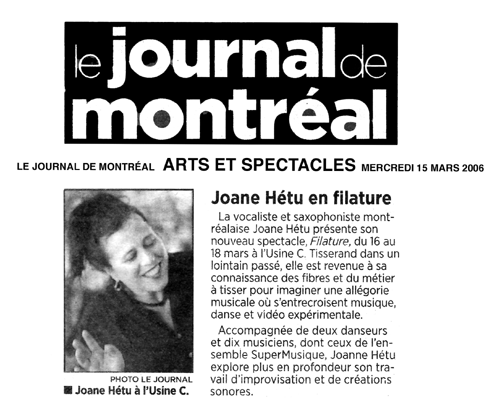
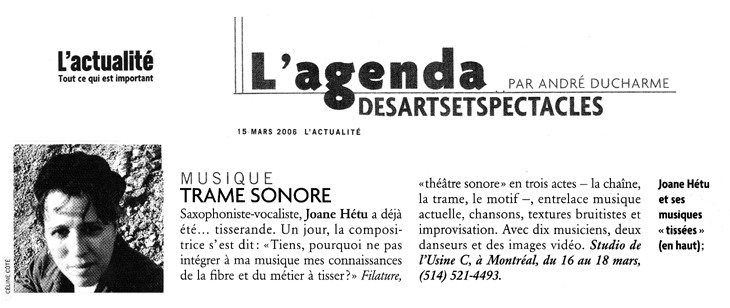
    Dans les années 70, avant de devenir la musicienne qu’on connaît, Joane Hétu était tisserande. Une autre vie, qu’elle a longtemps reniée. Dans une période de doute et de désenchantement par rapport aux exigences d’une carrière en musique de création, elle a avancé l’hypothèse un peu farfelue d’un retour au métier de tisserand. Ainsi est née Filature, une œuvre pour dix musiciens et deux danseurs truffée d’images vidéo et d’éclairages.

    «J’ai revécu tous les gestes que je faisais dans le tissage, raconte-t-elle. Dès ce moment, c’est devenu clair que je voulais exprimer le fil qu’on monte sur un métier et celui qu’on passe à travers pour créer le tissu.» Elle a donc créé un théâtre sonore en trois actes — la chaîne, la trame, le motif —, plus construit, moins basé sur l’improvisation que d’habitude.

    «Pour une fois, j’ai eu la volonté de faire comme dans le théâtre: avec plus de répétitions, une conception d’éclairages, deux danseurs. J’ai appelé ça “théâtre sonore” parce que je voulais partir du texte, de la partition musicale; les autres éléments allaient s’y rattacher.»

    Joane Hétu évolue sur la scène canadienne des musiques actuelles depuis 25 ans. D’abord versée dans le rock déjanté des formations Wonder Brass, Justine et du trio Les Poules, elle s’est tournée vers un travail de composition plus abstrait, alliant textures sonores, texte et voix. Membre d’Ambiances magnétiques et présidente de la maison de disques DAME, elle a toujours aimé faire interagir différentes disciplines. La compagnie de concerts Productions SuperMusique, qu’elle codirige avec Danielle Palardy Roger et Diane Labrosse, a notamment conçu en 2002 la superbe fresque multimédia Each… and Every Inch, sur la vie et l’œuvre de l’écrivaine canadienne Elisabeth Smart. Pour ses 25 ans, SuperMusique a décidé d’accorder une part importante de son budget à la création d’une production plus importante. C’est au tour de Joane Hétu de piloter la sienne…

    L’esprit du tissage a ainsi déterminé la structure de Filature. Le premier acte ne met en scène que les créateurs-interprètes masculins — Guido Del Fabbro, Jean Derome, Normand Guilbeault, Pierre Tanguay, Nemo Venba et le danseur Daniel Soulières; le second acte, que les femmes — Mélanie Auclair, Claire Gignac, les trois codirectrices de l’Ensemble SuperMusique et la danseuse Séverine Lombardo.

    «Le fil de chaîne se doit d’être noble, il faut que la fibre soit solide, rappelle la tisserande. Le fil de trame peut être de toutes sortes de qualité, métallique, en velours, etc. J’ai répertorié 25 textures que j’ai transposées musicalement.» Tout ce beau monde se retrouve au troisième acte pour mettre en scène cet entrelacs de générations d’artistes, de musiques, de voix (des chansons écrites par Joane Hétu), de mouvements et d’images signées par le réalisateur Pierre Hébert.

    La vie est ainsi faite de hauts et de bas qui se nourrissent mutuellement. Quand le fantasme d’abandonner la musique a effleuré son esprit, Joane Hétu y a puisé l’essence même du plus imposant projet de sa carrière. «C’est quelque chose d’avoir une aussi grosse équipe. Ça arrive à point dans ma carrière. C’est la pièce qui représente le plus mon univers musical.»

    Pee Wee et moi, The Feeling of Jazz in Vital

    “Review”, Dolf Mulder, Vital, no. 517, March 15, 2006
    Wednesday, March 15, 2006 Press

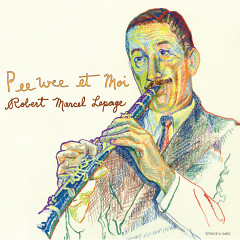
    Veterans of the new music/jazz scene of Montréal honor some of their jazz idols. The trio presents 11 standards of Duke Ellington, Lee Konitz, Sonny Clark and even Misha Mengelberg. Why record these standards that have been played and recorded by the composers and others so well and so often? Derome simply states “music needs to exist in the flesh” which is undeniably so. Jean Derome plays flute, saxes and also sings. Normand Guilbeault plays bass and Pierre Tanguay percussion. They really enjoy playing these standards and play them with verve. Robert Marcel Lepage concentrates on the work of Pee Wee Russell (1909-1969) a composer and clarinet player in the ragtime and swing-period. Not by playing his compositions, except one (Muskogee Blues). But by evoking his music through his own bluesy compositions. The pieces are played by Tanguay (drums) and Guilbeault (doublebass), René Lussier (guitar) plus Lepage and six other musicians on clarinets. In each track Lepage explores an aspect of Pee Wee’s legendary phrasing and tonal language. The result is some really ‘goodtime’ and accessible jazzmusic. Only by the complex and freaky guitarwork by Lussier — as in track 2 — we know life is more complicated.

    The result is some really ‘goodtime’ and accessible jazzmusic.

    ARC — Beneath the Surface in Vital

    “Review”, Dolf Mulder, Vital, no. 517, March 15, 2006
    Wednesday, March 15, 2006 Press

    On july 18, 2005 Berthiaume and Seino gave a concert at Big Apple, in Kobe, Japan. It is perfectly recorded and made available on this cd. And it was worth it. Because this duo offers some really innovating guitarwork that’s hard to describe. Both are unknown guitarists. Berthiaume debuted a few years ago with a cd with duets with Fred Frith and Derek Bailey. It was followed by a cd in trio format with pianist Quentin Sirjacq and sound engineer Norman Teale. Both cds were released by Ambiances Magnétiques. But of the two players Seino seems to be most experienced one. He has already several cds out, just explore the VOS catalogue. He had his own trio, and group and was engaged in numerous — mostly japanese — collaborations. Both are well-educated and very talented guitarists, and what is more important they are intelligent musicians who have something to tell. If easy listening and avant garde can go together, I would say this describes some of their improvisations, like the first part of track 6 or the solo piece by Berthiaume. Also the title-track is an excursion into spacious and echoing guitar-sounds that makes them more related to Frisell or Fripp-like soundscaping then to Frith or Bailey-inspired improvisations. But at other moments they chose for a very hectic, distorted and dynamic approach, like in the end of the title track. Although the cover makes no mentioning of it, it is evident that both have surrounded themselves with lots of technical and electronic devices. But the gentlemen are throughout in charge of what they are doing and deliver some very engaging music, true sonic symphonies I would say.

    Both are well-educated and very talented guitarists, and what is more important they are intelligent musicians who have something to tell.

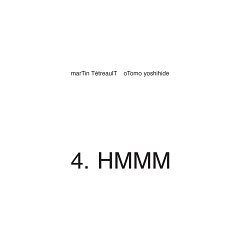
    4. Hmmm in Panpot

    “Review”, Jay Jay Erickson, Panpot, March 14, 2006
    Tuesday, March 14, 2006 Press

    Since the late 1980’s, Japan’s Otomo Yoshihide has been busy crafting his art, both as an instrumental guitarist, but also as a unique turntable exploiter and all-around noise experimentalist. His thirst for ear damaging improvisation is tailor made for the borderless directions his compositions often travel. (To those vaguely familiar with his work, he may be best known for his recent releases on John Zorn’s Tzadik label.) Personally, I like the fact Otomo named one of his past projects Les Sculpteurs de Vinyl (Memory & Money), because this so-called genius probably wasn’t referring to spinning the discs, but rather tragically transforming them (nope, this isn’t for the faint of heart).

    This live duo project with Montréal’s Martin Tétreault was recorded over several dates in France, the Netherlands and Switzerland in 2003- and I’m fairly certain no vinyl was damaged or destroyed. That’s because Tétreault and Yoshihide’s turntable time on 4. Hmmm is spent inside the machines, or at least messing about with its speed motor and its physical components. This is about finding sonic textures and frequencies by tearing the turntable apart- something Martin Tétreault has been experimenting with for some time, ultimately making this a perfect artistic match. To be perfectly honest, this is left-over material from prior Actuelle CD releases featuring the duo, namely 1. Grrr, 2. Tok, and 3. Ahhh. (This release now completes the boxed set and is available only in limited numbers).

    Several moments within 4. Hmmm bring to mind complete noise chaos, or damaged aeroplanes, like the metallic brutality which unravels in the 14-minute Grenoble no 4 / Le 102 29.04.03. Naturally, it goes without saying that this is hand wired with its share of feedback and distortion. But the results can be quite pleasant, or “relaxing” as a visiting friend pointed out, especially if you get cozy when hearing the light crackle of audio circuitry, or the occasional soothing rotations of a spinning wheel. These are turntable art masters that beautifully transform noise into percussive elements and where fresh ears are best served focusing on the subtle nuances.

    These are turntable art masters that beautifully transform noise into percussive elements and where fresh ears are best served focusing on the subtle nuances.
  • 21
  • 22
  • 23
  • 24
  • 25
  • 26
  • 27
  • 28
  • 29