actuellecd

Blog

199 results
  • 6
  • 7
  • 8
  • 9
  • 10
  • 11
  • 12
  • 13
  • 14
  • Idiolalla in The WholeNote

    “Review”, Andrew Timar, The WholeNote, no. 12:2, October 1, 2006
    Sunday, October 1, 2006 Press

    While I couldn’t find the intriguing sounding title word Idiolalla anywhere, I did however uncover the neologism “idiolalia”, which arose recently from “idio”: personal, distinct, private, peculiar, and “lalia”: speech; therefore “idiolalia”, meaning a private or unique form of speech.

    On this CD, the two singers, DB Boyko and Christine Duncan, no strangers to the exploration and extension of vocal limitations, certainly make good use of idiolalia. Jean Martin, the polished jazz percussionist impresses us with his free improv chops and fine musicianship.

    On first listening, the sheer range of vocal utterance astonishes, what with lightening quick switching between vocables and effective presentation of many extended vocal techniques. On the other hand, it did take me a while to relax with this mix of Dadaist-inflected aesthetics (which was originally designed to poke fun and agitate) and (much) nonsense language. Except when used in touches of irony, don’t expect to hear belle canto singing here!

    There is more to this music than virtuoso exploitation of avant-garde vocalism. The lack of intelligible lyrics (much of the time) doesn’t impede the singers’ ability to sound in turn lyrical, childlike, declamatory, menacingly silly, hysterically scary or amazingly like Inuit throat singers. Just when one imagines they have run the gamut of emotional set-pieces, they pull out a comically operatic bit, including wicked Pagliacci laughter.

    Stay with it. This CD rewards repeated listening and reveals initially hidden structural elements and an adventurous and playful soul.

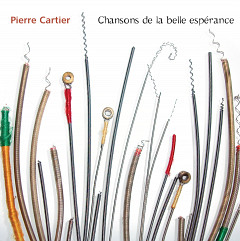
    Chansons de la belle espérance in The WholeNote

    “Review”, Tiina Kiik, The WholeNote, no. 12:2, October 1, 2006
    Sunday, October 1, 2006 Press

    “Now that was good!” These are my first thoughts after listening to Pierre Cartier’s release of self-described “French love songs”. Cartier’s compositions set to Quebec poetry, his bass playing, his own lyrics, and his singing (especially the endearing way he struggles to capture some of the high notes) combine to make this musically intriguing disc fun to behold. The excellent band is comprised of some of Montréal’s finest jazz performers — Jean Derome on alto sax and flutes, Jean René on viola, Tom Walsh on trombone, Bernard Falaise on guitar and Pierre Tanguay on drums.

    The seven selections have elements of both jazz and musique actuelle but also encompass a variety of musical styles. An almost Las Vegas style sentiment surfaces in Il nous aurait fallu while La chanson de Marie is almost simultaneously an Irish jig and an Eastern European dance. My favourite, Mirabeau, using a text of Guillaume Apollinaire, begins in a fugal manner, then moves more upbeat, and closer to the end almost becomes a 1970s rock anthem with its screeching guitar solo. Cartier’s vocals are the glue that holds the works together throughout.

    The bilingual French and English liner notes describe Cartier’s ideas behind each piece, though my high school French leads me to wish the lyrics also had an English translation. This is a moot point however — the music would be a welcome backdrop to any drive in the country or dinner affair. I’ll leave the final words to Pierre Cartier — “And if we may say that sometimes love is blind, how could we ever imagine love being deaf?” Touché!

    Now that was good!

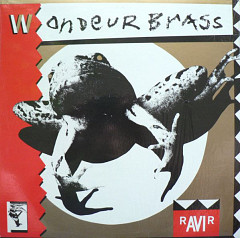
    Ravir, Simoneda, reine des esclaves in Agartha

    “Recensione”, Ruggero Formenti, Agartha, September 26, 2006
    Tuesday, September 26, 2006 Press

    Dischi con un sound tipicamente “Ambiances Magnétiques”, Ravir (1985) e Simoneda, reine des esclaves (1988) opera delle Wondeur Brass, possono essere descritti come avant-RIO di chiara matrice francofona, con qualche suono sintetico di troppo (specialmente nella ritmica) dovuto probabilmente all’epoca a cui i due lavori risalgono, alcune buone idee, purtroppo non sviluppate con quell’inclinazione progressiva a noi tanto cara, dei frammenti di musica accomunabili a certe cose dei Miriodor (che, comunque, nella loro massima espressione rimangono su di un altro pianeta…), voce ed interpretazione femminile in classico RIO stile, del rumorismo (moderato) ed un tessuto talvolta minimale… che altro posso aggiungere? Voi che ci leggete (…tutti quanti voi tre) avete già ampiamente capito di che si tratta e cosa aspettarvi esattamente da questi due pezzi di plastica (e sì, di vinile trattasi …ancora in vendita, facilmente ed economicamente reperibile, ma pur sempre vinile: per il sottoscritto un fatto negativo, per qualcuno di voi, lo so, uno stimolo in più… ). Qualche altra informazione utile: dalle ceneri delle Wondeur Brass sorsero poi le Justine, di cui consigliamo entrambi i due lavori editi nel 1990 e nel 1994, rispettivamente intitolati Suite e Langages fantastiques. Esiste una compilation in cd delle Wondeur Brass contenente buona parte dei due vinili e qualche pezzo di un’altro gruppo correlato, Les poules, composto da tre ex membri delle Wondeur Brass che nel 1986 pubblicarono Les contes de l’amère loi e più di quindici anni dopo Prairies orange. Quel che vi ho raccontato non è sufficiente per decidere o meno l’acquisto? … Se avete i due lavori delle Justine e vi piacciono, procuratevi anche i due vinili delle Wondeur Brass, se non li avete, partite dai cds delle Justine, se conoscete i lavori delle Justine e non li apprezzate, evitate anche le Wondeur Brass.

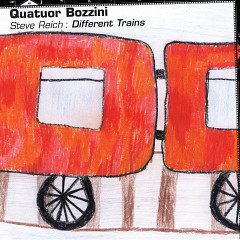
    Steve Reich: Different Trains in emoRAGEi

    “De zéro à disque”, Nicolas Pelletier, emoRAGEi, September 8, 2006
    Friday, September 8, 2006 Press

    Le Quatuor Bozzini est un prolifique ensemble de cordes entièrement féminin. [sic] Spécialisées dans l’interprétation des compositeurs classiques de notre temps, les musiciennes s’attaquent cette fois à l’Américain Steve Reich, un pionnier du minimalisme et de l’utilisation de motifs répétés. Le créateur du «loop», pourrait-on dire. Reich a aussi le mérite d’avoir intégré des bandes pré-enregistrées à ses œuvres, ainsi qu’à avoir élargi son champ d’action jusqu’à un opéra-vidéo en 2002. L’œuvre Different Trains date de 1988. Il s’agit de la superposition de plusieurs quatuors à cordes et de bandes où des bouts de phrases sont répétés. Le tout évoque les voyages en train que faisait Reich enfant, au début des années 1940, entre NYC et LA. Étant juif, il réalise par après la chance qu’il a eu d’être né en Amérique. En Allemagne, son voyage ferroviaire aurait sans doute été un aller simple vers la mort… Le Quatuor Bozzini en fait une interprétation magistrale, recréant les différents bruits d’un train avec leurs violons. Une œuvre hypnotique et impressionnante. Une fascinante réflexion humaine.

    Songs of Place in Octopus

    “From Process to the Sound City (3rd part): The place in-itself, Songs of Place by Steve Heimbecker”, Philippe Gimet, Octopus, September 1, 2006
    Friday, September 1, 2006 Press

    Songs of Place, a series of sound portraits of urban and rural places (Halifax, Montréal, Vancouver) initiated by the tireless Steve Heimbecker in the year 2000, is the latest stop on our journey to the heart of art and the renewal of formal repertories. This elaborate, multi-perspective work evolved in accordance with the artist’s travels, often occasioned by invitations or artist residencies in Canada. Songs of Place was created in the context of a residency at Oboro, a vital and atypical player on the Montréal scene (www.oboro.net), and came out in the spring of 2005. Using multiple recordings produced over a brief period of time, these works seek to capture the sound space that is specific to a place, so as to reveal the place in-itself. It is a journey to the heart of a place’s physical resonance, an interior journey that transcends the world of the senses.

    The series Songs of Place is as difficult to categorize as Steve Heimbecker himself. It is a visual and sound work that fully engages the audience’s senses and sensibilities. This work is at the crossroads of electroacoustic composition, soundscape and acoustic ecology, video editing and sound sculpture. Category aficionados, beware! Steve Heimbecker is the perfect illustration of the Nietzschean principle according to which the saving virtue of a journey is only to be found on the zigzag of the crooked path.

    A Saskatchewan native Steve Heimbecker received a fine arts degree from the Alberta College of Art and Design (Calgary, Canada). Though he has never abandoned his interest in the visual, or more specifically spatial dimension, sound has become the main focus of his creative practice. Heimbecker, who actually defines himself as a sound sculptor, is interested in the sculptural effect of sound. Recognized for his works in the audio art and electroacoustic fields, he has also created several sculptures and installations that incorporate sound components and sound-generating devices of his own invention.

    Heimbecker’s installations are part of a very rich tradition of alternative music and sound production system design that go back to the experiments of the Futurists and Dadaists. It is in this vein that he presented the personal exhibition “Soundpool: The Manufacturing of Silence” at the Illingworth Kerr Gallery of the Alberta College of Art and Design. In this whimsical installation, eight large-scale paintings, which also function as loudspeakers, engage both eyes and ears. Once activated the installation envelops the audience in an inaudible though physiologically perceptible three hertz vibration amidst a cacophony of motor and machinery noise. This installation was subsequently shown in Montréal (2001), Quebec (1996) and Edmonton (1996).

    As part of the international exhibition and conference “The Tuning of the World,” held at the Banff Centre and the Nickle Arts Museum of the University of Calgary, and inspired by R Murray Schafer’s eponymous book, Heimbecker created the installation The Acoustic Line as the Crow Listens (1993), in which he explored the acoustic spaces of vast outdoor places. To accomplish this work the artist, who is also a founding member of The World Forum for Acoustic Ecology, recorded eight points simultaneously over a linear distance of 1.5 kilometres in order to develop “sound mappings”, and to engage in a spatially rich auditory experiment by using the speed of sound in the natural environment as a sonic event that can be recorded and hence played back.

    During the same period Heimbecker developed techniques for mixing direct and prerecorded sounds for quadraphonics and octaphonics on a multichannel system that he designed. A series of concepts such as “the soundpool”, “sound sailing”, “acoustic mapping”, and “dynamic voltage mapping” emerged from these techniques, which envelop the listener in a rich sonic fabric. This technical process follows in the footsteps of concrete music, initiated by pioneers such as Pierre Schaeffer, who used recorded sound in the environment to create works.

    Songs of Place is a work worthy of total immersion, for even though it appears to be solely about the everyday life unfolding in a place, the resulting portraits reach beyond that level. The everyday in fact takes on an extraordinary quality when it is rendered audible at such a high resolution. The two DVDs contain four multiphonic video and sound portraits of places (Halifax, Montréal, Vancouver and Springwater, Saskatchewan), which were created using quadraphonic recording and production techniques. The guiding principle is based on applying a mapping system, conceived by the artist, to identify a geographically determined centre and circumference. In choosing eight to ten equidistant locations, corresponding to the cardinal points, a virtual circle is traced and an omni-directional and quadraphonic recording is made at each location. The still images and video are turned toward the outside of the circle’s perimeter and are recorded at the same locations as the audio. One is thus at the heart of the interface, understood in the Kantian sense of the term.

    The system essentially functions like the score of a composition that calls both on artistic intention and randomness.

    The recording locations are all outdoor public spaces: streets, crossings, parks, riverbanks and seashores. This particular mapping of space reveals a complex temporal organization and experience based on a spatial deployment that succeeds in capturing what many approaches fail to accomplish: the expression of a place in-itself, the revealing of the identity and heritage of our public spaces.

    Though these portraits are essentially meditations on the currents that nourish these places, they also allow the audience to switch viewpoints between the multiple subjective perspectives unfolding along the circumference of the mapped space and between its periphery and centre. A space where we find ourselves fixed but not still, wavering between immobility and movement. In the same way that walking is an odd forward flight predicated on the dance of disequilibrium, with Songs of Place Heimbecker gives us the opportunity to understand the multidimensional currents of a place. In fact, his works as a whole are perhaps best characterized through the analogy of the squaring of a circle: the eight points of the octaphonic audio evoke a cube, or, by extension, an immersive sound experienced in four dimensions (the fourth being time). Thus submerged in a pool of sounds and the resonance of a place, we perceive the out of the ordinary as we are plunged into a musical universe of a rare serenity. In closing, Steve Heimbecker’s greatest victory, that which makes Songs of Place a remarkable and significant work, is to invite us to discover time in its dual dimension of flow and suspension, as a song both visible and audible. [English translation: Bernard Schutze]


    … a remarkable and significant work…
  • 6
  • 7
  • 8
  • 9
  • 10
  • 11
  • 12
  • 13
  • 14