actuellecd

Blog

192 results
  • 1
  • 2
  • 3
  • 4
  • 5
  • 6
  • 7
  • 8
  • 9
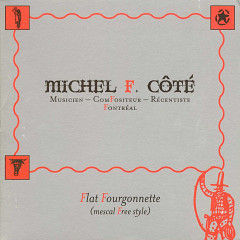
  • Flat fourgonnette (Mescal Free Style) in Exclaim!

    “Review”, Nilan Perera, Exclaim!, November 7, 2005
    Monday, November 7, 2005 Press

    Michel F Côté has a dedication in this release that is directed to Fabrizio Gilardino, describing it as a “spaghetti western.” Well, upon listening to this movie for the ears, and in between bouts of laughter, I have concluded that it is actually a poutine western. Anybody who doubts that Quebec has a distinct culture had better listen to this CD and come to their senses. This take on American culture could not have come from anywhere else. Côté has assembled a work that staggers between electro-acoustic atmospherics, cowboy songs, jazz moments and old roots/jazz record samples. Songs dissolve like amnesiac drunks drifting into space or the strangest’shroom fuelled channel surfing that you’ve ever done; it definitely has a Tom Waits/Eugene Chadbourne jump cut feel to it, but is totally in its own wacky little world. The only criticism I can muster is that I find it a bit guitar heavy; a wider diversity of instrumentation or a greater use of samples and musique concrete by Côté would have been more to my liking. But hey, this is one inspired movie that I would recommend to all. Maybe poutine instead of popcorn, though.

    … I have concluded that it is actually a poutine western.

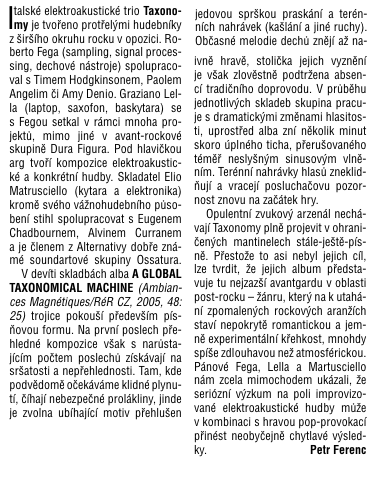
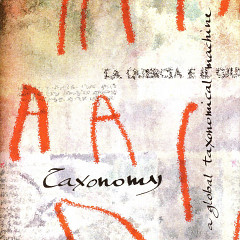
    A Global Taxonomical Machine in Altremusiche

    “Recensione”, Michele Coralli, Altremusiche, November 7, 2005
    Monday, November 7, 2005 Press

    La breve frase di una chitarra ripetuta e sporcata da una serie di disturbi elettronici che lentamente hanno il sopravvento sull’interno paesaggio sonoro di questa macchina tassonomica globale. Dietro al glitch si nasconde oggi tutto ciò che viene processato, ovvero allontanato da qualsiasi evocazione gestuale a tal punto da far scomparire l’idea stessa del musicista e suggerire invece quella di un’intelligenza artificiale che plasma la musica secondo un proprio disegno, razionale, quanto incommensurabile.

    Certe esperienze come quelle di Taxonomy (alias Elio Martusciello, Graziano Lella e Roberto Fega) andrebbero lasciate sedimentare a lungo (anni o decenni), prima di poterne trarne un qualsivoglia tipo di giudizio. Non si tratta di pusillanimità critica, bensì di consapevolezza della necessità di un maggiore distacco storico da molte di quelle esperienze estemporanee che si stanno adunando attorno alle apparentemente infinite possibilità dei processi di manipolazione digitale. Molte delle sperimentazioni che si compiono oggi sono da ascriversi in un contesto che trova l’inizio della propria storicizzazione in molte di quelle musiche del recente passato in stretta relazione con le innovazioni tecnologiche che hanno consentito di allargare le capacità percettive di una buona fetta di ascoltatori.

    Certo oggi il laptop senza il giradischi, i nastri Ampex, le valvole AEG e i circuiti modulari farebbero senz’altro un’altra musica, così come i Taxonomy senza Schaeffer, Cage, Riley, e… Marino Zuccheri. Ci sono costruzioni che però sembrano logiche, stabili, incrollabili pur nell’estemporaneità della loro edificazione (vedi l’Electro-Acoustic Ensemble), altre sfuggono il processo ricreativo che ognuno di noi innalza a Gestalt nell’ascolto di un lavoro anche complesso. Martusciello e compagni sembrano voler continuamente spostare l’angolo di tiro, per rendersi imprendibili e sfuggire ogni inquadratura.

    Una caratteristica del genere appartiene senz’altro ai grandi, anche se la creazione di una tassonomia basata sulla forza dell’errore può rilevarsi un progetto tanto utopico, quanto inutile, come già Pierre Schaeffer ha dimostrato con il suo tentativo, andato frustrato, di voler classificare tutti i rumori secondo decine e decine di categorie diverse. Anche la memoria di un laptop, o di mille laptop, per quanto umanamente non quantificabile, si pone come uno spazio segnato da un limite. Ma forse per capirne davvero le potenzialità si dovrà aspettare ancora.


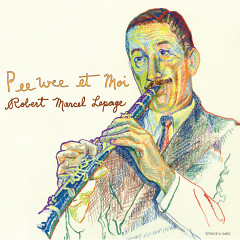
    Pee Wee et moi in AllMusic

    “Review”, François Couture, AllMusic, November 1, 2005
    Tuesday, November 1, 2005 Press

    Simply put, this is Robert Marcel Lepage at his best: witty, funny, acrobatic and jazzy. Pee Wee et Moi signals a return to the creative heights of La Traversée de la Mémoire Morte, Adieu Léonardo and Les clarinettes ont-elles un escalier de secours. The “Pee Wee” in question is clarinetist and band leader Pee Wee Russell. Here, Lepage pays tribute to the man in his very own special way: by assembling a seven-piece clarinet section playing Lepage originals written as Russell pastiches. The results are simply wonderful, pairing up Russell’s swing and idiosyncrasies with Lepage’s bouncy, let’s-break-the-rules-and-have-fun-while-doing-so style. His arrangements for the clarinet section are lush and inventive, with plenty of group playing and a judiciously small number of solos (it would have been nice to know who plays them, though). Besides Lepage, Guillaume Bourque, Jean-Sébastien Leblanc, André Moisan, Pierre-Emmanuel Poizat, Richard Simas and the Vancouver jazz mainstay François Houle handle the clarinets. Lepage did a wonderful job at reinventing Russell’s style and incarnating the master’s spirit into his own brand of music, but Pee Wee et Moi is also noteworthy for reasons slightly beyond Lepage: it marks guitarist René Lussier’s first appearance on an Ambiances Magnétiques recording since his late-’90s fallout with the label. And that is another reason to rejoice! Lussier’s wacky off-the-wall playing (often sounding like the missing link between Fred Frith and Eugene Chadbourne and heavily featured throughout the album. Bassist Normard Guilbeault and drummer Pierre Tanguay round up the impressive formation. The set list consists of 12 Lepage originals book-ended by two Russell covers, Pee Wee’s Blues and Muskagee Blues. The album is released in Ambiances Magnétiques “Jazz” series, but in spirit, it sounds closer to the label’s vintage “musique actuelle” sound of the ’80s and ’90s than any other release in that series. A late-2005 must-have.

    Simply put, this is Robert Marcel Lepage at his best: witty, funny, acrobatic and jazzy.

    Le bal in ImproJazz

    “Critique”, Luc Bouquet, ImproJazz, no. 88, November 1, 2005
    Tuesday, November 1, 2005 Press

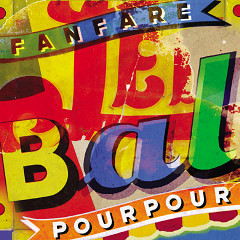
    Âgée d’une trentaine d’années et aujourd’hui rajeunie par l’arrivée de quelques trublions du collectif Ambiances Magnétiques (Jean Derome, Guido Del Fabbro, Normand Guilbeault), la Fanfare Pourpour n’a de fanfare que le nom. C’est en vérité un orchestre souvent redoutable, qui, s’il garde la nostalgie des valses d’antan, s’est ouvert à des sonorités et textures sans doute très éloignées de l’esthétique originale. Les bibelots sonores de Mademoiselle Rose, les traînées felliniennes de Gelsomina, les strates klezmer de La noce du brigand, le swing surréaliste de Coucou sont quelques-unes des belles réjouissances de ce disque. Rien de révolutionnaire ici mais à l’heure où fleurissent en France pléthore de fanfares (le plus souvent sans grande imagination), réjouissons-nous de la découverte de cette iconoclaste consœur québécoise.

    … un orchestre souvent redoutable, qui, s’il garde la nostalgie des valses d’antan, s’est ouvert à des sonorités et textures très éloignées…
  • 1
  • 2
  • 3
  • 4
  • 5
  • 6
  • 7
  • 8
  • 9