actuellecd

Blog

239 results
  • 1
  • 2
  • 3
  • 4
  • 5
  • 6
  • 7
  • 8
  • 9
  • Playing Guitar: Symphony #1 in L’Express

    “Ce jazz qui nous vient du froid”, Dominique Denis, L’Express, November 30, 2004
    Tuesday, November 30, 2004 Press

    Parfois, il faut laisser tomber le masque du critique, soit lorsqu’une réaction viscérale — et donc subjective — s’impose d’elle-même (ça m’est arrivé il y a quelques semaines avec le Requiem de Mozart, dans la magistrale version des Violons du Roy), soit parce qu’à défaut d’outils adéquats pour aborder une œuvre qui existe en marge de nos repères habituels, on serait condamné à dire des conneries.

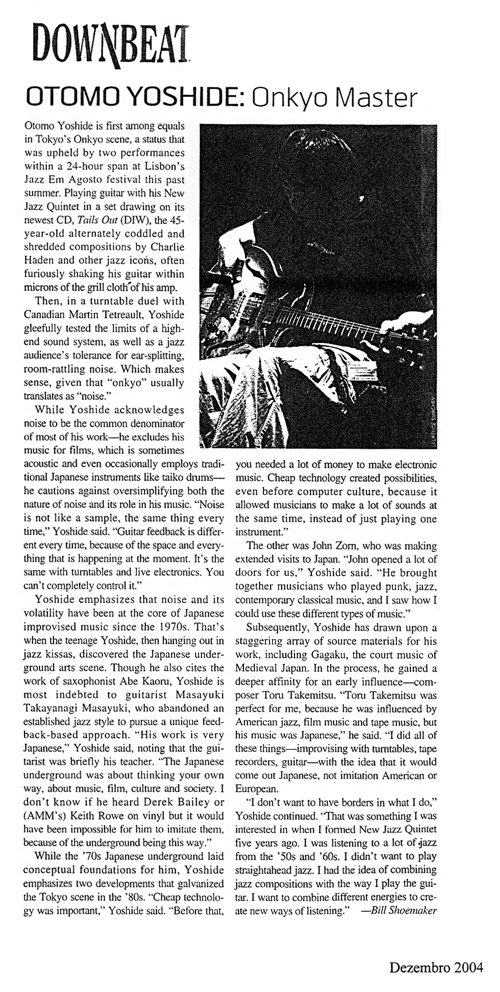
    Depuis un mois, je suis confronté à ce second dilemme, tournant autour de Playing Guitar: Symphony # I (Ambiances Magnétiques/SRI), de Tim Brady, fascinante composition pour guitare électrique et orchestre de chambre (le Nouvel Ensemble Moderne, sous la direction de Lorraine Vallancourt).

    Un mois que cette œuvre polymorphe me suit, servant de trame sonore à mes errances tororatoises, et la seule analogie qui me soit venue à l’esprit est la suivante: si le génial Bill Trisell, lui-méme guitariste sans frontières, s’était emplayé à réconcilier l’urgence rythmique du Sacre du printemps et la lumineuse transparenœ de La Mer, le tout pour les besoins d’un film de Hitchcock, il aurait peut-être pondu quelque chose qui ressemble à Playing Guitar.

    Mais là, on tombe en pleine conjoncture, comme disait l’autre, ce qui ne vaut guère mieux qu’une critique ratée…
    Bozzini Quartet in Los Angeles Times

    “Tenney’s visions brought to life”, Josef Woodard, Los Angeles Times, November 13, 2004
    Saturday, November 13, 2004 Press

    Composer James Tenney has claimed that he tries to avoid emotionality in his music, preferring to explore diverse experimental ideas. Yet on the evidence of the career-spanning “James Tenney at 70” concert Thursday night at REDCAT, dodging emotion is one goal he hasn’t entirely attained. A certain austerity hovers over his work, but the results are never served cold.

    Currently the music department chair at CalArts, Tenney has long been involved in avoiding the usual. He has delved into conceptual Minimalist ideas, mathematical procedures, just intonation, drones and chance operations, with affectionate nods to his hero and colleague John Cage. He has also pursued interests in acoustical and perceptual phenomena: how we listen as much as what we listen to.

    What might sound dryly intellectual on paper, however, came alive Thursday as the workings of a fine, elastic musical mind.

    In a compact this-is-your-life fashion, the program — featuring the Montréal-based Bozzini Quartet, who are Tenney specialists — leapt back and forth in time and styles. It even included the world premiere of a 1955 string quartet, written when Tenney was an obviously gifted, and obviously Bartok-copping, 21-year-old student. The solo Just a Bagatelle, played lucidly by violist Stéphanie Bozzini, was a rare trip into serialist writing, and the composer’s unexpected, astringent grace was intact here as well, showing a love of timbre and punctuating silences.

    Indeed, the careful-yet-freedom-loving Tenney touch governed the entire program, which was neatly framed by two versions of his piece Koan. The first, written in 1971 and played with illuminating care by Clemens Merkel on violin, is simple in design, haunting as a listening experience. Two tones steadily oscillate, one constantly shifting in near-infinitesimal pitch variations, creating an aural tension and the sense of a magnetic field in flux. Closing the concert was a string quartet version written in 1984, with the sonic and strategic plots thickened.

    Koan is one of Tenney’s Postal Pieces, its musical designs rudimentary enough to fit on a postcard. Another was Having Never Written a Note for Percussion, in which Danny Holt created a real-time arc of crescendo and decrescendo on the tam-tam.

    Ergodos II (for John Cage), from 1964, represented Tenney’s electronic music phase, when he worked at Bell Labs with engineer Max Matthews. It remains an effective example of electroacoustic music, featuring a quintet of live musicians engaging in delicate transitory dialogue with phantom electronics. In the string trio piece Harmonium #5, glimpses of logic and order keep abutting anarchic disjointedness. Harmonies happen, then disperse in a semi-random universe.

    Whether or not Tenney intends it, his music is engagingly meditative on more than one level, alluring in sound and thought.

    In a carreer-spanning concert featuring the Bozzini Quartet, Tenney’s specialists, the composer’s ideas are engagingly performed…

    Atlas Epileptic in AllMusic

    “Review”, François Couture, AllMusic, November 10, 2004
    Wednesday, November 10, 2004 Press

    This is certainly not a typical Ambiances Magnétiques release, but definitely a typical one for sound/video artist Pierre-André Arcand, whose previous efforts came out on the Quebec City-based imprint OhmEditions. Atlas Epileptic picks where Transfuge + Transfuge hadleft, down to reproducing the twin set format of audio CD + video CD. Where Transfuge was a transitional work, Atlas Epileptic is (sound-wise) much more assured and convincing. Arcand is using the same (a)technological toys, from his atavistic sounding book and ashtray to his “macchina ricordi” (a self-programmed piece of Max/MSP software). Once again the music evolves through a process of transformative accretionary loops, but this time around the sound palette is significantly more varied and the music more dynamicand responsive. Transfuge was a rather cold disc, while Atlas Epileptic displays a certain warmth, even though the listener still feels trapped inside an enormous machine built for the sole purpose offunctioning. Arcand’s heavily treated voice is still an important soundsource and is responsible for any Industrial Coil, Nurse with Wound, Einsturzende Neubauten references the press has made. But Arcand’s soundworld is much more abstract, self-contained and enigmatic than even the more experimental disciples of that genre. The audio CD presents nine pieces (total duration: 69 minutes). The 10-minute title track and the 16-minute Un Casino à la Radio are the highlights and represent some of theartist’s finest works. The video CD (viewable as a CD-Rom or DVD) contains 11 pieces for a total duration of 49 minutes. The music component, while not being exactly the same as what is found on disc 1, uses the same soundelements and at times consists of edits or reworkings of the same tracks.Arcand’s video art is much more limited than his music. His image bank is restricted to only a few themes (kaleidoscopes, objects with facial features, penises, and computer screens). His fondness for making videocaptures of live computer screens sketches an interesting paradox: the analog capture of digital displays as if they were paintings. But otherwise his experimental videos are of limited appeal. Their repetitiveness tends to over shadow the fact that the music is actually much more varied. Taken in small doses (like Le Muezzin de Mayabunder or Moultécrans, these videos set the music in different, stimulating contexts. In larger helpings Dividing by Zero is Good, L’Érotique du Désert, they become a “viewing experience” one is not keen on repeating.

    Le bal in Trad magazine

    “Critique”, Patrick Plouchart, Trad magazine, November 5, 2004
    Friday, November 5, 2004 Press

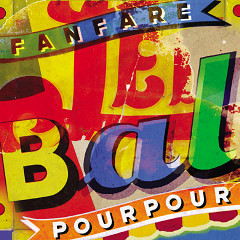
    Issu d’un libre regroupement de joyeux lurons qui paradaient déjà dans les rues de Montréal dans les années 70, et qui porta successivement les noms évocateurs de «Pouet Pouet Band» ou du «Montréal transport limité», c’est en 1995 que naît vraiment cette fanfare réunie uniquement pour le plaisir de rejouer ensemble. Ce deuxième CD, sorti en mars 2004 après cinq ans de leur première galette intitulée Tout le monde, est un vrai régal dans le genre… Les quinze musiciens, âgés entre 21 et 68 ans, au départ comédiens, graphistes, animateur radio, informaticien et retraités nous emportent au fur et à mesure de ce «bal imaginaire» dans leur univers «triste gai» des films de Fellini, Kurt Weill, Tati, Renoir ambiance de Caf’conc’ et de Band New Orleans, avec leurs compositions, mais aussi une reprise traditionnelle Cajun La valse du dimanche après-midi comme vous ne l’avez encore jamais entendue… Assez bavardé, vous l’aurez compris, je suis sous le charme de ce bal de la Fanfare Pourpour, et espère juste que vous le serez aussi comme moi, dès la première écoute. Alors! Prêt pour 67 minutes de grandes émotions?
    Alors! Prêt pour 67 minutes de grandes émotions?
  • 1
  • 2
  • 3
  • 4
  • 5
  • 6
  • 7
  • 8
  • 9