With two CDs to be released during the 2004-2005 season and his first opera, presented earlier this year, to be staged again, Tim Brady is certainly one of Canada’s most active musicians. But to top it all, he is also completing a second symphony and working on a second opera! Despite this whirlwind of activity he still found Time to answer La Scena Musicale’s questions.
Although Brady didn’t come to the guitar through the classical route or with an eye to concert works, he is nevertheless a recognized composer of contemporary music, and his works are performed by such prestigious groups as the English Guitar Quartet and the Nouvel Ensemble Moderne. Note that he almost exclusively plays the electric guitar, an instrument that is a virtual newcomer to the concert stage.
“It’s funny,” says Brady, “because forty years ago today [September 8,1964], the Beatles gave their famous concerts at the Montréal Forum. Clearly, like lots of baby-boomers, they are what made me want to play the electric guitar. And then of course there was rock, blues, and, when I was about eighteen, the discovery of jazz with guitarist John McLaughlin and his Mahavishnu Orchestra. My interest in McLaughlin led me to read, for example, an interview with him where he said he liked complex rhythms such as those of Bartók or Stravinsky. “Who’s he talking about?” I wondered. I did some research, and the first classical recordings I bought were The Rite of Spring and Boulez conducting Debussy’s music.”
Between the ages of eighteen and thirty Brady was leading two parallel lives: one studying jazz guitar and playing concerts in night clubs or festivals, the other as a classical composition student who won the CAPAC (now SOCAN) prize in 1981 (String Quartet No. 1), in 1983 (Piano Fantasy in Three Movements, Concertino for Orchestra), in 1985 (Lyric), and in 1987 (Variants), among others.
“In 1986 while spending thirteen months in London, I decided to try composing music that could represent the sum of my different experiences and musical influences — something that could take it all in, from the Beatles to Xanakis. It was the only thing to do, otherwise I’d have had to resign myself to a Jekyll and Hyde existence. As a result I play electric guitar (but also acoustic guitar sometimes, although I haven’t the classical technique, since it was out of the question to begin studying classical guitar at thirty). There aren’t many examples of classical-style composition using the electric guitar, but they do exist. Boulez uses one in Domaines [1968] for example. From the strictly technical standpoint, the electric guitar has a distinct advantage: it can be amplified. This is important when you’re playing with an orchestra. Unless I’m mistaken, when a classical guitar is used with orchestras today, it’s also amplified. So we’re all electric guitarists now!
“Again, in 1986, hardly any composers were working in chamber or orchestral music using the electric guitar. That’s probably what led me to become a composer. Of course, when I was younger I tended to copy the style of the greats, writing derivative Elliot Carter or playing like a counterfeit John Abercrombie. It was simpler to develop my own language in an almost virgin landscape than follow the well-trodden paths of dozens of composers. So I chose to become a genuine Tim Brady. At first I was so insistent on having my own musical language that I didn’t write a note that I couldn’t play myself. Today, let’s say, I allow myself a certain space for manoeuvring. If I want to write for the flute, for example, it’s impossible to do this adequately using a guitar. As a composer, I have to accept the fact that each instrument has a specific capacity.”
Music composed with the help of a guitar rather than a piano has a distinct difference. According to Brady, “It’s true that when I compose with the guitar, there’s far less counterpoint. The harmony is also more restrained, being limited to two, three, or four notes in a chord. However this is a stimulating restriction for a composer. Guitars also produce very rhythmic music, and their tuning allows for melodic lines that wouldn’t be natural on another instrument. Even when I compose with a keyboard I realize that I’m sometimes using intervals that belong to the guitar.”
Tim Brady’s music has been on our orchestral programs for some Time. He has been able to develop a style of writing that takes account of the special constraints of contemporary orchestras. “The Montréal Symphony Orchestra gave me forty-five minutes of rehearsal Time for Three or Four Days After the Death of Kurt Cobain in November 2002, conducted by Rafael Frühbeck de Burgos. I was being spoiled, because usually you get a lot less than that. The MSO interpreted my work superbly. You’ve got to be realistic when you work with an orchestra. Budget and union constraints are phenomenal. When you write for an orchestra you’re caught up in a huge historical and social machine. You can claim to write pure music without paying attention to the limitations of reality, but you’re asking to be disappointed if you do. I’m not talking of making compromises, of writing “simple music”, and so on, but you’ve got to know what you’re doing. Once you’ve accepted the constraints that come with an orchestra, you still have a fabulous instrument. There’s nothing like the experience of hearing ninety or a hundred musicians playing together!”
Today’s music
After a long association with Montréal’s Justin Time Records, which released eight of his recordings with various ensembles (Visions [1988], Double Variations [1990], Inventions [1991], Imaginary Guitars [1992], Scenarios [1994], Revolutionary Songs [1996], Strange Attractors [1997], and 10 Collaborations [2000]), Brady decided to move to “musique actuelle” specialist Ambiances Magnétiques. “I don’t think there’s a fundamental difference between my recordings for Justin Time and what I’m doing now, although of course my work is evolving to some degree. However, the recording market has progressed a great deal in the last twenty years. Around 2000 or 2001, on the part of both myself and Justin Time, which is run by people I admire, we felt that my music would perhaps not be well served in a catalogue that was becoming increasingly focused on jazz and mainstream. I won’t say there’s no jazz influence in my music, but all the same it wasn’t a natural association. By 1999, when I was touring to promote Strange Attractors, I also realized that everywhere I went, whether it be Australia or China, people were talking to me about Ambiances Magnétiques! I said to myself, these people know how to make music travel!”
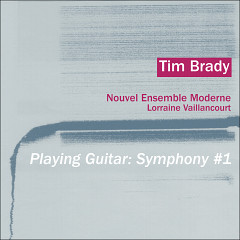
In 2002 Ambiances Magnétiques released Brady’s Twenty Quarter Inch Jacks, featuring the work of the same title for twenty guitarists. It won the Prix Opus for composition of the year for young audiences (at the awards ceremony the Conseil québécois de la musique also awarded him the Prix Opus for composer of the year). In 2003 Unison Rituals was released, bringing together recordings of Brady’s music by the saxophone quartet Quasar, the Kappa ensemble, and his own Bradyworks. Ambiances Magnétiques’ third Brady release is Playing Guitar: Symphony No.1, recorded with Brady and the Nouvel Ensemble Moderne (see p. 20).
Are these recordings closer to contemporary music than Brady’s earlier work? He is very clear about this: “For me, Strange Attractors or Imaginary Guitars are just as much contemporary music CDs as the recent works. All this music has been written down, and I’m even selling the scores. Obviously the use of electric guitar is a problem, as usual. It used to disturb me, but now I don’t think twice about it. People in record stores have had trouble classifying me for twenty years. I think that twenty-five or fifty years from now the electric guitar won’t be associated with rock or jazz as it is today, but simply for what it is: an instrument for playing all kinds of music. Actually, I believe the fact that there’s almost no guitar used in rap will help change people’s perception of it as a typically pop music instrument. A young guitarist registered in classical composition at McGill got in touch with me because he wanted to have the electric guitar as his main instrument. He was told it wasn’t possible, as there was no repertoire for it! He asked for my help, and was able to do an audition and be admitted. It’s a big step in the right direction. Percussion instruments had the same problem in the early twentieth century.”
Brady’s most recent CD features the Nouvel Ensemble Moderne with its enviable international reputation. This too is undoubtedly a step in the right direction. He has performed Symphony No. 1 with the Lorraine Vaillancourt Ensemble in Montréal, New York, and Marseille with great success, and a tour is planned for 2006-2007. “It wasn’t done consciously, but this work is a magnificent summary of my entire vocabulary, both as a guitarist and a composer. It was composer Michel Gonneville who made me realize, right after the première, that it wasn’t simply a concerto, but rather a work embodying symphonic thinking. I ended by accepting this approach when putting the CD together, and there we have my Symphony No. 1.”
Brady has kept the symphonic ball rolling. His Symphony No. 2 Fo(u)r Saxophones will be performed by the Winnipeg Symphony Orchestra and Quasar. “The WSO’s composer-in-residence, Patrick Carrabré, suggested that I write a work for orchestra and sax quartet, and I immediately agreed, because I’ve been thinking of it for years. He asked me for a twenty-minute work, and I allowed myself thirty-two. I suggested playing only the second and third movements for the first performance. The whole work can be performed later.”
Brady has also been attracted in recent years by the opera repertoire. His Three Cities in the Life of Dr. Norman Bethune, first presented in 2003 at Montréal’s Chapelle historique du Bon-Pasteur, will be staged in Toronto in January 2005, again with baritone Michael Donovan. In April 2005 a new opera will be mounted in Kitchener-Waterloo — The Salome Dancer, performed by four singers and six musicians. The libretto is by John Sobol, himself a musician and poet, with whom Brady began discussing the project in 1992. “The opera is already completed,” says Brady, “and John and I are already discussing the next one. By the way, I have four more in my head, two of which use a large orchestra.”
Some of Brady’s as yet unpublished works, performed by the Australian group Topology, will be released on a forthcoming CD by Ambiances Magnétiques. There’s no doubt that the guitarist and composer has the wind in his sails and that his boat is well launched and will travel far!

![Tim Brady [Photo: Laurence Labat]](https://res.electrocd.com/image.php/image/b/brady_ti.3.jpg?width=n2&cropratio=1:1)