actuellecd

More from the blog

10 results
  • 1
  • 2
  • Rebecca Bruton + Jason Doell: a root or mirror, blossom, madder, cracks; together in Take Effect

    “Review”, Tom Haugen, Take Effect, September 19, 2025
    Friday, September 26, 2025 Press

    Alissa Cheung, Clemens Merkel, Stéphanie Bozzin and Isabelle Bozzini, i.e. Quatuor Bozzini, come together with Stephanie Chua, Joseph Ferretti, and Elaine Lau, of junctQin Keyboard Collective, for these classically influenced pieces that don’t shy away from avant-garde ideas.

    Rebecca Bruton’s The Faerie Ribbon opens with 4 segments, where the unpredictable keys and atmospheric strings unfold with much beauty, curious ambience and even a haunting nature further on.

    The back half belongs to Jason Doell’s to carry dust & breaks through the body, where a single 20+ minute track comes with strategic droning, plenty of cinematic qualities and somewhat of an eerie intimacy.

    A highly creative outing that’s tonally aware, uniquely psychedelic and emits solos from many players that seem like one, every moment is engaging and artistic.

    A highly creative outing that’s tonally aware, uniquely psychedelic and emits solos from many players that seem like one, every moment is engaging and artistic.

    Rebecca Bruton + Jason Doell: a root or mirror, blossom, madder, cracks; together in Free Jazz Blog

    “Review”, Nick Ostrum, Free Jazz Blog, February 13, 2025
    Friday, February 14, 2025 Press

    Quatuor Bozzini, a string quartet featuring Alissa Cheung, Clemens Merkel, and siblings Stéphanie and Isabelle Bozzini, have been at the forefront of Canada’s new music scene for over two-and-a-half decades, now. Here, they are joined by the junctQín keyboard collective, a somewhat younger but well established and distinguished piano trio — that’s three pianos — consisting of Stephanie Chua, Joseph Ferretti, and Elaine Lau in a series of realizations of composer Rebecca Buton’s Faerie Ribbon and Jason Deoll’s to carry dust & breaks through the body. These and the album title, a root or mirror, blossom, madder, cracks; together, are evocative, but in their opacity and undefined suggestiveness. And maybe that is a fitting way to lead into the review proper. The music is suggestively enigmatic.

    Burton’s The Fairie Ribbon consists of four parts of glittery, romantic music that borders on the hymnic. At the same time — and maybe linked to that religious idea of calm, sacred space — it evokes an uneven saunter through a forest pathway with strings enveloping birdsongs just well enough to add an impressionistic mystery. As with any proper forest tale, it plays with light and dark, sometimes seeming more foreboding than carefree. (Leo Orenstein comes to mind in this blend of elements.) Long pauses separate the sections within each part, of which there are four. These mark transitions and escalations, but also mimic the detours and distractions of a light hike, where one stops to view a vista here, or a strange, colorful bird in a tree there, or an odd outcropping one may or may not want to risk exploring. After a quick glance, one returns to their thoughts, meandering along with the hiker’s uncertain path. The listener’s mind and attention is set wandering in a similar fashion, until, in the final part, the piece climaxes in a majestic moment of clarity.

    The second half, loosely speaking, of a root or mirror consists of a realization of a composition from Jason Doell. This one is somewhat darker than The Fairie Ribbon and relies on long doubled tones and slow progressions to achieve a sort of grandiosity. Slow melodies waft around a couple central dramatic leitmotifs. The melodies, meticulously excavated from what could otherwise have been a morass of chords, are heavy and plodding, almost menacing in their unison. But the piece shows its real power in the persistence of the drones, the heavy key strikes, the constant loop back to the foundational melody, the anticipation those elements engender. To carry dust is a strong piece, more linear than the itinerant Fairie Ribbon.

    In this release, we see two related but diverging faces of the many-sided dice of contemporary composition, inspired by various strands of the postwar new music, but avoiding the stark minimalist or cacophonist extremes. Composers Burton and Deoll are not alone in this pursuit, of course. However, they pursue it with a rare degree of skill and confidence. As do the Bozzini and junctiQin ensembles.

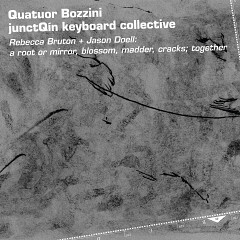
    The music is suggestively enigmatic.

    Rebecca Bruton + Jason Doell: a root or mirror, blossom, madder, cracks; together in The Intelligencer

    “Review”, David Reed, The Intelligencer, December 10, 2024
    Tuesday, December 10, 2024 Press

    Quartuor Bozzini is a respected string quartet, known for their love of contemporary music. The junctQín keyboard collective is a trio of pianists working for six-hand piano (meaning all three pianists are playing the same piano together).

    The two entities have merged for this latest release, celebrating and interpreting the music of Rebecca Bruton and Jason Doell.

    Bruton’s The Faerie Ribbon is a four-part suite. Part One is a percolating tapestry at the beginning, dissolving into moments of stark minimalism, and gradually rebuilding.

    Humming and whistling augment the gentler second part and the third part features only piano with extended silences. Part Four is a dense closing movement.

    Doell’s to carry dust & breaks through the body is a curious twenty-minute journey that finds the strings gradually detuning by a semitone over the course of the work, while the piano stays in tune. The resulting dissonance is uncomfortable (which is the point).

    Those who are unfamiliar with modern classical music may find this record challenging, but I would encourage the effort to try something new. A wise friend once said “we need to be comfortable with being uncomfortable.”

    … percolating tapestry at the beginning, dissolving into moments of stark minimalism, and gradually rebuilding.

    Rebecca Bruton + Jason Doell: a root or mirror, blossom, madder, cracks; together in The Strad

    “Review”, David Kettle, The Strad, October 25, 2024
    Friday, October 25, 2024 Press

    The Montréal-based Bozzini Quartet has long been a persuasive new music advocate, and this first vinyl release on its own label amounts to a quiet, quirky celebration of its country’s music and musicians. It’s a collaboration with the Toronto-based junctQín keyboard collective (here, three players at a single piano keyboard), and showcases two thoroughly distinctive Canadian composers.

    Rocky Mountains-based Rebecca Bruton mines folk-music sensibilities in her expansive The Faerie Ribbon, which unfolds like a series of brief vignettes observing similar material from contrasting perspectives. She conjures some uncannily beautiful sonorities using harmonies spread right across the piano’s range, plus an orchestral-style richness of double-stopped strings, and there’s a Reichian opulence to the piece’s closing sections, with reedy sustained string harmonies against chiming piano figures. The Bozzini plays with elegance and strong definition throughout, with singing, whistling and humming adding another magical dimension.

    By contrast, Canadian composer Jason Doell explores a fascinating and very simple idea in his to carry dust & breaks through the body. An apparently unchanging electronic drone slides lower by a semitone across the course of his piece. The string players adjust their tuning to it as the work progresses, while the pianists, naturally, can’t. The result is a compelling contemplation of sameness and difference, of out-of-tune-ness and dissonance (where does one end and the other begin?), delivered with wit and insight through slow-moving, subtle gestures and not-quite repetitions. The Bozzini’s account is magisterial, often cool and detached, but bristling with engagement, and supple in its shaping of Doell’s sometimes enigmatic phrases. It’s a rewarding release, captured in close, warm sound.

    … magisterial…
  • 1
  • 2