actuellecd

Jürg Frey: Continuité, fragilité, résonance

Jürg Frey / Bozzini Quartet, Konus Quartett

The chamber music of Jürg Frey is both quiet and unsettling. CD HotList

A special combination that of four strings and four saxophonists in Jürg Frey: Continuité, fragilité, résonance, a combination you rarely hear, but which allows Frey to create beautiful sound works. Nieuwe Noten, Netherlands

CD (ELSEWHERE 026, 2023)

  • This item is not available through our website. We have catalogued it for information purposes only.
  • You might find more details about this item on the Elsewhere website.

On the web

In the press

Review

Rick Anderson, CD HotList, February 5, 2024

The chamber music of Jürg Frey is both quiet and unsettling. Describing his long one-movement work, the aptly titled Continuité, fragilité, résonance, Frey writes: “the new piece will work with sound movements and stillness, but always develop these phenomena out of silence and lead them back into silence, thus creating its own acoustic reality of concentration and deepening.” One could argue that all musical phenomena develop “out of silence,” but in the case of Frey’s music this is psychologically as well as literally true. This piece in particular, written for an octet consisting of string and saxophone quartets, begins with near-silence and gradually swells to a sort of high mezzopiano, with extended instrumental lines layering and overlapping each other to create chords that are sometimes gently sad and that occasionally bristle with a quiet foreboding. Les Signes passagers, on the other hand, is written for solo fortepiano and consists of seven relatively brief movements. This music is very quiet as well, but here Frey is exploring the sonic world of an instrument known for its limited dynamic and timbral palette; instead of pushing its boundaries, he keeps things low-key — but there’s plenty of complexity in the delicacy of his compositions.

The chamber music of Jürg Frey is both quiet and unsettling.

Kritiek

Ben Taffijn, Nieuwe Noten, January 28, 2024

A special combination that of four strings and four saxophonists in Jürg Frey: Continuité, fragilité, résonance, a combination you rarely hear, but which allows Frey to create beautiful sound works. An entirely different work, then, from that ’Les Signes Passages’. Frey himself says about this piece: “Music can also have its starting point in silence, yes, even more, this silence can be the foundation of an entire composition. In this sense, the new piece will work with sound movements and stillness, but always develop these phenomena out of silence and lead them back into silence, thus creating its own acoustic reality of concentration and deepening.” And very special how those sounds here interlock, complement and overlap into impressive harmonic structures. There is hardly any melody here, and even less rhythm, but Frey still manages to captivate us as listeners with these clouds of sound. And as we get further into the piece, the diversity increases, the soundscape becomes more dynamic.

Translated from Dutch.

Original text

Een bijzondere combinatie die van vier strijkers en vier saxofonisten in Frey: Continuité, fragilité, résonance, een combinatie die je zelden hoort, maar Frey in de gelegenheid stelt om prachtige klankwerken te creëren. Een geheel ander werk dus dan dat ‘Les Signes Passages’. Frey zegt zelf over dit stuk: “Music can also have its starting point in silence, yes, even more, this silence can be the foundation of an entire composition. In this sense, the new piece will work with sound movements and stillness, but always develop these phenomena out of silence and lead them back into silence, thus creating its own acoustic reality of concentration and deepening.” En heel bijzonder hoe die klanken hier in elkaar grijpen, elkaar aanvullen en overlappen tot indrukwekkende harmonische structuren. Van melodie is daarbij nauwelijks sprake, van ritme al helemaal niet, maar Frey weet ons als luisteraar toch sterk te boeien met deze klankwolken. En naarmate we verder komen in het stuk neemt de diversiteit toe, wordt het geluidsbeeld dynamischer.

A special combination that of four strings and four saxophonists in Jürg Frey: Continuité, fragilité, résonance, a combination you rarely hear, but which allows Frey to create beautiful sound works.

Review

Massimo Ricci, The Squid’s Ear, September 25, 2023

It is incredible how multiple attempts to analytically justify a given piece of music can produce the opposite effect, perplexing the listener in the face of a very plain message, communicated by the music itself to every sensible individual. This happens quite frequently when one tries to verbally delimit compositions of the Wandelweiser persuasion, of which Jürg Frey is a renowned representative.

However, in the midst of an admirable quest for catching the butterflies of intangibleness during an interview with Yuko Zama, founder of the Elsewhere label, the composer himself scatters around a few clues to the interpretation of Continuité, fragilité, résonance. In one of those moments, Frey says that it is possible, in this work, to perceive the fragility of continuity, precisely because — in the first place — a true concept of continuity is not really being asserted. That continuity — according to French philosopher Gaston Bachelard, to whom Frey refers — is provided by the audience’s emotional resonance.

Utterly deprived of substantial outcomes, we could reason about some fascinating possibilities for hours. What is left for those who barely tolerate redundancy is to hear the physical resonance for themselves, in this case delivered by the string and saxophone quartets for which the score was designed: respectively, Quatuor Bozzini (Clemens Merkel, Alissa Cheung, Stéphanie and Isabelle Bozzini), and Konus Quartett (Fabio Oehrli, Jonas Tschanz, Christian Kobi and Stefan Rolli).

By integrating all of the suggestions he developed, Frey did an outstanding job of bringing the paired ensembles to an optimal level of timbral and contrapuntal integration. The underlying objective of this kind of composition, as it seems, is to achieve an equilibrium of shapes and more or less conspicuous harmonic motions within an overall state of stillness, the inner as well as the external. Due to the pristine grace of specific chordal overlays and the vibrational effectiveness of some clusters, selected passages of this 51-minute opus caused this writer’s head to rise, and ears to perk up. The sounds murmur to the unclouded ear the answers that an overly intellectual mind might not find, much less process.

Ultimately, this is gorgeous sonic matter that adjusts to any environment and listening setting. It is a testament to the time and energy that both the composer and the interpreters invested in it. Simply accept it as a gift, without even considering its conceptual dressing.

Ultimately, this is gorgeous sonic matter that adjusts to any environment and listening setting. It is a testament to the time and energy that both the composer and the interpreters invested in it.

Review

Bill Meyer, Dusted Magazine, July 6, 2023
A listener should come to this music prepared to have their sense of time gently but effectively disrupted.

Review

Eyal Hareuveni, Salt Peanuts, June 27, 2023

Swiss composer Jürg Frey explains the essence of his new, most beautiful composition Continuité, fragilité, résonance he has written in 2020-2021 for octet, the double quartet of the Montréal-based string Quatuor Bozzini and the Bern-based saxophone Konus Quartett: «In movement, music has an energy that moves forward, in stillness, music sinks into the vertical depth of the moment. Music thrives on this dynamic contrast, and the special moments of stillness in composition have fascinated and touched composers time and again throughout the centuries. Music can also have its starting point in silence, yes, even more, this silence can be the foundation of an entire composition. In this sense, the new piece will work with sound movements and stillness, but always develop these phenomena out of silence and lead them back into silence, thus creating its own acoustic reality of concentration and deepening».

The two quartets have premiered other works of Frey’s in the past and have a deep understanding of the composer. This 51-minute composition was premiered by this ad-hoc octet in September 2021 and was recorded a year later, with the presence of Frey during a three-day recording session at the Auditorium of Zentrum Paul Klee in Bern in August 2022. The time that has passed between this composition’s premiere and its recording contributed to Frey, Quatuor Bozzini and Konus Quartett deep understanding of its sonic possibilities. Needless to add, the performance of the octet is masterful and excels with its mature and sensitive musicianship.

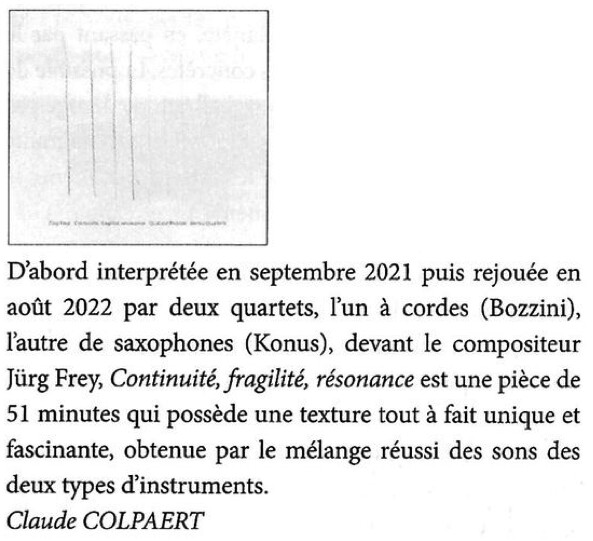
Frey also did the suggestive artwork, a watercolor drawing of eight straight lines, apparently made years before composing the new work but reflecting its clean, almost transparent sounds and the layered yet spacious interactions of the double quartets and capturing its profound contemplative spirit. The long lines that the two quartets play are elusive and stress the standstill, the almost abstract flow of time. Time becomes an elastic entity, time as continuity and time as fractured, vertical moments. Therefore the title of the composition: Continuité is the continuity in the timeline. Fragilité says this timeline is not a given fact. And with Résonance, time goes in different directions, also backward, or vertical. But the subtle shifts, the delicate and vulnerable timbres with its rare harmonic depths do not assert and proclaim continuity. They make it possible to experience continuity as something very fragile, transient as all living things.

… the performance of the octet is masterful and excels with its mature and sensitive musicianship.

Review

Bruce Lee Gallanter, Downtown Music Gallery, June 2, 2023

Swiss born composer and clarinetist, Jürg Frey, is a member of the Wandelweiser Group, an international collective of composers currently based in Austria who specialize in “silent music”. This piece, Continuité, fragilité, résonance is performed by two quartets, a string quartet called Quatuor Bozzini and a sax quartet called Konus Quartett. I know of the Quatour Bozzini from their work performing the music of James Tenney, Steve Reich and Jean Derome / Joan Hetu. They’ve also worked with Mr. Jurg previously recording his string quartets. I only know of the Konus Quartet from their performance of a disc by Salvatore Sciarrino.

Continuité, fragilité, résonance is one long piece of around 51 minutes. I had to turn off the fan in my kitchen window so that there would be no distractions other than the music itself. The cello creates a short pulse at the center when the piece begins. The strings are static, hovering and remind me of the way Morton Feldman creates subtle sounds which seem to unfold organically as if they were nature itself speaking to us, the way the wind often does. The saxes and strings are both creating drones or long notes. Since many of the notes are carefully stretched out, we can observe the way each note resonates. The overall sound is similar to a church organ, the long notes have a calming effect. I find this music to be somewhat fragile yet, precise or focused with each note or line evoking an ongoing series of floating feelings or vibrations. About half way through, the pace picks up a bit and we feel more anxious, the sound gets a bit more dense. There is something refreshing, uplifting going on here, as if we are being warned for something coming up. As the tempo of a string pulse speeds up, the calmness at the center evaporates and the vibe becomes more eerie. The blend of the saxes and strings sound like an accordion or even a harmonium at times. What I like most about this is that every note or line of notes evokes a feeling within us. The shape and texture of each sound is thoughtfully planned and played. Even at 51 minutes, the disc seems to go by quickly, rustling up a blend of haunting vibrations.

What I like most about this is that every note or line of notes evokes a feeling within us.

Critique

Claude Colpaert, Revue & Corrigée, no. 136, June 1, 2023
Continuité, fragilité, résonance est une pièce de 51 minutes qui possède une texture tout à fait unique et fascinante, obtenue par le mélange réussi des sons des deux types d’instruments.

Review

Marc Medwin, Point of Departure, May 29, 2023

There is a very real sense in which, never mind any rhetoric to the contrary, the Romantic era never ended. Nowhere is that more apparent than on this new offering from Elsewhere. Of course, the situation is slightly more complicated, but elongate the opening bars of Mahler’s fifth symphony’s Adagietto, the music just before the melody enters, to get an idea of Continuité, fragilité, résonance’s sonic weightlessness. Jürg Frey’s music often dwells in anti-gravitational areas, whether he’s working with instruments, field recordings, or some combination of electronic and acoustic sounds, but this 51-minute palimpsest for strings and saxophones, both in quartet, adds a layer of repetitively skewed Romanticism to the normal convergences, divergences, and their attendant silences, all realized with requisite grace and power by Quatuor Bozzini and the Konus Quartett.

It’s difficult to gauge which is more delectably serene, the music or the performance. A degree of interdependence is obvious. Certainly, both the participants’ familiarity with Frey’s work and his presence at the 2022 recording sessions elicit spellbinding results, but the composition’s malleability affords opportunity for expansion and restraint of many varieties. It could be that Mahler’s appearance in the wings results from the textural variance at play throughout. The pointillistic opening, with its pizzicati and interregistral fluctuations, offers no hint of the thirds in sustain at 1:19, soon to evaporate into single pitches even though the pizzicato gesture remains. The opening music is in fact repeated at 0:55, a temporal disjuncture indicative of the immersions to come. As for sustain, it recurs in various iterations as the amoebic music proceeds. Listen to the vast harmonic vista at 3:04, another third at 5:32 or to the especially long elastic thirds beginning at 14:43 to hear the stasis in astonishing flux. At 42:22, the formerly lush sonics are reduced to a single repeated pitch then changes to a bit of string monody before fanning back out into multivalent sonority. However, at least in the first sustains, the pizzicato remains as both a reminiscence and an implication. Sustain is complemented by extremes of sonority and silence, as with the swells occurring after the half-way point and the silences at 26:54 or a more extended pause at 40:16.

As is so often the case, the constituent parts comprise a much larger and certainly more redolent whole. The recording and production are superb, as is the case with every Elsewhere release, and they function in such a way that the performance brims with detail and with raw power in all the right places. Beyond that, each instrument blends with every other to create the lush interweaving of tone and timbre necessary for the various disassemblages and reconstructions to become an audible part of the narrative. It’s that narrative that makes this and Elsewhere’s other Frey releases so successful. Strings and saxophones often blur to the point of indistinguishability but also separate when the moment of emphasis is right. The beauty of this rendering demonstrates just how far we’ve come from the brutality and understandable but regrettably myopic micromanagement heard in so many “new music” recordings of the 1950s and 1960s. As the music has expanded in terms of temporal scope and historical reference, its performance is finessed in equal measure. It is difficult to imagine the composer’s versatility being better served, both in the present work’s sinewy structures and in general by the always estimable Elsewhere label. If this release entices, the Elsewhere and Erstwhile catalogs offer an excellent overview of a unique and ever-evolving compositional voice.

… all realized with requisite grace and power by Quatuor Bozzini and the Konus Quartett.

Review

Ben Harper, Boring Like A Drill, May 26, 2023

If you’re familiar with Frey then it all starts to sound a little too familiar, until you start to think about the instruments and realise you’re hearing them as a composite, neither in a functionally expressive role nor as pure “sound in and of itself”. Frey has reached a point where he employs techniques from previous generations of forward-thinking composers in ways that still sound fresh without reducing the instrument’s role to that of a vehicle for transmitting either pitch at one theoretical extreme, or timbre at the other. Elsewhere’s latest disc of Frey’s music is the 51-minute chamber ensemble work Continuité, fragilité, résonance. Completed in 2021, the piece reunites tow of his repeat collaborators, Quatuor Bozzini on strings and Konus Quartett on (don’t panic) saxophones. Frey has composed quartets for each before, and now he has meshed the two together in this expansive work, with no compunction about letting the full ensemble flow, nor with restrictions on the instruments’ inherent sonorities. In Frey’s own intimate way, it maintains the heft and sweep of a chamber symphony, laying on phrase after phrase of ensemble playing and steadily building things up to an inverted climax where the music suddenly stops. An extended, slightly muted coda follows, which simply ends without a resolution. Does it sound too full? It’s not correct to say that Frey is getting indulgent, for he has been so before, only in his earlier work it was with silences and repetitions. These pieces aren’t breakthoughs or revelations like I Listened to the Wind Again is, but they serve as a consolidation of his art.

In Frey’s own intimate way, it maintains the heft and sweep of a chamber symphony, laying on phrase after phrase of ensemble playing and steadily building things up to an inverted climax…

Review

John Eyles, All About Jazz, May 19, 2023

Released in the year of Jürg Frey’s 70th birthday, Continuité, fragitité, resonance marks his fifth appearance on Elsewhere, in a discography of around fifty albums on various labels also including Another Timbre, Edition Wandelweiser and his own B-Boim records. In line with his recent albums, Frey does not play but is the composer of the album’s sole composition, the title piece which was written in 2020-21. A glance at the Edition Wandelweiser score catalogue shows this composition to be Frey’s one-hundred-and-eightieth since he began in 1984.

Recorded at the Auditorium of Zentrum Paul Klee in Bern, Switzerland, from 9th to 11th August 2022, in the presence of Frey, the continuous, 51-minute piece was played by the Montréal-based string quartet Quatuor Bozzini and the Bern-based saxophone quartet Konus Quartett who together had premiered the piece on September 3rd 2021. Frey says that, more than for many other of his pieces, the one-year gap between the premiere and the recording was welcome as it gave the players time to understand the complexity of the piece and to give more depth, more context and more colours to it.

The combination of two violins, viola, cello and four saxophones—soprano, alto, tenor, baritone—blends well, with the eight players combining to create a constantly evolving soundscape of single, sustained notes overlapping and complementing one another. In particular, all the saxophones sound like those in an orchestra rather than a jazz band. The piece fits Frey’s description and title as it displays continuity, fragility and resonance in abundance. It is one of Frey’s best. Praise indeed.

Elsewhere’s successful streak continues…

It is one of Frey’s best. Praise indeed.

The Best Contemporary Classical on Bandcamp: April 2023

Peter Margasak, Bandcamp Daily, May 1, 2023

Some of the most indelibly gorgeous music by Swiss composer Jürg Frey has been written for different sorts of quartets, and this stunning new work enlists two of the finest such ensembles he’s worked with: the strings of Montréal’s Quatuor Bozzini and the saxophones of Bern, Switzerland’s Konus Quartett. As with all of his work, the music emerges from silence and retains a meditative stillness even when lines begin to intersect and harmonies blossom. As the composer notes in an interview with Elsewhere Music’s Yuko Zama, the various notes each musician plays are quite simple “but it takes time for a performer to understand the music and the context of these single notes.”

Indeed, the architecture is constantly, patiently shifting, with new combinations emerging at a steady but leisurely clip. A foundation of sumptuous, floating long tones seems to nourish spry bits of counterpoint that evolve, gaining complexity, as the 50-minute composition unfolds. Each new section unleashes a universe of harmonies, alternately characterized by ethereal beauty, dramatic beating, and spooky portent. Frey’s masterful writing blurs the seemingly distinct sound worlds of strings and reeds, not only making it hard to tell which is which, but often evoking the sounds of other instruments, whether organ or brass. It’s a work of profound depth and beauty as ravishing as anything in Frey’s vast œuvre, and it reinforces the fact that as he approaches his 70th birthday next month, his vision is undiminished.

It’s a work of profound depth and beauty as ravishing as anything in Frey’s vast œuvre…

Review

Keith Prosk, harmonic series, May 1, 2023

Isabelle Bozzini, Stéphanie Bozzini, Alissa Cheung, and Clemens Merkel and Christian Kobi, Fabio Oehrli, Stefan Rolli, and Jonas Tschanz perform the Jürg Frey composition for string and saxophone quartets on the 51’ Continuité, fragilité, résonance.

Clear thematic segments transition from one to the next seamlessly. Voices enter staggered and drift to sound all together, flowing and ebbing between a melodic propulsion and harmonic gyre. Beats of discrete tones root sustained ones, beating, and this recurring pairing lends a sense of circularity to sounds’ unfolding. Sound and silence sometimes reverse roles and the former assumes the stasis and depth of the latter with sustain. Even the two disparate quartet textures can blur like the cover watercolor could play at the simultaneous bucketing of yellow and green and their contiguous relationship on the visible spectrum. Always a dynamic equilibrium between two limits and at their tipping and intertonguing generate moments of stirring emotivity.

Always a dynamic equilibrium between two limits and at their tipping and intertonguing generate moments of stirring emotivity.

Recensione

Michele Palozzo, Esoteros, April 4, 2023
… the well-known Quatuor Bozzini and Konus Quartett — a sort of unprecedented dream team of radical minimalism — demonstrate an interplay dense with “vertical” virtuosity, cultivating with carefully weighed gestures a climax that is only perceived at its full completion, in revealing for a few moments the secret of a score permeated with grace.

Review

Spencer Cawein Pate, The Light of Lost Words, March 23, 2023

At this point in his musical career, composer Jürg Frey seems incapable of writing music that is not beautiful. His work has undergone a process of refinement to where it has become something like an aeolian harp; it is so finely tuned that even the brush of an errant breeze plucks notes from the air, condenses harmonies out of silence. Had Hermann-Christoph Muller not minted the phrase “the emancipation of the consonance” to describe the music of Howard Skempton, it could just as easily apply to that of Jürg Frey. And yet, as Michael Pisaro-Liu reminds us in his thoughtful essay included with the liner notes to Lieues d’Ombres (Elsewhere, 2022), Frey’s art is anything but effortless; it requires care and consideration, every note placed with an exactitude borne of patient listening, every repetition timed precisely according to an internal clock. And upon those repetitions are we borne back to the same place we began, but somehow transformed, made subtly different by the experience.

Frey’s glimmering, evanescent compositions for piano, like L’Air, l’Instant (Elsewhere, 2020) and the aforementioned Lieues d’Ombres best exemplify his minimalist tendencies (in the lowercase, literal sense of minimalism) — they seem transparent to the thoughts of their interpreters — but his chamber pieces, as collected on Grizzana, Ephemeral Constructions, Fields, Traces, Clouds, and Borderland Melodies, are more dynamic and direct. This music is so difficult to discuss precisely because of its unapologetic, unadorned beauty. I’m reminded of a quote from Auguste Rodin: “The dazzling splendor revealed to the artist by the model that divests herself of her clothes has the effect of the sun piercing the clouds.” What original observations can a critic possibly make about a sunrise or a nude, other than to make faltering, fumbling attempts to describe the blinding radiance revealed by her disrobing, its unveiling?

But nevertheless we must try. Frey’s chamber work privileges long, drawn-out tones that are allowed to swell and decay naturally, but it is emphatically not drone music—there is nothing aimless or aleatoric about its progression (which often proceeds in the manner of a canon). Instead, Frey is continually setting into motion shifting centers of (un) stable equipoise (“fragile” is by far the most frequently recurring word in the titles of his compositions); he is interested in capturing an illusionistic quality of flickering shadow and dappled shade. On the aforementioned albums, those curving, overlapping long tones are balanced against more delicate melodic fragments and electroacoustic textures. Rather than invoking fragility, however, they suggest fortitude in the face of melancholia, evoke a solitary traveler who wanders but is not lost. The hushed, heavenly Fields, Traces, Clouds (Edition Wandelweiser, 2019), is one of my favorites of Frey’s recent releases: listening to it is perhaps the closest I’ve come to experiencing Stendhal Syndrome. Played to perfection by the Ordinary Affects ensemble, the music is so light, and suffused with light, as to become vaporous and porous, with field recordings of an early morning city walk peeking through the eponymous clouds of sound.

Frey’s newest release on Elsewhere, Continuité, Fragilité, Résonance, is his boldest and most colorful chamber piece yet: an unusual octet for strings and saxophones played by Quatuor Bozzini and Konus Quartett. (Be sure to read Yuko Zama’s in-depth conversation with Frey on the Elsewhere website.) The deservedly celebrated Quatuor Bozzini had previously recorded Frey’s string quartets for Edition Wandelweiser (2006 and 2015); Alex Ross compared these to a “Mahler Adagio [… ] suspended in zero gravity,” which is strikingly similar to my own mental image of an untethered hot air balloon or a wind-blown circus tent. I am less familiar with the Konus Quartett, but I have heard their fine performance of Chiyoko Szlavnics’ intriguing “During a Lifetime” on her album of the same name (Another Timbre, 2017).

While many of Frey’s earlier pieces were cyclical in nature (hence his “Extended Circular Music” series), Continuité, Fragilité, Résonance sets out in a dramatic new direction: rather than finding change within stasis (and vice versa), it embraces a gentle blossoming of growth and the gradual surfacing of motion. Because of its concern with repetitive / iterative structures, the album could thus be considered Frey’s most sustained engagement with capital-M Minimalism. Its instrumentation and tone distantly recall spiritual free jazz (albeit at a much slower, calmer tempo); where Grizzana and Borderland Melodies (Another Timbre, 2015 and 2022) were alchemical weddings of air and earth, Continuité, Fragilité, Résonance is cleansing water and elemental fire. It is one of his most active, complex, vibrant, luxuriant, and moving compositions, as well as one of his loudest and longest chamber works at fifty-one minutes.

We can examine its form and content by analyzing the three words that comprise the title. First, (dis) continuity. Initially, it’s surprisingly challenging to the disentangle the entwined voices of the violins / viola and the horns, as their glistening timbres are so unadorned and pure. A phrase might begin with Quatuor Bozzini, continue with Konus Quartett, and then conclude with both groups playing in unison; each musical cell is often punctuated a resounding bass note or terminated with a brief silence. The piece gradually opens up, overflows outward, as the octet commingles and melds together into a blurred harmonic mass, with solo instruments and melodic lines rising forth from and sinking back into the stillness of the whole. Next, fragility. As time passes, the two units drift apart again—the strings alternating between grainy whispering and shivering arcs-en-ciel, Bozzini’s agitated dissonance pushing and pulling against Konus’ languid tides, while the ascending saxes perorate skyward, sketching vapor trails through the atmosphere and scraping the empyrean but never quite escaping Earth’s gravity. The mood is one of yearning for transcendent completion, sacred love. Where Frey’s earlier works resolve (or dissolve) into a newfound equilibrium, this one ends with an actual recognizable climax. Finally, resonance. The juxtaposition of sax and strings creates a shimmering effect, like a wave that is simultaneously approaching and receding, and the stereo separation between them affords the listener a vivid, physical sensation of circulating, vibrating air. The two quartets tangle and swirl together in the middle of the sonic field, constructive and destructive interference playing out before our ears.

Continuité, Fragilité, Résonance signals a surprising evolution in Jürg Frey’s œuvre and uncovers the depth of his roots in the classical tradition. Of his recent chamber works, it is the least characteristic of the now-familiar Wandelweiser aesthetic of quietude and patience, but it remains faithful to the Wandelweiser ethic of finding beauty and nuance in simple materials and ideas. Oceanic in scope and feeling, Continuité, Fragilité, Résonance is perhaps Frey’s most nakedly emotive composition, but it leaves us with an afterglow of ecstatic communion rather than with a tragic catharsis. It wraps its way around your heart and squeezes.

The deservedly celebrated Quatuor Bozzini had previously recorded Frey’s string quartets for Edition Wandelweiser (2006 and 2015); Alex Ross compared these to a “Mahler Adagio [… ] suspended in zero gravity,” which is strikingly similar to my own mental image of an untethered hot air balloon or a wind-blown circus tent… It is one of Frey’s most active, complex, vibrant, luxuriant, and moving compositions, as well as one of his loudest and longest chamber works at fifty-one minutes.