actuellecd

More from the blog

13 results
  • 1
  • 2
  • 3
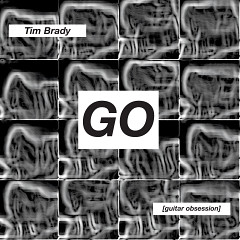
  • GO [Guitar Obsession], Concentrés et amalgames, 3, Sextant in Signal to Noise

    “CDs”, Kurt Gottschalk, Signal to Noise, no. 46, June 1, 2007
    Friday, June 1, 2007 Press

    Montréal’s Ambiances Magnétiques has released some 169 records since 1984 with a pretty remarkable batting record. The original members of the collective (including Jean Derome, René Lussier, Martin Tétreault and Danielle Palardy Roger) have for the most part continued to do challenging work, while younger musicians have been brought into the fold.

    Tim Brady is a talented guitarist with a rockish sensibility and plenty of jazz chops. He loves his instrument the way Jasper Johns loves paint: thick and apparent. His 2002 release Twenty Quarter-Inch Jacks was, in that sense, wholly satisfying. As is, in a certain way, his new offering, GO. It’s diverse, it’s raw, it’s pretty, it’s precise. Four compositions of his own and four by others, all strong but as a whole uneven. The disc feels as if Brady is trying to show off many approaches and styles he can pull off. And pull them off he does, so well that it sounds as if it could be a compilation album.

    Likewise pianist Gianni Lenoci’s wandering sextet record Sextant. At center, the group is a traditional enough line-up of keyboards, guitar, bass, drum and two saxophones, although the keyboards and guitars are sometimes electronically augmented. Two tracks not penned by Lenoci are Eric Dolphy’s Miss Ann and Morton Feldman’s Intermission VI. Lenoci’s pieces seem to follow the two worlds, skipping between minimalist and jazzy pieces, generally strong tracks, but ultimately seeming to be more a display of diversity than creating a unified feeling.

    The same charge could be leveled against clarinetist Lori Freedman’s new CD, culled from three nights of live performances with different trios. The difference here is that the record is exceptional regardless of her motives. A set with guitarist Lussier and turntablist Tétreault is a fascinating, warm rumble. A matchup with saxophonist Derome and guitarist/percussionist Rainer Wiens is strangely moody with touches of spaghetti western. And with percussionist Roger and bassist Nicolas Caloia she explores quiet, extended-improv techniques and jazzier explorations. Despite the different sources, the album holds together surprisingly well.

    A different sort of project is presented on the guitar duet by Arthur Bull and Daniel Heïkalo. It’s the sort of bashing-of-minds improv one would expect to find, at this point, in clubs and cafés around the world — busy, sometimes riotously so, and introspective, as if some personal space is being invaded simply by listening. Whereas the other discs ask to be listened to, Bull and Heïkalo seem forever to be changing the subject because a listener walked in.
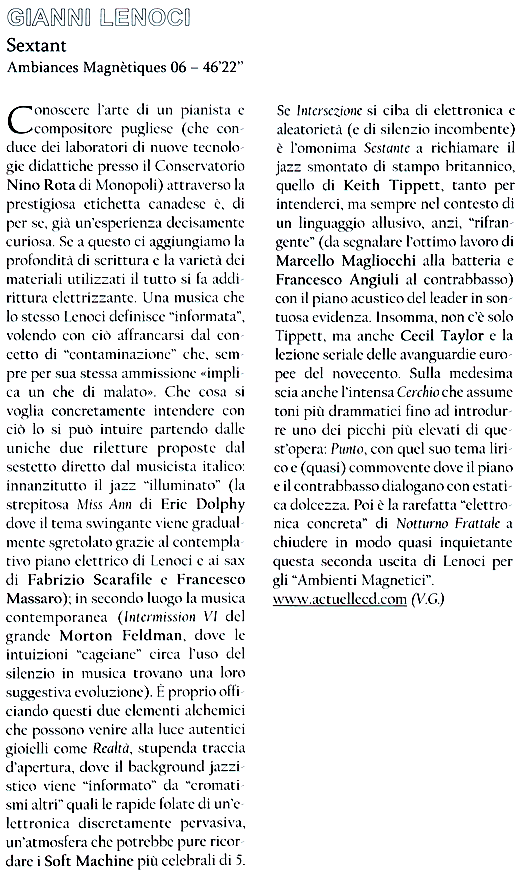
    Sextant in Downtown Music Gallery

    “Review”, BLG, Downtown Music Gallery, June 1, 2007
    Friday, June 1, 2007 Press

    Sextant — the second release by Gianni Lenoci on Ambiances Magnétiques — was born out of the new teaching methodologies’ workshops given by the Italian pianist at Nino Rota Conservatory in Monopoli. Lenoci’s experiments cover a large musical territory in which jazz draws inspiration from contemporary music. Acoustic and electronic instruments meet in harmony to form a highly dynamic whole. Here is how the artist explains his approach: “For years now, my main focus has been to try to create music that is not ‘contaminated’ but rather ‘informed’ and intelligent. Multiple and multifaceted music, yet coherent music nonetheless. Organic music made with gestures shedding light on the unclassifiable areas of language.”

    Sextant in All About Jazz Italy

    “Recensione”, Pierpaolo Faggiano, All About Jazz Italy, February 12, 2007
    Monday, February 12, 2007 Press

    Musica complessa, colma di specchi, di riverberi e di ombre che sembrano riflettere se stesse. Questa l’atmosfera che si respira in Sextant, sorta di messa a punto delle ricerche che il pianista pugliese conduce all’interno del “Dipartimento di Jazz, Improvvisazione e Musiche del nostro tempo” presso il Conservatorio di Monopoli. Una ricerca che copre un vasto territorio musicale in cui il jazz trae nuova vita dalla musica contemponanea, gli strumenti acustici si fondono con i sintetizzatori, il rumorismo sperimentale convive con il post-bop. “Il mio principale problema artistico da anni consiste nel tentare di generare una musica che non sia ‘contaminata’ (termine che implica un che di malato), nonostante le ineluttabili stratificazioni a cui l’epoca post moderna ci induce, bensì ‘informata’ ed ‘intelligente’” ci ha confidato Lenoci. Dunque, il pianista non rinuncia a quanto sul piano comunicativo offre la post-modernità. Anzi, lo sfrutta, lo piega, cerca di forgiarlo a misura d’uomo. Ne nasce una sorta di “future-jazz”, in cui il materiale tematico (sia esso scritto dal pianista o un frammento di Monk o di Porter) subisce continue dilatazioni, stratificazioni e permutazioni. Esemplare in questo senso il trattamento riservato a Miss Ann di Eric Dolphy o a Intermission IV di Morton Feldman. Lenoci non è solo in questa sorta di “work in progress”: lo assecondano alcuni dei suoi migliori allievi e un compagno di lungo data a lui molto vicino per sensibiltà: il batterista Marcello Magliocchi. (3/5)

    3

    Sextant in Musica Jazz

    “Recensione”, Angelo Leonardi, Musica Jazz, no. 63:2, February 1, 2007
    Thursday, February 1, 2007 Press

    I vari ambiti della ricerca musicale di Lenoci si susseguono in questo bel lavoro nato nei suoi laboratori didattici al conservatorio di Monopoli, nel settembre 2004. La musica (con Lenoci, La Volpe alla chitarra, Massaro al contralto e baritono, Scarafile al soprano, Angiuli al contrabbasso e Magliocchi alla batteria) spazia da riferimenti alle avanguardie statunitensi degli anni Sessanta e Settanta (il Davis elettrico, Dolphy e quant’altro) alla ricerca contemporanea di derivazione classica fino alla sperimentazione che va dal camerismo astratto all’estetica aleatoria.

    Sextant in Vital

    “Review”, Dolf Mulder, Vital, no. 555, December 7, 2006
    Thursday, December 7, 2006 Press

    Sextant is the second cd by this Italian composer and improvisor for Ambiances Magnétiques. In 2003 he recorded a cd of improvised duets with Joëlle Léandre. Now he returns with a totally different multifaceted album of nine compositions for a small ensemble. They originated from workshops given by this italian pianist at Nino Rota Conservatory in Monopoli, where he worked with new teaching methodologies. Most compositions are by the hand of Gianni Lenoci himself who graduated from Santa Cecilia Conservatory in Rome and studied improvised music with Mal Waldron and Paul Bley. They are performed by: Adolfo Lavolpe (electric guitar, electronics), Fabrizio Scarafile (soprano saxophone), Francesco Massaro (alto & baritone sax), Francesco Angiuli (doublebass), Marcello Magliocchie (drums) plus Gianni Lenoci himself on (electric) piano, synthesizer and electronics. In the centre of this cd however we hear a work by Morton Feldman: intermissionVI. A piece very close to silence. Tense and breakable. It is as if we are in the centre of a hurricane with this meditative piece, as most other pieces before and after are much more loud, jazzier, etc. intermissionVI is preceded by rothkovariations a piece that is about sound and texture with lots of electronics, plus piano and reeds. The second piece of this album intersezione and the last track of this album notturno frattale are both very otherworldly electronic-only pieces, that are absolutely non-jazz. Most other pieces are very free jazz like works that share similarities with the music of Ornette Coleman of Shannon Jackson. They catch attention most of all because of the very strange combination of odd electronic sounds combined with saxes, drums, etc., like in the opening track or in the title track. The works differ enormously in style and character. I wonder what the underlying musically unifying concept is for this album, if there is any. But of course there is nothing wrong with showing very different faces.

  • 1
  • 2
  • 3