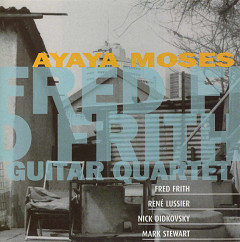
January 30 – February 28, 2017: DAME @ 25: Ayaya Moses
Monday, January 30, 2017
New releases
Disc Ayaya Moses by [frithquitarquartet_fr], released in 1997, is 25

Disc Ayaya Moses by [frithquitarquartet_fr], released in 1997, is 25
What more can be said of
Just about anyone with some degree of musical awareness has heard of Fred Frith, right
Our final CD here is from The Fred Frith guitar quartet. The idea of a guitar quartet makes perfect sense, really, if you consider how back in the early ’80s the World Saxophone Quartet, taking a page out of the book describing the string quartet’s structure, decided to write a repertoire for itself (consisting as it did on its inception of jazz giants David Murray, Oliver Lake, Julius Hemphill and Hamiet Bluiett, they had no trouble doing so) as well as to commission works to perform from modern composers. Fred Frith needs no intro, of course, and neither do his fellow axemen Nick Didkovsky, René Lussier and Mark Stewart. The most striking piece on Ayaya Moses is Pulau Dewata, a Claude Vivier piece of bewildering but lovely complexity, combining pure bell-like cadences with busy structure and slipknot-like turnabouts. There are odd bits here that recall the complexity of gamelan music and others that build expertly on the highly structured efforts of 1972-74 King Crimson (
This is simply amazing. A bit of novelty, perhaps, with a quartet of electric guitars playing some serious-type chamber music of a rock-style ensemble. I’ll bet the Fred Frith Guitar Quartet is great live—these guys are four of the most outside electric guitar players this side of Sonic Youth, all playing at the same time, sometimes scraping the strings with rocks, whatever, just goin’ to town on 24 strings. Sometimes cacophonous, sometimes brilliantly melodic, this is serious “art” music designed for listening. Sometimes you can party to this record, cuz they jam, too. I don’t know where the compositional process ends and the improvisational parts begin, and that makes the FFGQ listening experience all the more fun. The compositions are credited to all the members of the ensemble, not just to Mr. Frith. René Lussier, Nick Didkovsky, Mark Stewart round out the quartet that dables in rock, jazz and avant garde noise. Some call this kind of music “deconstruction”, but I don’t. The compositions are complex and the melodic material can be difficult.
Some of the most compelling music comes out of quartet settings. Bartok. The Beatles. Four Hand Grenades. If you like your music jittery, academically respectable and action-packed with a cartoon-esque appeal, you’ll dig the FFGQ. Sometimes they take you to the rings of Saturn as well. You’ll have to special order the CD from your local record store, though. Its an import from Canada, eh
Formed seven years ago the Fred Frith quartet finally releases its first CD. The music within is a dazzling display of… well,virtually everything that electric guitars can produce in the right hands. The pieces run the gamut from clean strumming and delicate melody through to blocks of atonal noise and all points in between. The electric guitar was originally, and will always essentially be a rock instrument -at least to these ears- and there’s something of the spirit of rock’n’ roll in this chamber ensemble playing certainly in its energy and hands on and amped up visceral power.
Although ostensibly his group, Frith’s quartet isn’t merely a platform for his ego. The other members René Lussier (who also played in Les 4 Guitaristes de l’Apocalypso Bar), Nick Didkovsky and Mark Stewart each chip in a piece.
The tracks range trom strict composition to spontaneous exclamations. The delicate oriental style unison passages in Vivier’s Pulau Dewata are intermittently broken up by stabs of feral power. The group composition The Stinky Boy Suite throws up huge blocks of noise which sandwich insect scratches and single bent notes. Here, Frith’s trademark strummed brittle chord h sixteenths is laid over what sounds like the three other guitars being dismantled. The hour or so of music is staggering.