Sauter au contenu principal
actuellecd

Aussi dans le blogue

11 résultats
  • 1
  • 2
  • Tom Johnson: Combinations dans Jazz Word

    «Review», Ken Waxman, Jazz Word, 19 septembre 2022
    vendredi 23 septembre 2022 Presse

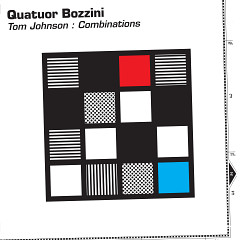
    Moving from improvisation to interpretation, Quatuor Bozzini (QB) with violinists Alissa Chung and Clemens Markel violist Stéphanie Bozzini and cellist Isabelle Bozzini bring their proven skills in dealing with and commissioning contemporary concert piece to four string quartet combination by American composer Tom Johnson. Concerned with minimalism, repetition and mathematical techniques, three of the creations are divided into tiny shards, some as brief as 14 seconds, with the turnarounds and breaks in all almost as short. Overall the performances are vastly more tonal and circular than those on the other discs. However it’s a testament to the QB’s skill that the four make rhythmic and fluid what could have been a series of academic exercises. The five-part Combinations for String Quartet for instance that opens the disc, is a monument to simplicity and beauty. Through many unison sections and seemingly endless pattern repetitions, sprightly and floating responses enter into the unfolding. The cellist even manages to suggest a foot-tapping rhythm. Moving on from the harsh and buzzing interruption in the fourth section, the piece ends with warmer, more moderate developments. Additionally, the concluding seven-part Formulas for String Quartet evolves with same sort of layered and lyrical interface. Including harder bass clef strokes and back-and-forth linear thrust, the QB creates something that is lyrical and almost flowery, but not at the expense of conscious projections. The penultimate VII confirms this with speedy glissandi that move from allegro to staccato, and the concluding VIII that displays slightly nervous, but never dissonant timbres that connect appropriately.

    … it’s a testament to the QB’s skill that the four make rhythmic and fluid what could have been a series of academic exercises.

    Tom Johnson: Combinations dans Nieuwe Noten

    «Kritiek», Ben Taffijn, Nieuwe Noten, 26 juillet 2022
    vendredi 26 août 2022 Presse

    Als er één strijkkwartet niet mag ontbreken in een serie over hedendaagse strijkkwartetten dan is het wel Quatuor Bozzini. Dit Canadese kwartet wijdt zich al decennia aan louter hedendaagse muziek en heeft reeds een groot aantal werken, vaak speciaal voor hen geschreven, in première gebracht. Eerder dit jaar verschenen albums met stukken van Tom Johnson, Combinations en Michael Oesterle, Quatuors op hun eigen label, als download te verkrijgen.

    Tom Johnson hoort bij de belangrijkste componisten van de Amerikaanse minimal music, ook al is hij minder bekend geworden dan Phililp Glass, Steve Reich en Terry Riley, zijn muziek is er niet minder boeiend door. Muziek ook die het uiterste vraagt van een strijkkwartet. De repetitieve figuren die Johnson direct in het kwartet waar het album zijn titel aan ontleent, Combinations gebruikt, vragen om een perfecte instrumentbeheersing en een optimaal gevoel voor timing. In het eerste deel in een vrij hoog ritmisch tempo, in het tweede, het vierde en vijfde deel in een veel tragere samenhang, maar in het derde in een tempo dat veel weg heeft van een dans. Prachtig hoe Johnson hier samenhang creëert tussen de vier strijkers. Tilework for String Quartet heeft slechts één deel, speels maakt Johnson hier gebruik van de toonladder. Opvallend is het uit vijftien delen bestaande Four-Note Chords in Four Voices, een opvallend ingetogen stuk. Tot slot klinkt het uit acht delen bestaande Formulas for String Quartet, waarin Johnson wederom werkt met een serie bijzondere patronen. Sommige daarvan zijn zeer fragiel, zoals de eerste twee, andere zoals bijvoorbeeld de vijfde, zijn opwindend ritmisch.

    Les figures répétitives que Johnson utilise d’emblée dans le quatuor dont l’album tire son titre, Combinations, exigent une maîtrise parfaite des instruments et un sens optimal du timing.

    Tom Johnson: Combinations dans The Squid’s Ear

    «Review», Brian Olewnick, The Squid’s Ear, 14 juillet 2022
    mardi 19 juillet 2022 Presse

    Tom Johnson has referred to himself as more of a list maker than composer and any survey of his work will at least partially bear this out. He often devises patterns, sometimes relatively simple or cyclic, sometimes complex, a little like aural presentations of a diagram of a mathematical sequence, and the musicians trace the resultant patterns. As one might expect, this can lead to music that is occasionally a bit on the dry side. But often enough, as with deterministic but highly detailed math sets, the result can be wondrous, even deeply moving. Sometimes it seems that this can depend on the interpreter. For example, the original recording of Johnson’s The Chord Catalog (XI Records, 1999), accurately subtitled, “All the 8178 Chords Possible in One Octave”, played on piano by the composer, was an impenetrably dense and regular iteration of the premise, an oppressive experience. Johnson conceded that his own limited pianistic prowess was an impediment, however, and when Samuel Vriezen tackled the work (Wandelweiser, 2013), the outcome was revelatory, the composition blooming into a hitherto unheard sound world of endless fascination. As the notes on this disc state, “Tom Johnson uses numbers as base material, turning formulas, combinations and other mathematic phenomena into music. And somehow, this music becomes poetry.”

    Happily, the pieces on this recording are performed by perhaps the single most exciting and innovative string quartet now extant, Quatuor Bozzini (Alissa Cheung, violin; Clemens Merkel, violin; Stéphanie Bozzini, viola; Isabelle Bozzini, cello). Four works are presented: a stand alone piece (Tilework for String Quartet (2003)) and three sets of compositions, ranging from five to fifteen elements and consisting of relatively short pieces, several below a minute in length.

    Combinations for String Quartet (2003) has five sections, the first coming as close to “standard” minimalism as anything here, reminding this listener of Reich’s Violin Phase. Four sets of four repeated notes are played, initially by one member, joined gradually by the others playing slightly augmented versions of the first line. After all four members are sawing, three drop out and a single member returns with a slightly different melody and the process continues. It’s a good example of a fairly “simple” process yielding fascinating results that lie just beyond the listener’s ability to confidently predict what comes next. After a sparse, lovely second section, part three arrives with a wonderfully bewildering set of six note phases that alternate as a sort of round followed by an interlocking pattern; again, easy enough to parse apart, difficult to keep it all in your head. And quite impressive. A drier, spare section (with some, to these ears, surprising echoes of Shostakovich), leads to the final portion, a kind of elegiac music, with somewhat mournful iterations of an eight-note melody played by all members. Tilework also plays with phrases of six and twelve notes, but interspersed among other compositions; as tiles, this is a complex set of tesserae, forming patterns here, dissembling them there, re-emerging in slightly different form at still another point. The basic pattern is rather jaunty, perhaps even reflecting Baroque motifs, disassembled.

    Four-Note Chords in Four Voices (2009) consists of fifteen short parts, with durations of between 0:14 and 2:18. They’re taken slowly, the harmonies once again possessing a dirge-like aspect, with a mix of hymnal sweetness and Ives-ian atonality. There’s a general downward trend in the patterns, reminding me of a series of falling leaves, very moving, including the last movement, an abrupt ending with but three notes that leaves one a bit shaken. The final work, Formulas for String Quartet contains eight brief parts. The first section is light in tone, with a seesawing three note pattern repeated over a high, rhythmic six-note phrase scurrying beneath; fairly “traditional” sounding in this context. The next two parts are softer, more melancholy, before the fourth movement stirs things up again, with active, agitative layers of rising notes that assume a struggling, even romantic character. In much of this music, any mathematical or formulaic underpinnings are well hidden; coming in blind, I’m not sure the innocent listener would suspect anything of the kind, though it’s doubtless there, working its magic. Parts V and VII again evoke older forms of minimalism, here perhaps a slice of John AdamsShaker Loops. The work, and disc, ends on a questioning note, with ascending phrases that never quite attain purchase, fittingly.

    A wonderful document, superbly played by Quatuor Bozzini, and a fine example of Johnson’s very unique approach to… list making.

    A wonderful document, superbly played by Quatuor Bozzini, and a fine example of Johnson’s very unique approach to… list making.
    Tom Johnson: Combinations dans The WholeNote

    «Review», Andrew Timar, The WholeNote, no 27:7, 20 mai 2022
    mardi 31 mai 2022 Presse

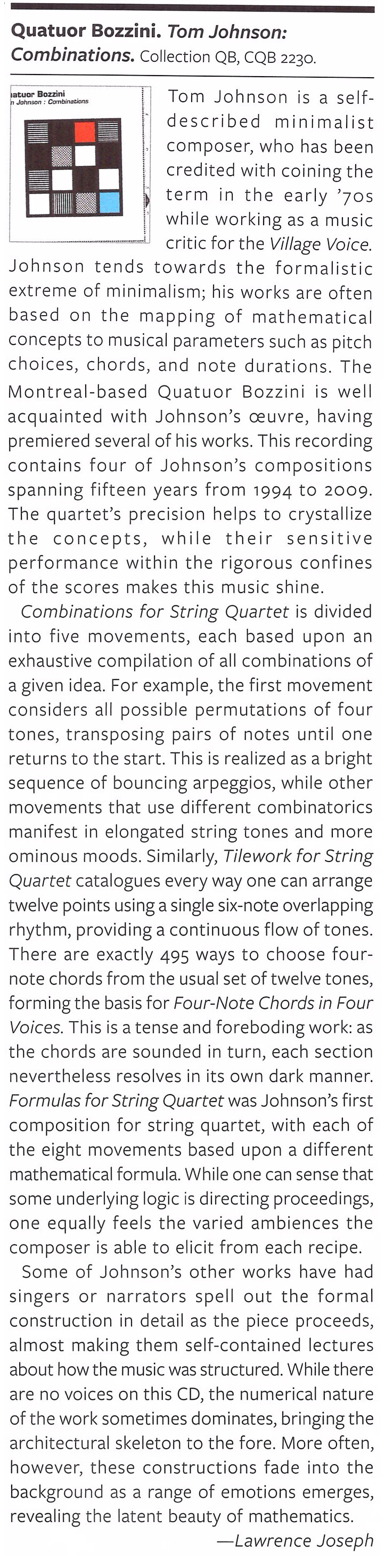
    American-born composer and longtime French resident, Tom Johnson (b.1939), served as The Village Voice’s influential music critic from 1971 to 1983 covering the era’s exciting new classical music scene. The first to apply the term “minimalist music,” Johnson’s personal compositional style leans toward minimalist formalism. Quatuor Bozzini has collected his complete works for string quartet covering four compositions from 1994 to 2009 on this album.

    Dwelling on mathematic sequences and permutations of a limited core musical material, in Johnson’s hands the musical whole emerges satisfyingly greater than the sum of its lean components and intellectual procedures. Each relatively brief movement vibrates like a sonic poem. For example, the opening six-note motif of Johnson’s Tilework for String Quartet (2003) is transformed through his exploration of the myriad ways in which lines are “tiled using six-note rhythms,” relying on a computerized list of rhythmic canons. The composer helpfully adds, “Of course, composers, performers, and listeners don’t have to know all of this, just as we don’t need to master counterpoint to appreciate a Bach fugue… [because] music allows us to directly perceive things that we could never grasp intellectually.”

    Performed senza vibrato, Quatuor Bozzini renders these scores with virtuoso precision along with warmth and a subtle lyricism, a winning combination I grew to appreciate after repeated listening.

    Performed senza vibrato, Quatuor Bozzini renders these scores with virtuoso precision along with warmth and a subtle lyricism…
  • 1
  • 2