actuellecd

Blog

3585 results
  • 118
  • 119
  • 120
  • 121
  • 122
  • 123
  • 124
  • 125
  • 126
  • Le Sacre du printemps in The Squid’s Ear

    “Heard in”, Dave Madden, The Squid’s Ear, August 25, 2014
    Monday, August 25, 2014 Press

    With 101 years of concerts, riots, discussions, thesis, influence, acceptance, canonization, you would think there isn’t much more that can be said about Stravinsky’s immaculate, ground-breaking Rite of Spring. However, this quintet’s interpretation is forcing us to reopen the tomes. Isaiah Ceccarelli on drums, electric guitarist Bernard Falaise, Phillipe Lauzier on bass clarinet and soprano saxophone, violinist Joshua Zubot and ringleader Pierre-Yves Martel also on viole de gamba and “diverse objects” here deliver a candid version of the work that’s based in straightforward score adherence and detours that range from slight to wild, but always back to the map — and always interesting.

    Apart from a deep muffled drone, the introduction of L’adoration de la terre begins on queue with Lauzier delivering the high C and rhapsodic opening gesture; Falaise gently plucks out pinpoints to cover the brass counterpoint. Just as faint, Zubot joins to complete the intimate trio. Things are going exactly as planned, the performance washes over you, you’re rising to heaven — bam, one minute and forty-seven seconds marks the first frenzied burst of instrumental twisting, guttural breaths and string disfigurement. As if suddenly unpossessed, the band immediately hops back into character before Ceccarelli and Falaise lurch into a bluesy stomp. Zubot goes it alone with a stark, pan-tonal rogueness as prelude to the Augures printaniers (the staccato 8th note part with lots of accents that you can almost shake Devil horn hands to — the portion John Williams ripped off for Jaws). For this movement, the crew restrains the otherwise tension with Ceccarelli opting for jazz brushes and all working muted and mezzo forte. However, it isn’t long before the members burst into a brash groove, complete with Gene Krupa drum bashing. The group moves forward with the lugubrious, snake-charmer Rondes printanières, laying into the swaggering pulse of Stravinski’s vision while adding Lauzier’s steamy Coltrane-esque exploration on top. Rocking out, guitar string and amp mangling, barely audible drones and a raging barn-stomping frenzy follow to close out the first half.

    Le sacrifice tracks the same model of faithfulness and interjection, the latter delivered with woo to convince that the deviations should be there. The act flows from dinner theatre to corner slinking lounge with a great deal of space near the beginning. As the group approaches Glorification de l’élue (the percussion-heavy bombast), the air is frantic with Martel taking a nimble extended solo. The players launch back in and cadence just as Falaise takes flight with something not quite metal, but certainly heavy: dense, warbling, detuned chords that slightly shift pitch, hang, and dissolve like clouds on the verge of thunder. Ceccarelli steps in and the two put a dirge-like punctuation on the Golden Mean of the piece. The ostinato of Action rituelle des ancêstres (again, being a Star Wars child, I associate this with the Jawa sand crawler) starts like a lamb, works into a two-headed lion and burns out. The finale is a curious medley of mechanized grinding and rumbles from what seems to be a turntable also playing a short hazy loop of Stravinski’s original in reverse. Soon everyone wails, the beat grows three heads due to Falaise’s distortion and Ceccarelli’s assault, and cut.

    It is a daunting task filled with ghosts throughout history to tackle Le Sacre as a small chamber ensemble and make it your own, but there is nothing bare-bones about this version. The approach could have gone Three Bears: one is too rigid, the other too wild, free and disrespectful. Quartetski’s augmentation of this landmark work is just right.
    Quartetski’s augmentation of this landmark work is just right.
    En orbite in Vital

    “Review”, Dolf Mulder, Vital, no. 944, August 11, 2014
    Monday, August 11, 2014 Press

    Et/Ou is a collaboration of Martin Tétreault and Michael Langevin. They started in 2007 and released a first album in 2013: En orbite and so En chute libre is their second statement. Tétreault needs no introduction here. He is a longtime avant garde composer and player with the turntable as his main instrument. Langevin has a history as a drummer in the heavy metal band Voivoid. Also he was and still is engaged in numerous experimental outfits and projects. In most pieces ont his album Langevin drums with a pulse or beat. The patterns sound rather simple and not very demanding. Repetition is an important characteristic like in Duo02. They are completed by noisy textures produced by Tétreault. Their music surely arises from dialogical interplay between the two. The ingredients both players supply, do not lead in each piece to something that arises above the combination of both ingredients. The sound constellations by Tétreault offer far more depth and complexity and make a contrast with the rather straight drumming. So let us say, it is an unusual work and for that reason an interesting one. Maybe I miss the point here, but their improvisations didn’t inspire me.

    … it is an unusual work and for that reason an interesting one.

    En orbite in Improv Sphere

    “En chute libre”, Julien Héraud, Improv Sphere, July 18, 2014
    Friday, July 18, 2014 Press

    ET/OU est la rencontre inédite de deux figures des musiques expérimentales québécoises: Martin Tréteault, platiniste renommé des musiques improvisées et Michel Langevin, batteur qui a longtemps participé au groupe de métal Voivod. Ce duo s’est formé il y a déjà plusieurs années et marche vraiment très bien.

    De son côté, Tréteault aborde les platines de manière percussive, tandis que Langevin aborde la batterie de manière sonore et abstraite. Mais là, ce sont les détails. Car avant tout, Tréteault explore les particularités abrasives des platines, des diamants et des préparations, et Langevin joue tout de même de manière très rythmée, très rock même souvent. Et c’est ce qui fait le charme de ce duo, de l’improvisation très rock, avec de beaux patterns rythmiques binaires et entraînants, mais aussi des excursions violentes et puissantes dans les domaines les plus parasitaires des platines.

    ET/OU propose avec En chute libre une suite de huit improvisations axées sur la puissance du rythme binaire et des textures noisy, mais aussi sur les possibilités rythmiques des platines préparées et les possibilités exploratrices des instruments acoustiques (la batterie). Un disque parfois puissant et dansant, parfois explorateur et abstrait, le fruit d’une rencontre inattendue mais très juste. Car les deux musiciens se complètent et s’entendent très bien, ils jouent chacun leur jeu, tout en tenant compte des particularités de l’autre, et c’est ce qui fait la richesse de cette collaboration entre la noise, le métal et l’improvisation libre.

    Un disque parfois puissant et dansant, parfois explorateur et abstrait, le fruit d’une rencontre inattendue mais très juste.

    Combines in Le son du grisli

    “Critique”, Pierre Cécile, Le son du grisli, July 1, 2014
    Tuesday, July 1, 2014 Press

    La couleur du vinyle aurait dû me mettre la puce à l’oreille… il y avait bien là de quoi faire monter la fièvre, d’autant que le GGRIL (pour Grand groupe régional d’improvisation libérée) tournait à plein régime (une douzaine de membres) et sans chef attitré (pas plus le bassiste électrique Éric Normand que le guitariste électrique Robert Bastien, même si…).

    Même si les deux hommes s’essayent au rôle de chef en face B et si le premier est l’auteur de ces «jeux pour improvisateurs». Mais alors, ces jeux? Ils en appellent autant à un folk tournant qu’à une conduction / déconstruction ambiantique, voire ambiantiste. Sa qualité évolue selon les «combines» ou les combinaisons: excellente quand tel ou tel instrument (la trompette d’Alexandre Robichaud, le vibraphone de Tom Jacques ou l’accordéon de Robin Servant, par exemple) s’éloigne du noyau dur de l’orchestre, moins remarquable (étrangement) quand l’orchestre cherche à jouer collectif. C’est difficile, la musique orchestrale; c’est pourquoi le GGRIL s’en tire avec non pas de beaux dommages mais avec de bien beaux honneurs.

    C’est difficile, la musique orchestrale; c’est pourquoi le GGRIL s’en tire avec non pas de beaux dommages mais avec de bien beaux honneurs.

    Le caillou in The WholeNote

    “Something in the Air: Translating a Singular Vision to a Large Ensemble”, Ken Waxman, The WholeNote, no. 9:19, June 25, 2014
    Wednesday, June 25, 2014 Press

    Reflecting one person’s imagination, musical composition is an intimate art. But, especially if the creation is wide ranging and sonically multihued, sympathetic interpreters are needed to express the composer’s vision. As this group of CDs demonstrates, notable interpretations of a composer’s singular vision can illuminate the writers’ concepts. […]

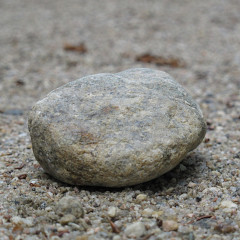
    For her part, Montreal percussionist Danielle Palardy Roger has such a consistent sonic concept that she can release a disc such as Le caillou with seven performances from 1998 to 2013 and have the disc sound as if came from one session. Featuring a shifting cast of 23 musicians called Ensemble SuperMusique, most tracks are variations on her original composition Le caillou (the pebble), a multi-faceted game piece which allows improvisers to collaborate on its musical development. Over the CD’s course everything from bel canto-like whoops to Sun Ra-like interplanetary percussion rumbles to top-of-range clarinet shrills and turntable scratching takes centre stage. With sequences that shift from rustic fiddle-and-guitar interludes to rock-styled drumming and intense jazz-like sax-and trombone lick trading, part of the fun for the listener being kept off balance. But this flexibility includes consistency. Even contributions from ebullient French bassist Joëlle Léandre, featured on one track, are no more prominent than others. Although The Stone the one Manhattan recorded tune is the most challenging in its strident stropped string and slapped percussion outlay, the defining track is Le cristal. Seemingly encompassing something for everyone from straight-ahead swing and martial rhythms, to splayed rock-guitar chords, dog-whistle altissimo to closely harmonized woodwinds the track encompasses bedlam, baroque and bop, Highlighted by a well-paced duet between Jean-Denis Levasseur’s clarinet and Jean Derome’s also sax, the climax preserves the beat and theme with jumping strings and to-the-point percussion. […]

    Danielle Palardy Roger has such a consistent sonic concept that she can release a disc such as Le caillou with seven performances from 1998 to 2013 and have the disc sound as if came from one session.
  • 118
  • 119
  • 120
  • 121
  • 122
  • 123
  • 124
  • 125
  • 126