Sauter au contenu principal
actuellecd

Blogue

22 résultats
  • 1
  • 2
  • 3
  • 4
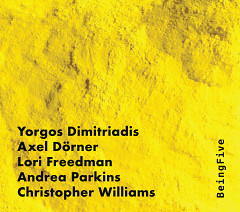
  • BeingFive dans Free Jazz Blog

    «Review», Stuart Broomer, Free Jazz Blog, 27 juillet 2023
    jeudi 24 août 2023 Presse

    Lori Freedman has the dual distinction of being Canada’s most distinguished clarinetist of both the “classical” avant-garde and the worlds of free jazz and free improvisation. Her 2019 solo CD Excess is a riveting program that includes daunting works by Richard Barrett and Brian Ferneyhough, while her improvising skills are evident in numerous associations, including the Queen Mab Trio, with violist Ig Henneman and pianist Marilyn Lerner (Réunion, Mikroclimat, 2017) and Amber (Clean Feed Records, 2022), her duo with trombonist Scott Thomson who contributes the liner note to BeingFive.

    The music heard on BeingFive came together during a 2022 residency in Berlin and consists of works devised by Freedman for an improvising quintet. The international group that she assembled includes Greek percussionist Yorgis Dimitriadis, German trumpeter Axel Dörner and Americans Andrea Parkins, heard here playing accordion, amplified objects and electronics, and bassist Christopher Williams.

    Discussing the pieces, annotator Scott Thomson suggests that the music “reflects, not a desire to execute a conceiver-composer’s will, but a pursuit of collective discovery.” In a sense suspended between composition and improvisation, the formed and the forming, the music is both largely calm in a way that can include rare explosive bursts, meanwhile refusing to stand still in either a textural or formal sense. The opening Eclipse begins in the subtlest weave of instrumental voices at chamber music dynamics, then the acoustic instruments are suddenly interrupted by clouds of muffled electronic sound, this description seemingly conditioned by value judgements not to be heard in the sounds themselves or their apparent relations. An expressionist burst of clarinet brings on a sustained tremolo of arco bass, a flutter of accordion, a thin stream of trumpet, then randomized drum strokes. An occasion for introductions, perhaps the true songs of freedom and consciousness are always tuneless. A microtonal wander of clarinet and accordion is interrupted by mildly abrasive electronic noise. At the conclusion of the piece, a very quiet female voice says “… I can’t see anything”. Is this the source of that title, Eclipse, or an ironic comment on it? I reverse the CD. I can’t find it. Then the voice seems to appear, but it’s different, different words, further away. I go to the window. The speaker is a neighbor, nearby. BeingFive invites (and strangely rewards) a listening so concentrated it may go beyond merely including the incidental, environmental event, somehow actually to thematize it.

    The longest piece, the 15-minute and central Miniatures, ironically, is constructed of very short, time-determined pieces, the shortest between 10 and 30 seconds then followed by longer units of between one and three minutes, a strict structural pattern that is improvised in all of its “details” and which results in some of the group’s most intense “moments”.

    The final piece, Freeze has minimal movement, a near-drone that is compounded of continuous acoustic and electronic elements, individually, gradually, evenly, rising in volume, at one point a complex sound in which the sustained metallic shimmer of cymbals and a constant electronic whistle will become a single sound within a continuum, in part maintained by a continuous low-pitched hum, that seems to maintain a constant collective volume level, that voices rise to sustain, including intermittent hard-to-identify high pitches and an oscillating bass clarinet.

    Among the creative ironies to which BeingFive (five pieces by five people) gives rise, its collective spontaneous elaborations on minimal designs invite, whether verbalized or not, the active, even intense, compositional participation of the listener.

    BeingFive invites (and strangely rewards) a listening so concentrated it may go beyond merely including the incidental, environmental event, somehow actually to thematize it.

    Éliane Radigue: Occam Delta XV dans Musicworks

    «Review», René van Peer, Musicworks, no 145, 1 juin 2023
    jeudi 29 juin 2023 Presse
    Occam Delta XV is music as it might appear under an electron microscope — a captivating conglomerate of waves. This is keeping with the way Radigue has approached her art from the beginning: working on the physical properties of sound through imagination.

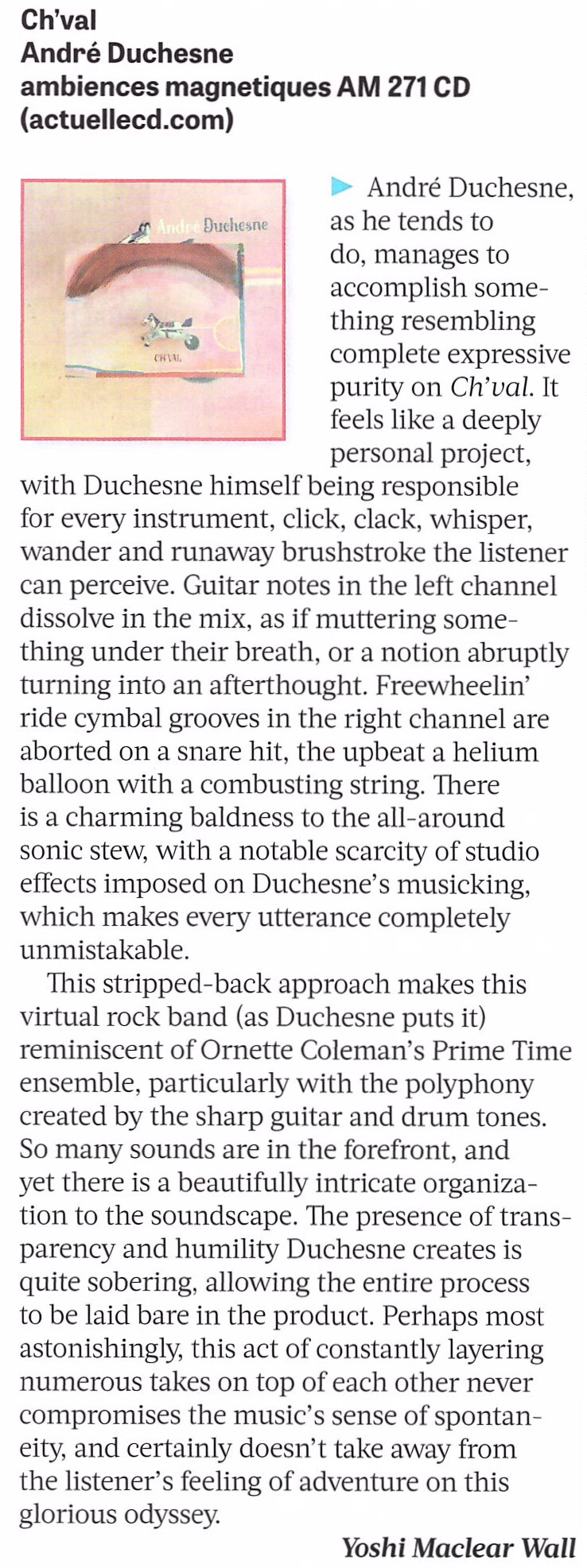
    Ch’val dans The WholeNote

    «Review», Yoshi Maclear Wall, The WholeNote, no 28:6, 1 juin 2023
    vendredi 16 juin 2023 Presse
    Perhaps most astonishingly, this act of constantly layering numerous takes on top of each other never compromises the music’s sense of spontaneity, and certainly doesn’t take away from the listener’s feeling of adventure on this glorious odyssey.

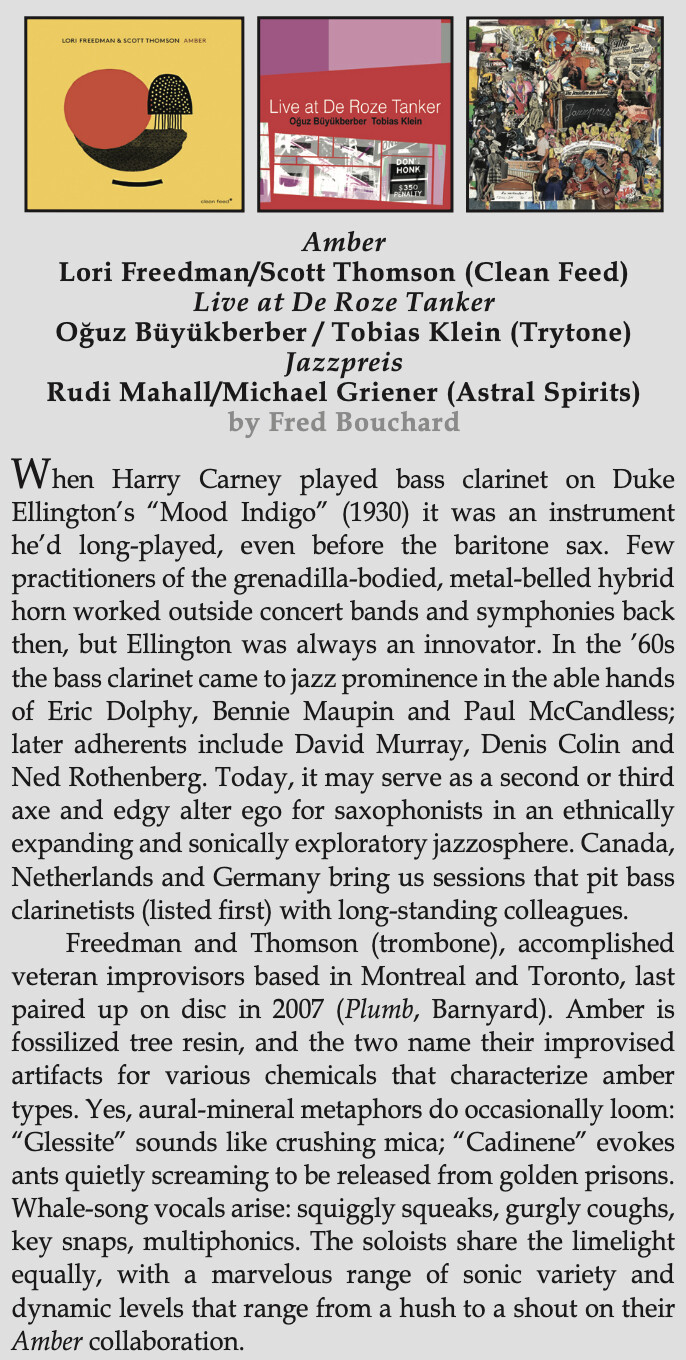
    Amber dans The New York City Jazz Record

    «Review», Fred Bouchard, The New York City Jazz Record, no 254, 1 juin 2023
    mercredi 31 mai 2023 Presse
    The soloists share the limelight equally, with a marvelous range of sonic variety and dynamic levels that range from a hush to a shout…

    Éliane Radigue: Occam Delta XV dans 5:4

    «Review», Simon Cummings, 5:4, 12 mai 2023
    lundi 15 mai 2023 Presse

    You would think, by now, i’d be getting the hang of this piece. Éliane Radigue‘s Occam Delta XV, conceived for the Bozzini Quartet, has crossed my path on a couple of occasions, first at its UK première in Huddersfield in 2018, a performance that i subsequently explored in more depth, and again in January this year at the Dark Music Days in Iceland. i was struck by how different the two accounts of the work had seemed from each other, and that experience has been compounded by a new recording the Bozzini’s have released, featuring two further performances, made on successive days in November 2021.

    The first observation to make is that the Huddersfield version, at around 20 minutes’ duration, is nearly half as long as the two recorded performances (37:25 and 36:31 respectively; i didn’t time the Iceland performance but i’m sure it was about the same length). i don’t know the reason for such an extensive change in duration, but considering some of its siblings in Radigue’s output, it may have something to do with optional aspects in terms of how long to remain in one episode before moving on to the next. All the same, an almost doubling in length is surprising.

    i used the phrase “unstable stability” to describe the piece before, and as with so much of Radigue’s music, that seems to be an appropriate way to regard its inherent musical behaviour. But of course, the key thing with both of those words is that they constantly undermine each other. What this does not result in is ‘balance’ (i’ve just checked and am relieved to see i’ve never used that word when exploring Radigue’s music); on the contrary, while there’s the semblance of an equilbrium, Occam Delta XV occupies a gentle but permanent tension, like a piece of elastic constantly being gently stretched and released. i don’t hear that as ‘balance’, but as flux, friction, discreet energy, with the abiding sense throughout that, though where we are right now might be somewhere we stay for a while, the music is always looking ahead, ever caught in the midst of a gradual process from infinity to infinity.

    From a listening perspective, an outcome of this is that it throws a lot of attention on the here and now, what’s happening in the music moment by moment. For music so glacially slow that might seem counterintuitive, yet it’s that sense of its infinitude that makes the question of a longer-term listening perspective (something i’ve spent years trying to cultivate) seem rather moot. It’s not that such a longer-term perspective is impossible, or meaningless, rather that what Radigue so often seems to be striving for in these works is that persistent state of semi-static movement, where lingering on what’s taking place right now is just as significant as what was happening five, 10 or 20 minutes ago.

    In these two performances of Occam Delta XV that liminal stasis is beautifully realised, the Bozzinis keeping things in a tantalising state of sounding resolved, unresolved and in the process of resolving all at the same time. The work’s fluid harmonic state passes between contrasting states of simple and complex, purity and dirtiness; oblique notes suggest themselves as passing notes but don’t so much resolve as become grafted onto the chordal core. Even after this has happened, and that core has been delicately recoloured, it still doesn’t sound like a resolved action; again, everything points on, to the necessity for something more.

    Especially nice is the way the Bozzinis control the texture as it ventures into more fragile territory. In the first track (‘2021-11-09’), at around the midpoint there’s a curious impression of rumble, and the harmony seems to be pulling in all directions such that the music sounds like it could just come apart at the seams. It ends up registrally polarised but somehow a perfect fifth fundamental rematerialises, whereupon the upper notes become dancing harmonics of the lower. In the second track (‘2021-11-10’), the fragility sounds more marked, which is appropriate considering how the opening minutes of this performance exhibit a greater sense of flux, as if made of concentric chords rotating at different rates, a mesmerising effect. The fundamental returns in the same way, and the closing minutes of both performances are, depending on your perspective, either an extended coda, gently tilting like soft fabric wafting in a breeze, or simply the current stage in an ongoing process without beginning or end.


    In these two performances of Occam Delta XV that liminal stasis is beautifully realised…
  • 1
  • 2
  • 3
  • 4