Sauter au contenu principal
actuellecd

Blogue

3585 résultats
  • 21
  • 22
  • 23
  • 24
  • 25
  • 26
  • 27
  • 28
  • 29
  • Vraiment plus de Snipettes!!! dans Percorsi Musicali

    «Review», Eyal Hareuveni, Percorsi Musicali, 8 décembre 2024
    dimanche 8 décembre 2024 Presse

    Canadian, Québec-based Martin Tétreault is a sound artist, turntablist, DJ and improviser who came to music from the visual arts milieu. His work shifted from highly imaginative puzzles of musical citations to exploration of the intrinsic qualities of the turntable, its motor sound, its interferences, needles, or prepared surfaces, with preparations and analog glitches He has collaborated with local improvisers like René Lussier, Jean Derome and Michel F Côté and others from the international, free-improvisation scene like Otomo Yoshihide, Ikue Mori and Xavier Charles.

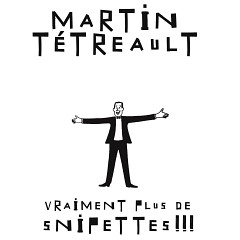
    Vraiment plus de Snipettes!!! (Really more Snipettes!!!) is Tétreault’s third installment in a series that he began in 1992 with a limited edition of 250 cassettes of Snipettes! (remastered to an album by Ambiances Magnétiques, 2007), and continued with Plus De Snipettes!! (More Snippets!!, Ambiances Magnétiques, 2018). Now, at 65 and without the enthusiasm of a 25-year-old, Tétreaul promises this is the final installment.

    These installations are made of raw chunks of material excavated from Tétreault’s early archives — magnetic tapes and audio cassettes that were transferred to the computer and then being destroyed. In some cases, the original recordings were made without a mixing console, directly onto a reel-to-reel tape recorder. “I wanted to preserve as much as possible the original qualities of these materials and their supports”, Tétreault explains. “This involves the good moves and the mistakes conducive to learning and the naivety of time. The disc brings together gone gestures, analog tools and magnetic sounds. Most of the tools used for these recordings have disappeared from my entourage. As for music, it fixes in time plays and explorations that are elsewhere… ” The sound materials for Vraiment plus de Snipettes!!! were collected between 1984 and 2023.

    Vraiment plus de Snipettes!!! demonstrates the brilliant, thought-provoking work of Tétreault as a sound artist and turntablist who finds delight in abrupt and brief, subversive juxtapositions between concentrated, obscure fragments of sound, that, surprisingly, gain enigmatic clarity and momentum as the album progresses. Obviously, all these sonic collisions. highlight Tétreault’s wily sense of humor. The last, 25th piece, the 27-minute From Raymond a Micheline begins after three minutes of silence and documents a virtuosic, cathartic live recording from 1994, showing Tétreault juggling with conventional DJ techniques alongside his wildly imaginative story-telling gift and personal abstraction tactics. It ends with the analog scratches of vinyl. Vraiment plus de Snipettes!!! is a reflective but bumpy rollercoaster journey to an innocent musical universe but also a remarkable, experimental sound art with a punkish, even John Cage-like sense of discovery.

    The album comes with Tétreault’s text — thoughts about the irreverent nature of his art and each piece and its original materials. “Improvisation means work, pain, occasionally prolonged spells away from home, sacrifices, and God knows if we improvise”, he wonders in Improviser. “Listen carefully, because it will sound to you crazy. And, if it does not sound to you crazy, that is a sure sign that you have not started to understand what we are talking about. That not to understand is something like not to understand music. And you’ll begin to understand when you begin to find out that you can love music. That you can begin to get really interested in ideas, in puzzles, in surprises. And then you’ll realize that science is much more interesting than music”, he quotes a lecture by Hungarian-American theoretical physicist Edward Teller, “the father of hydrogen bomb”, in Bongos en furie (Furious Bongos). Tétreault immediately matches this statement with Conscience/Awareness, and his own thoughts about Teller’s statement: “Now, here are some other exercises that will help you become aware. Correction, correction, I repeat, correction. Okay, that makes you happy. Take a moment to think about your answer, to develop it mentally. Hmmm… Are you thinking? Let’s start: one, two, four, three, five. Phew!”. Tétreault concludes this text with an optimistic promise: “If you listen to this record, you will always feel ready to face the next day”. You are guaranteed to feel better after taking this wild ride with Tétreault.

    … brilliant, thought-provoking work of Tétreault as a sound artist and turntablist who finds delight in abrupt and brief, subversive juxtapositions between concentrated, obscure fragments of sound, that, surprisingly, gain enigmatic clarity and momentum as the album progresses.

    Vraiment plus de Snipettes!!! dans Monolith Cocktail

    «Review», Dominic Valvona, Monolith Cocktail, 3 décembre 2024
    mardi 3 décembre 2024 Presse

    As the exclamation marks denote this is the third such volume of retrieved archival experiments produced via an apparatus of record player, cassettes, radio and various surface sounds from the free improvisation Québec innovator Martin Tétreault. With over sixty releases under his belt there’s a lot of material floating about: a lot of it previously unused.

    Although there’s been considerable gaps in this series, which initially began back in 1992 with the limited cassette collection Snipettes!, followed by a “reprise” in 2007 after that inaugural instalment was re-released on CD, the latest volume continues to draw upon the idiosyncratic turntablist’s more “irreverent” sonic, dialogue, concrete and musical collages. For there is levity, a sense of fun, playfulness, wit in the way each avant-garde etude, passage or improvised performance is spliced (more in the sense of how it sounds than actual methodology) and put together.

    At the centre of it all, or most of this play, is the turntable, which often sounds as if it is being impeded or led astray through pitch and speed manipulation and covered or wrapped by hidden materials. Less Qbert or DJ Shadow and more Basquiat or Nam June Paik qualifying for an avant-garde version of the DMC World Championships, captured extracts of serious theory, science, philosophy, lectures, the state of consciousness are morphed, twisted or shunted by a lifetime of accumulated snippets from TV, radio, cartoons, theatre, the opera, the rock concert and the art world. High meets low art, popular soundtracks meet the Afro-Cuban, and retro futuristic predictions of computer power, of domed utopias and the like come up against the mooning, the loony and ridiculous.

    At times it plays out like Fluxus skits, and at others, finds a new rhythm and groove bordering on Afro-jazz or no wave or even funk from the transformed source material. A bastardised jazz-prog-noodling Zappa can suddenly also evoke Django Reinhardt fronting The Fugs; an informative French speaker is taken over by staccato nylon-strung Caribbean music and an off-kilter transformation of the Tango; Michèle Bokanowski “cirque’ comes to town under a bendy hallucination of shooting effects and Library music zaps; an echo of Jef Gilson is lost in the background cacophony of classical theatre; articulated ideas on science and reality sit next to feminine coquettish French annunciation and the scraping, rubbing and distorted abrasion of paper; and retro computerised calculus and sci-fi is paired with the spooky gothic theatrics of Edgar Allen Poe. These are just some of the happy accidents or intended results (in my mind) of these often humorous and amusing snippets. The uninspiring concrete mundanity of loading the tape recorder and other mechanised clicks, the dialling of an old telephone, stretch the imagination, whilst also stretching the listener’s patience in what can only be described as another of these Tétreault teases or in-jokes.

    Originally these recordings would have been directly recorded on to a reel-to-reel, bypassing any mixing console. And so all the “quirks” the surface noises, the fizzes, crispy crinkles and muffles are kept as part of the makeup, the character; as Tétreault puts it, in keeping with preserving as much of the original recordings as possible.

    Reanimating and morphing a diverse range of collected fragments from lessons in hypnotising to Marx Brothers like nights at the opera, and from echoes of the Art Ensemble of Chicago to recontextualised lofty addresses and sketches, Vraiment plus de Snipettes!!! is in many ways an antidote to the seriousness and earnestness of this art form.

    Facilitated by the Canadian Ambiances Magnétiques — just one of the many labels that gathers under the Distribution Ambiances Magnetiques (or DAME as it is known) platform umbrella — this third collection of fragments, variations further cements Tétreault’s playful and experimental legacy, whilst also introducing a new generation to his pioneering work in the field of turntable-led, but also radio and cassette tape, exploration and transference. I’d recommend to anyone interested in Philip Jeck, Christian Marcley, People Like Us and Milan Knizak.

    … this third collection of fragments, variations further cements Tétreault’s playful and experimental legacy, whilst also introducing a new generation to his pioneering work in the field of turntable-led, but also radio and cassette tape, exploration and transference. I’d recommend to anyone interested in Philip Jeck, Christian Marcley, People Like Us and Milan Knizak.

    Rebecca Bruton + Jason Doell: a root or mirror, blossom, madder, cracks; together dans The Strad

    «Review», David Kettle, The Strad, 25 octobre 2024
    vendredi 25 octobre 2024 Presse

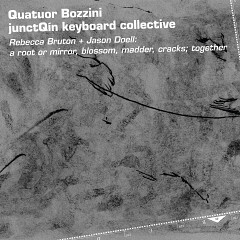
    The Montréal-based Bozzini Quartet has long been a persuasive new music advocate, and this first vinyl release on its own label amounts to a quiet, quirky celebration of its country’s music and musicians. It’s a collaboration with the Toronto-based junctQín keyboard collective (here, three players at a single piano keyboard), and showcases two thoroughly distinctive Canadian composers.

    Rocky Mountains-based Rebecca Bruton mines folk-music sensibilities in her expansive The Faerie Ribbon, which unfolds like a series of brief vignettes observing similar material from contrasting perspectives. She conjures some uncannily beautiful sonorities using harmonies spread right across the piano’s range, plus an orchestral-style richness of double-stopped strings, and there’s a Reichian opulence to the piece’s closing sections, with reedy sustained string harmonies against chiming piano figures. The Bozzini plays with elegance and strong definition throughout, with singing, whistling and humming adding another magical dimension.

    By contrast, Canadian composer Jason Doell explores a fascinating and very simple idea in his to carry dust & breaks through the body. An apparently unchanging electronic drone slides lower by a semitone across the course of his piece. The string players adjust their tuning to it as the work progresses, while the pianists, naturally, can’t. The result is a compelling contemplation of sameness and difference, of out-of-tune-ness and dissonance (where does one end and the other begin?), delivered with wit and insight through slow-moving, subtle gestures and not-quite repetitions. The Bozzini’s account is magisterial, often cool and detached, but bristling with engagement, and supple in its shaping of Doell’s sometimes enigmatic phrases. It’s a rewarding release, captured in close, warm sound.

    … magisterial…

    Rebecca Bruton + Jason Doell: a root or mirror, blossom, madder, cracks; together dans Groove

    «Kritik», Frank P Eckert, Groove, 24 septembre 2024
    mardi 24 septembre 2024 Presse

    Das Montréaler Streichquartett um die Bozzini-Schwestern Isabelle und Stéphanie hat sich von Beginn an herausgenommen, über die Ränder der Neuen Musik hinweg zu agieren. Zu ihren Interpretationen gehören eben nicht nur Alvin Lucier und John Cage, sondern ebenso elektronische Komponistinnen wie Èliane Radigue oder Sarah Davachi.

    Trifft das Quatuor Bozzini auf das ähnlich freigeistige junctQín keyboard collective, ist musikalisches Um-die-Ecke-Denken garantiert. Für a root or mirror, blossom, madder, cracks; together (Collection QB, 28. August) haben sie sich dieser Abenteuerlust entsprechende langformatige Stücke von Rebecca Bruton und Jason Doell ausgesucht, ebenfalls Grenzgänger:innen zu Ambient und elektronischer Pop-Avantgarde. Wo sich Brutons „The Faerie Ribbon” an der Schnittstelle von Freak Folk und Neuer Kammermusik bewegt, spielt Doells „to carry dust & breaks through the body” auf rein akustische Weise mit elektronischen Drone-ENekten, mit minimalen Verschiebungen in direkter Nachbarschaft etwa zu seinen digital manipulierten Pianostücken auf dem experimentellen Ambient/Pop-Label Whited Sepulchre.

    … la pensée musicale hors des sentiers battus est garantie.

    Geister dans Sequenza 21

    «Review», Christian Carey, Sequenza 21, 9 septembre 2024
    lundi 9 septembre 2024 Presse

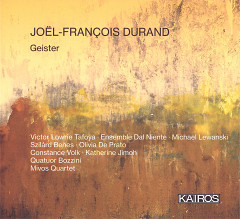
    On Geister, a double-CD release on Kairos, the music of Joël-François Durand receives benchmark performances by some of the best performers in contemporary classical music today. It features works from 2005-2022. Originally from France and currently based in the United States, Durand is Professor of Composition and Director of the School of Music at the University of Washington.

    Over the course of his career, Durand has increasingly used microtones in his works. Since 2019, he has added the technique “beating,” in which two pitches are placed very close together, creating strong fluctuations. Another signature aspect of his style is intricate development of linear material.

    His First String Quartet (2005), played here with fastidious detail by the Mivos Quartet, predates this investigation, but its use of simultaneous pizzicato and arco attacks, microtonal duets, and altered bowing, makes for an intricate musical surface. Written in the same year is In the Mirror Land, a duet played by Constance Volk, flute, and Katherine Jimoh, clarinet. The technique of shadowing, with the clarinet slowly emerging from its overlapping into the background, is important to the piece. Then the duo supply heterophonic overdubs of strident lines. La descente de l’ange (2022), for violin and clarinet, played by violinist Olivia De Prato and clarinetist Szilárd Benes, addresses similar concerns, but with its own distinct formal trajectory.

    De Prato also provides a tour de force performance of the solo work In a Weightless Quiet (2020). At twelve minutes long, the intensity of the piece’s energy never flags.The use of open strings in the aforementioned beating technique appears at structural points in the piece. Then fortissimo fast repeated notes and bowed glissandos are juxtaposed against the beating, harmonics. and multi-stops. It finishes with altissimo secundal passages, double stops, and harmonics — a difficult piece delivered with élan.

    Ensemble dal Niente, conducted by Michael Lewanski, performs Mundus Imaginalis (2015), the largest of the works programmed. Bass drum and a clattering metallic ostinato supply a syncopated groove. Lines overlap, at times contrapuntally, at others doubling to create reinforced textures. The tempo fluctuates, and semitones suggest cadences, only to be canceled swiftly by dissonant verticals. The incorporation of microtones intensifies as the piece progresses. Forte lower brass and chimes are added as it reaches its climax. Then a gradual denouement with a slowing of the percussive groove, chimes, colorful chords, repeated notes in the harp, and sustained wind solos that disassemble the opening material. Overtone verticals provide the piece with a stirring conclusion.

    Geister, schwebende Geister… (2020) is a highlight. It also uses off-kilter percussion, corruscating melodic intervals, and open strings against small intervals to create beating and copious glissandos. Soloist Victor Lowrie Tafoya and Ensemble dal Niente, conducted by Lewaski, provide a fantastic performance that would serve as an excellent introduction for anyone curious about Durand’s music.

    Cast in four movements, String Quartet No. 2 (2020), “Cantar de amigo,” played by Quatuor Bozzini, once again begins by bringing together previously mentioned techniques: the pulsation of tight beating intervals, sharp attacks, and bent sustained notes. Another texture prominent in the quartet is repeated notes set against glissandos. The tuning pitch, A = 440Hz., appears over and over, treated by all of the aforementioned techniques rather than settling into the in-tune version one would expect to hear before the beginning of an orchestra piece. The second movement begins to add harmonics above the A. The third movement puts hollow retorts of different notes below A, most relating to fifths above and below (E + D: other open strings found in the quartet in conventional tuning). The A bends this way and that, with microtonal glissandos distressing its centricity. With loud utterances, a high E starts to take prominence, only for A’s to cluster against it, and then low open strings weigh in as well. The only movement that begins attacca is the last, which at nine and a half minutes is of a significantly longer duration than those preceding. It begins once again with glissandos, but this time these start in the low strings, only gradually having all registers represented. In addition, some move in lower sliding figures, thus are higher up on the stringboard than the usual open sonorities. This creates a bit more of a covered sound. Midway through, octave A’s make a veritable cadence, only to be replaced by beating seconds in various registers. After a significant absence, a dash of repeated notes enter. Overlapping glissandos create a swath of blurred sonorities that persists throughout the middle section of the movement. Multi-octave A’s continue to announce each sectional division. As the piece progresses, glissandos ascend and descend into overlapping, mutable pitch schemes. High B cancels the penultimate octaves, leading to a final section in which the glissandos first grow smaller, prevailingly microtonal, and then wend their way towards A played pianissimo and cut off abruptly. String Quartet No. 2 is a combination of centricity, ambiguity, and extended harmony: a fascinating and successful work played with riveting poise and superlative attention to the smallest details by Quatuor Bozzini.

    Geister is a collection to which I plan to regularly return to listen. It is one of my favorite recordings of 2024.

    String Quartet No. 2 is a combination of centricity, ambiguity, and extended harmony: a fascinating and successful work played with riveting poise and superlative attention to the smallest details by Quatuor Bozzini.

    Hypnokaséta dans The Wire

    «Review», Julian Cowley, The Wire, no 484, 1 juin 2024
    vendredi 6 septembre 2024 Presse

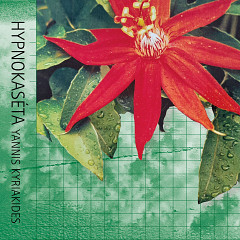
    The Greek title alludes to a suggestion by the late cognitive scientist Daniel Dennett that dreams spool within the slumbering mind, like cassette tapes that have been loaded into consciousness. Cyprus born, Netherlands based composer and sound artist Yannis Kyriakides has drawn on dreams he experienced during the first few months of lockdown, translating their fractured narratives and dislocated imagery into music for string quartet, plus his own live electronics, with guest improvisor Andy Moor wielding electric guitar and cassette tapes. The work’s sequence of 16 sections conveys the enigmatic orientations of the dream state without recourse to cliches of swimmy instability and blurry contours. Kyriakides brings his customary vigour and rigour to the making of music that is nonetheless intriguingly cryptic and irreducibly strange.

    Kyriakides apporte sa vigueur et sa rigueur habituelles à l’élaboration d’une musique qui n’en est pas moins intrigante, énigmatique et irréductiblement étrange.
  • 21
  • 22
  • 23
  • 24
  • 25
  • 26
  • 27
  • 28
  • 29