actuellecd

Blog

3585 results
  • 245
  • 246
  • 247
  • 248
  • 249
  • 250
  • 251
  • 252
  • 253
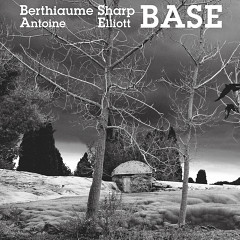
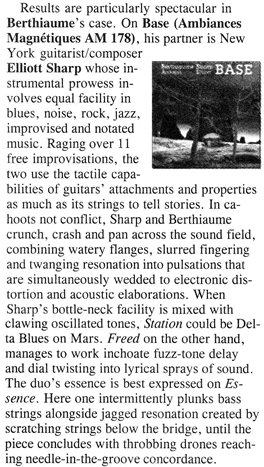
  • BASE in The WholeNote

    “Review”, Ken Waxman, The WholeNote, no. 14:6, March 1, 2009
    Sunday, March 1, 2009 Press
    Results are particularly spectacular

    Ellwood Epps, Philippe Lauzier, Pierre-Yves Martel in Hour

    “Improv Al Dente”, Mike Chamberlain, Hour, February 26, 2009
    Thursday, February 26, 2009 Press

    Mardi Spaghetti celebrates a year of twirling improv at Le Cagibi.

    The front room of Le Cagibi, the comfortable, funky neighbourhood café at St-Laurent and St-Viateur, is normally populated by students and post-university types huddled over their laptops. But for the last year, the back room has been the scene of Mardi Spaghetti, a Tuesday night improvised music series curated by Josh Zubot, Philippe Lauzier, Pierre-Yves Martel and Gordon Allen. The series brings together musicians, often in whimsical combinations, and each one of the four organizers is responsible for one Tuesday per month. The musicians come from disparate musical worlds — jazz, musique actuelle, rock — but improvisation is the common thread, according to Allen. In the year since the series began, more than 100 musicians have taken part. This coming Tuesday, March 3, Mardi Spaghetti is marking its one-year anniversary with a party and a number of special events, including a reprise of Martel’s “toiletronics,” a performance from inside the washroom that sits beside Le Cagibi’s stage, and an improvisation in the alley by Allen. Allen, the trumpeter with the porkpie hat and crooked grin, has practically been a one-man scene-maker since arriving in Montréal from Guelph a couple of years ago, as he’s also one of the people behind L’Envers, the performance space at 185 Van Horne that’s been running since September. He’s proud of what Mardi Spaghetti has accomplished. “Because Mardi Spaghetti is happening every week, it’s in the back of people’s minds, so it’s now part of the fabric of the neighbourhood and that café,” Allen says. “It’s intimate, with a small stage, and the room has a particular feel to it. It’s like the back room, not the dungeon. Because of the big windows, there’s a view from the street, and people stop by and listen because of that. There was already a good level of activity in Montréal for improvised music, but this series has made the music more visible, quite literally.”

    There was already a good level of activity in Montréal for improvised music, but this series has made the music more visible, quite literally.

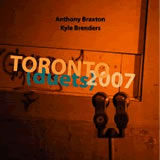
    Toronto (Duets) 2007 in All About Jazz

    “Review”, Mark Corroto, All About Jazz, February 24, 2009
    Tuesday, February 24, 2009 Press

    Want more Anthony Braxton Ghost Trance Music (GTM)? Yes please. Following recent releases of 12+1tet’s 9 Compositions (Iridium, 2006) (Firehouse 12, 2007), Nine Compositions (DVD) 2003 (Rastascan, 2008) and Quartet (GTM) 2006 (Important, 2008), this two-disc outing of GTM is paired down to simply (is anything ever simple with Braxton?) saxophone duets.

    Fans of Braxton and his GTM surely will recognize the format. For the uninitiated, paraphrasing Supreme Court Justice Potter Stewart’s characterization of pornography fits best: “I shall not attempt define it, and perhaps I could never succeed in intelligibly doing so. But I know it when I see it.” Same with GTM, as explained by Braxton himself; it’s music with no beginning and no end. And like a flowing river, it’s impossible to step into the same GTM song twice (apologies to Heraclitus).

    This trimmed GTM format cuts to the essence of the music. Braxton is joined by Canadian saxophonist Kyle Brenders, a student at Wesleyan University where Braxton teaches, who at times seems to be a cross between Evan Parker and Steve Lacy. Braxton and Brenders skate together through the composed themes, which can be both hypnotic and, at times, a source of vertigo. The tension accumulates when each accompanies the other or plays off the other’s improvisation. Like other like-minded disciples of the Braxton system such as hornist Taylor Ho Bynum, guitarist Mary Halvorson, or saxophonist Steve Lehman, Brenders clearly has a bright future in music. The discipline and freedom within this system is quite impressive.

    These two lengthy compositions are valued additions to the Ghost Trance Music mystique. The charm and allure of this music may be its defining of a sound with no beginning and, hopefully, no end.

    The charm and allure of this music may be its defining of a sound with no beginning and, hopefully, no end.

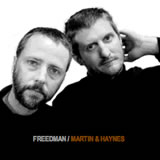
    Freedman in Panpot

    “Review”, Eric Theriault, Panpot, February 20, 2009
    Friday, February 20, 2009 Press

    Simply gorgeous. This new release from the Barnyard Records imprint further demonstrates how bigger isn’t necessarily better.

    The overriding philosophy about running your own record label is the exhilarating joy of building a project, your very own project, from scratch — and watching it evolve into something beautiful, with the hope of engaging a community of like-minded individuals. There’s also the romantic idea that you’ll be able to discover and release some new remarkable talent along the way. But on the flipside, the ability to release your own material, especially new creative projects which ordinarily fall before deaf ears, is probably the secret jackpot which gets a good number of musicians involved in the first place. And that’s exactly what you get here, in all likelihood, from percussionist and producer Jean Martin’s label Barnyard Records, through his duo with Justin Haynes.

    Remarkably, all you get on Freedman, is a ukulele and a suitcase. The initial idea sounds a little rogue, a little sparse, but that’s all you get. Really. For these two forward-thinking individuals, this is the vehicle to peddle the music of fellow Canuck Myk Freedman, and it works incredibly well. Haynes’ plucked chords dance softly, and dangle in thoughtful directions. Martin’s shuffle is a little more abstract on occasion, and provides a little weight to the feather. For all its lacking in the realm of sonic possibilities, there’s a simple liberating breath, a subtlety in the melody, and just a wonderful spirit; like a dusty needle or a faint lyrical flutter from a simple, captivating landscape.

    Freedman sits quite well next to two other releases from the label, namely the excellent Mexican-Parisian free-jangle of It’s Only Life! from the eclectic Blah Blah 666— with its evocative flourishes of melodica, b6 defretted guitar, and plastic blow things tailor-made for slow-poke afternoons. The other is the duet recording between Toronto saxophonist Kyle Brenders and legendary saxophonist Anthony Braxton who combine twisted forces on two “ghost trance compositions” on (the poorly titled) Toronto (duets) 2007. Needless to say, there are some nice things running around the farm these days.

    Simply gorgeous

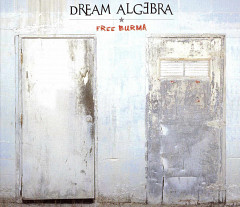
    Free Burma in The Gazette

    “Review”, Irwin Block, The Gazette, February 20, 2009
    Friday, February 20, 2009 Press

    Just as the Vietnam War inspired Billy Bang’s brilliant reflection on the conflict (Vietnam: The Aftermath), avant guitarist Rainer Wiens was moved after a visit in 1991 to the Karen hill tribe heartland in Burma to reflect musically on their battle with a tyrannical regime. The result is this splendid suite of six pieces that evokes the sounds and sonorities of that southeast Asian environment, with Wiens fitting in harmonically on the West African kalimba. Traditional Chinese flautist Shuni Tsou and Frank Lozano on western flute imitate bird-like sounds before the music becomes more threatening and brooding, with Jean René on viola leading the way with brilliant playing on themes that are menacing without being mournful. His 11-minute ballad, A complicated Sadness, is an outstanding statement. Percussionist Ganesh Amandan and drummer Schneider create rhythmic combinations that could be mistaken for indigenous while retaining their New World verve. It all ends on a hopeful note. Five stars out of five.

    The result is this splendid suite of six pieces that evokes the sounds and sonorities of that southeast Asian environment

    Vulgarités in The Squid’s Ear

    “Review”, Dave Madden, The Squid’s Ear, February 19, 2009
    Thursday, February 19, 2009 Press

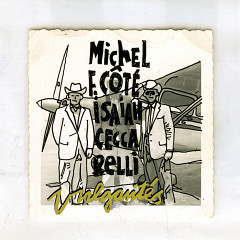
    As more of a rhetorical, sarcastic ribbing than an actual query, Michel F Côté and Isaiah Ceccarelli write, “What can we do when we’re just two drummers?” Indeed how does a percussion duo entertain an audience for forty-six minutes without a visual aid, balancing all the elements of music into a satisfying listener experience? Côté and Ceccarelli capably do so with a contingent of boundless creativity, astonishing sounds, impeccable performances (both men are accomplished composers and performers who have been around many a Montréal block) and knowing when enough is just enough (the average track length is under four minutes).

    Armed with kits, assorted junk drums, piano, pocket trumpet, “electronics”, feedback and lap steel guitar, Côté and Ceccarelli busily cycle though the history (and future) of percussion techniques. Beginning with “tape” hum and drum head stretches on Surmenage brun, they quietly and anxiously tap on rims, pull adhesives off heads, drag brushes on snares, flick on/off brief mechanical belches and strike every possible angle of their gear. After a brief pause, the duo reworks the first half, replacing some of the acoustics with subtle electronic shadows and closing with a pondering, lugubrious sub-harmonic echo. Moving to a more metal aesthetic, Grâce maussade is a polyrhythmic melee of various Gamelan bells, scraped metals and all manner of prepared keyboard tinkering (string strums, wood knocks, mallet thumps etc.) versus a spacious, lethargic piano melody. Nous, les troglodytes is what would happen if Steve Reid and Kieran Hebden followed through with the direction they hint of on their recent collaborations: hyperactive Interstellar Space style free jazz drumming with a bed of glitching Hammond organ, generated harmonics and DSP keeping pace. Côté and Ceccarelli aren’t simply about assault, however, and they show their range with Las du futur, a tenuous drone formed from oscillating sine waves, melodic feedback, bowed cymbals and intriguing sonic detritus (i.e. wiggling noisy cables), and the chatter-driven, bass drum grumbling, pianissimo Avantage de la débilité.

    Despite John Cage’s work in the 1940s and Edgard Varèse’s Ionisation (1930), the idea of “percussionist as band” is still often treated as a novelty — and, due to the excessive contraptions, toys and otherwise cacophonous instruments employed in most of the repertoire, this is often a fair label. But what happens when this equipment falls into the right hands? The answer is Vulgarités, an album that eschews the word “gimmicky” in favor of “virtuosity”.

    But what happens when this equipment falls into the right hands? The answer is Vulgarités, an album that eschews the word “gimmicky” in favor of “virtuosity”.
  • 245
  • 246
  • 247
  • 248
  • 249
  • 250
  • 251
  • 252
  • 253