Sauter au contenu principal
actuellecd

Blogue

223 résultats
  • 11
  • 12
  • 13
  • 14
  • 15
  • 16
  • 17
  • 18
  • 19
  • Bebe Donkey dans Bad Alchemy

    «Kritik», Rigobert Dittmann, Bad Alchemy, no 55, 1 août 2007
    mercredi 1 août 2007 Presse

    Die Begegnung mit Derek Bailey 2002 war schon ein Schlüsselerlebnis für den Gitarristen Antoine Berthiaume, aber ein Semester am Mills College bei Fred Frith und Joëlle Léandre verschob seine Perspektive ein weiteres Mal. In Oakland traf er auch auf die Flötistin & Laptopelektronikerin MaryClare Brzytwa, die sich als ein Wurmloch in ein Riot Grrrl-Wunderland entpuppt. Die 1981 in Youngstown, Ohio, geborene Tochter sehr katholischer Polen ist eine rasiermesserscharfe “Queen of B-bands”: In Bolivar Zoar mit Ava Mendoza & Theresa Wong halbwegs zwischen Äffchen und Engeln, oder wie Mendoza meint, halbwegs zwischen Bo Diddley und Hildegard von Bingen; als Byznich setzt sie im Alleingang ihr Mysti Marie Teater in Szene; und bei Slow, Children improvisiert sie mit der Kotospielerin Kanoko Nishi & der Drummerin Shayna Dunkelman E!!!!!motronics. Womit klar sein dürfte, warum Carla Kihlstedt sie auf das Unlimited 21 nach Wels eingeladen hat. Das MySpace-Wurmloch hat mich inzwischen über The Norman Conquest zu Nuclear Times rutschen lassen, dem Trio von Norman Teale mit Quentin Sirjacq und Berthiaume. Schwindlig gewirbelt durch diese Oakland-zentrierte MySpace-Zentrifuge, lande ich erst jetzt wirklich bei Bebe Donkey, benannt nach dem Donkey Punch Who is Really A Roller Derby Girl from Philadelphia. Berthiaume & Brzytwa scheinen da ihre Bewerbung abzugeben für eines dieser Akusmatikstipendien, die man nur bekommt, wenn man Bruitismus als ernste Sache betreibt. Alle Anklänge an Quirky-Pop, Frauenpower und Anti-Bush-Politik, in der Oakland-Szene allgegenwärtig, werden abgeschliffen zu schimmernden Gitarrendrones oder im Laptop zerschrotet, um damit abstrakte Gemälde zu bespritzen. Knispelige, knarzige Clicks, spotzige Störsignale und brummig verzerrte Wellen rauschen vorüber, ab und zu auch ein Anhauch von Flöte und keuchender Stimme. Bis Punch mit elegischer Zartheit und gezupfter Gitarre einem unerwartet direkt in die Augen schaut. Und She also tut das einige knurschige und pfiffige Minuten später noch einmal, mit orgelähnlichem Melos. Als Clou schließt Alitron mit einer verrauschten Hommage an Derek Bailey.

    Yé-Yi-You-Ya dans emoRAGEi

    «De zéro à disque», Nicolas Pelletier, emoRAGEi, 24 juillet 2007
    mardi 24 juillet 2007 Presse

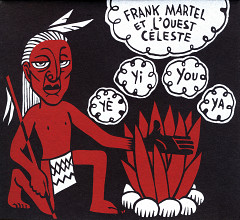
    Ah, l’humour surréaliste de Frank Martel est en plein ce dont j’avais besoin en cette grise matinée de semaine où je marchais en direction de l’arrêt d’autobus… Dès les premiers vers de Hahahihi, le poète de l’absurde venait d’ensoleiller ma journée! «Il me pousse des nageoires / je sens monter en moi le dérisoire / il me pousse des pétales / je sens monter en moi le végétaaaal…» lance-t-il dès le départ, comme pour donner le ton aux prochaines 36 minutes de délire qui s’amorcent. On y entend des airs de faux country (Janapapapamama), de folk déjanté (l’intense Les partitions de l’amour) ou de rockabilly de l’espace (l’obscure Cameroun). Je dis «faux country» parce que l’oreille distraite ne va qu’entendre une voix nasillarde et quelques guitares «slides» et banjos, mais en portant une attention plus soutenue, on réalise la belle variété musicale offerte ici. Frank Martel est toujours accompagné par le brillant Ouest Céleste, soit Bernard Falaise à la guitare et à la co-production, Michel F Côté aux percussions et Éloi Deit à la basse. Pour vous situer, l’œuvre de Martel se classe entre les premiers albums d’Hubert Félix Thiéfaine, de ceux de Charlebois période Wasapitchou, ou encore de Geneviève et Mathieu (en moins naïf), et même, d’une façon plus poétique et talentueuse, pas si loin de la démence de Normand L’Amour (écoutez Martel bloquer sur ces raisins verts dans Petite belette…). Pur délire, pur délice.

    Pur délire, pur délice.

    Étymologie dans Ici Montréal

    «DVD», SP, Ici Montréal, 19 juillet 2007
    jeudi 19 juillet 2007 Presse

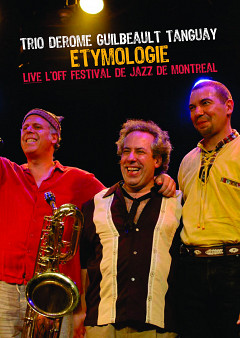
    Avec seulement 2 albums en 12 ans, c’est en concert que ce trio d’excellents musiciens déploie sa redoutable efficacité. Pour ceux qui ne les ont jamais vus, voici l’occasion d’être soufflé par leur intensité: pas de réchauffement ici, tout est à fond dès la première pièce. Enregistré au Lion d’Or pendant l’Off Festival de Jazz 2006, la prise de son est très bonne (disponible en 5.1) et les images de qualité. Ces géants du jazz d’ici n’hésitent pas à revisiter les Dolphy, Ellington, Tristano, Waller, Mengelberg et, bien sûr, Derome de façon très convaincante. Leurs sourires sur la pochette démontrent leur satisfaction autant que la nôtre.

    Pour ceux qui ne les ont jamais vus, voici l’occasion d’être soufflé par leur intensité

    Geisteswissen­schaften dans Vital

    «Review», Frans de Waard, Vital, no 585, 17 juillet 2007
    mardi 17 juillet 2007 Presse

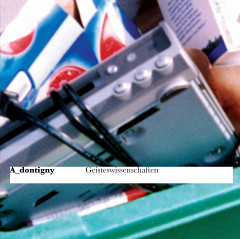
    The A in A_dontigny stands for Aimé, and he is a free noise composer from Canada. His name may ring a bell or two for his involvement in Napalm Jazz (not reviewed in Vital Weekly), morceaux_de_machines (see Vital Weekly 338 and 454), or his duet CD with Diane Labrosse (see Vital Weekly 384). Quite a busy man, but he never made a solo recording and Geisteswissenschaften is his first solo excursion. He gets help from various people on guitar, cello and bass, but by and large it’s a solo work indeed. What exactly A_dontigny plays himself then? That is perhaps a bit harder to answer, but perhaps it’s safe to say that it’s a multitude of precorded sources — meaning vinyl, CDs, mini discs, computer files of existing material that he treats through further computer processing, electronic effects and such like. He may add highly fucked up rhythm machines and/or samplers of any kind, but the end result is quite a fascinating journey through the world of today: we zap around, on TV, on the net, and we get a true bombardment of sound and images — here only sound. A world that would drive a lot of people crazy, or in fact it perhaps already did. Much better it would be to sit down and enjoy A_dontigny’s release. Turn off the TV, switch of computers and let yourself sink back in this crazy world that is madness enough for those who really want to listen. A_dontigny crosses the world with crazy sounds, and an interesting mixture of techniques to approach the world: musique concrète like, noise based and improvised in playing. It all can be done. If the previous releases by morceaux_de_machines were something you liked, then this new release by one half will appeal to you too: it’s by no means half as good; it easily matches the duo.

    A_dontigny crosses the world with crazy sounds, and an interesting mixture of techniques to approach the world: musique concrète like, noise based and improvised in playing. It all can be done.

    Cordâme, L’autre dans Vital

    «Review», Dolf Mulder, Vital, no 585, 17 juillet 2007
    mardi 17 juillet 2007 Presse

    The young Malasartes Musique label, is an initiative by Damian Nisenson, a composer and saxophonist from Argentina who settled down in Canada some years ago. The second release was a CD by a trio of Jean Félix Mailloux, called Aurores boréales. Mailloux now returns again in trio format with Cordâme. Himself playing doublebass, the trio is completed by Marie Neige Lavigne on violin and Julie-Odile Gauthier-Morin on cello. Pierre Tanguay helps out on percussion, plus Guillaume Bourque on clarinet on Au bord du Nil and Anit Ghosh on viola on Eider. All compositions and arrangements are again from Mailloux. In many tracks there are influences of folk music to be traced, especially from the middle east as title as Au bord du Nil and Valse hébraique suggest. Some of the compositions lack a own face and are a bit stereotype, others however are very good. The musicians give a dedicated and warm interpretation of the pieces. Similar in mood and atmosphere is the music on L’autre. At work is now a quartet of Jean-Marc Hébert (electric guitar), accompanied by Christophe Papadimitriou (bass), Pierre Tanguay (drums, percussion) and Marie-Soleil Bélanger (violin, ehru). All compositions come from Hébert, who studied guitar and composition in Toronto. With his group Skalène he already released three CDs. Also he participated in a project with Indian musicians. Like in the compositions of Mailloux we hear influences from other parts of the world, but, again like by Mailloux, the music breaths an unmistakably francophone atmosphere. This is due to their lyric and sensual approach Melancholy comes from the ehru, a chinese violin, played by Bélanger. We first heard this instrument on the duet cd of Bélanger and Normand Guilbeault, reviewed earlier for Vital Weekly. The playing of Hébert is sober but effective, and reminds sometimes of Antoine Bethiaume. Both Mailloux and Hébert make no drastic maneuveurs as composers. They are not into avant garde, rather they are engaged in an intelligent play with of all kind of influences in a music that always remains very accessible and enjoyable without becoming ‘easy’.

    Both Mailloux and Hébert […] are engaged in an intelligent play with of all kind of influences in a music that always remains very accessible and enjoyable without becoming “easy”.

    Philippe Lauzier dans The Gazette

    «Live Reviews: Festival International de Jazz de Montréal», Adam Kinner, The Gazette, 9 juillet 2007
    lundi 9 juillet 2007 Presse

    […] A fascinating concert of improvised and mostly improvised music took place at Cabaret Juste pour rire with French pianist Bénoît Delbecq making an exceptional debut with Philippe Lauzier’s Trio. Delbecq’s approach to improvisation — something in between John Cage’s prepared piano pieces, a gamelan orchestra, and Cecil Taylor — was refreshing in this already piano-saturated festival. By preparing the piano with various objects on the strings, Delbecq can access a wide variety of textures and colours not usually found in the piano. And Montréal-based saxophonist/clarinetist Lauzier provided a sympathetic stage for the gifted French pianist. With bassist Miles Perkin and drummer Thom Gossage, the trio’s sensitive and unified improvising was a remarkable setting in which Delbecq could shine.

  • 11
  • 12
  • 13
  • 14
  • 15
  • 16
  • 17
  • 18
  • 19