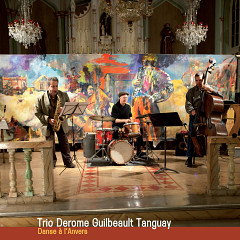
Danse à l’Anvers in The WholeNote
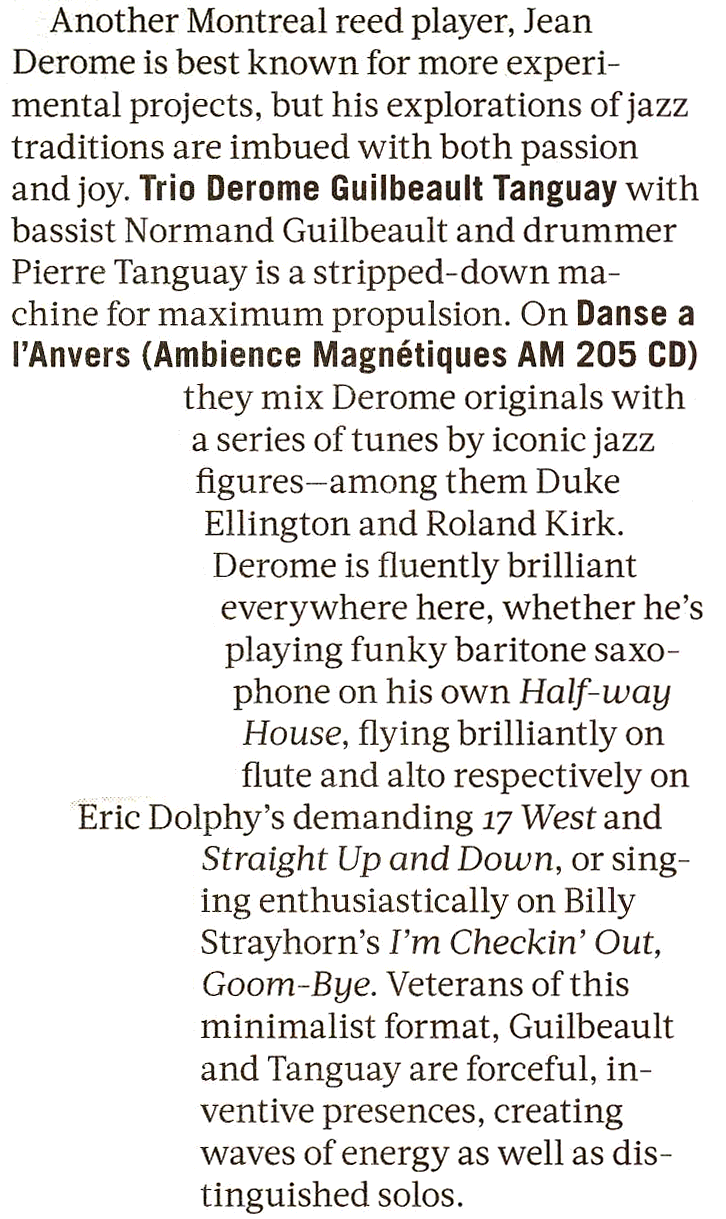
“Review”, Stuart Broomer, The WholeNote, no. 17:9, June 1, 2012
Friday, June 1, 2012 Press

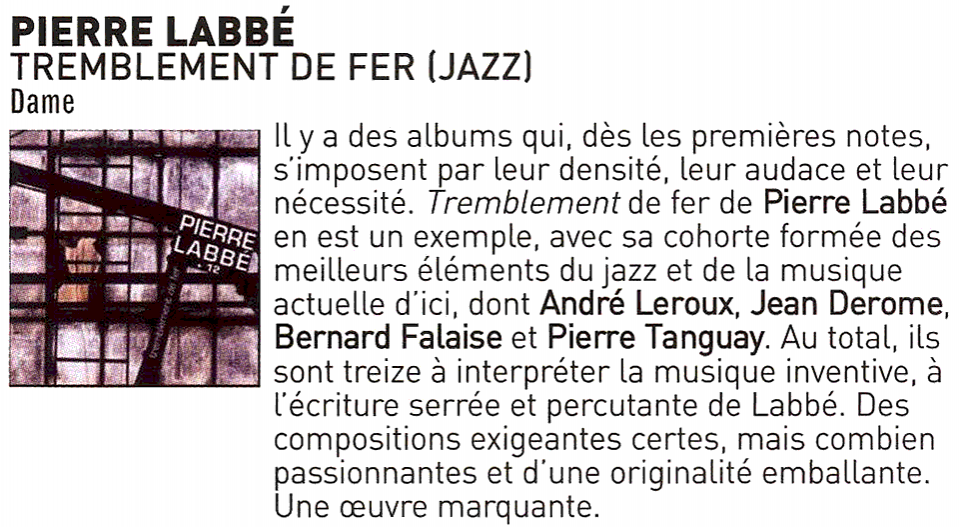
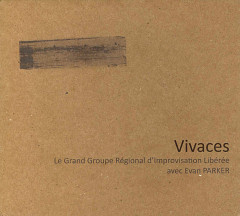
Pour des raisons souvent aussi économiques qu’esthétiques, l’improvisation se pratique bien plus en petite formation qu’en orchestre à l’heure actuelle. C’est certainement pourquoi je n’avais pas entendu d’improvisation collective, dirigée ou non, mais sous forme orchestrale, depuis maintenant pas mal de temps. C’est donc plutôt avec plaisir que j’ai découvert le
Ma première surprise en écoutant
La deuxième chose qui m’étonne, en comparaison surtout avec les deux orchestres précités, c’est la facilité avec laquelle s’écoute ces improvisations, et la joie présente dans ces improvisations, deux éléments qui rapprochent le
From a different perspective, the next set also faetured three strings but was completely different. The last set of Day 2 featured a quartet led by Jean René on viola with Joshua Zubot on violin, Nicolas Caloia on acoustic bass and Pierre Tanguay on drums. The sound of this ensemble was like a twisted string quartet with the drums as an equal part. Whereas Zorn’s string players were articulate and tight, this quartet had a looser earthiness, which was wild and chaotic at times. The quartet blended partially written material with frenzied sections and sparse moments as well. Mr. René’s writing seemed to draw from folk/rock as well as the odd classical influence. Sometimes all three strings buzzed together intensely while longtime AM drummer Pierre Tanguay balanced both rhythmic and subtle melodic counterpoint. What was surprising about this set was that you never knew what direction was coming next. Both Josh Zubot on violin and Jean René on viola took a number of inspired solos while the group interplay that was filled with many odd twists and turns. This was music that will take some time to get used to so it is probably a good idea to get Mr. René’s disc on AM (sic
Ensemble SuperMusique is/are an Ambiances Magnetiques all-star ensemble with ten members for this set, which featured longtime AM players like Jean Derome, Joan Hetu, Michael Cote, Danielle Roger and Martin Tetreault plus some young musicians like Alexandre St-Onge (el. bass) and Guido De Fabro (violin). The musicians sat in a semi-circle so that they could see each other and the music seemed as if it were directed by certain improv guidelines. The instrumentation included two reeds (Derome & Hetu, also on voice, two percussionists (Roger & Cote), cello, violin, electric keyboards or synth and turntables. Considering that there were ten musicians on stage, the music was often sparse yet focused. Much of the set reminded me of John Zorn’s early game pieces (which are also directed improv without someone directing up front), although the overall vibe was slower and more cautious. Ms. Hetu did some odd vocal sounds which always fit well within the framework on the piece. Since nothing was explained, there were a series of incidents that took place which we had to interpret for ourselves. Each musician took a turn sitting in the middle of the stage and drawing or putting info into a laptop which directed the next part of the piece. I especially like the way each percussionists added something distinctly different to the direction of the set. There was also a fine sax duo with two founding members of the AM label, Joan Hetu and Jean Derome, which was both charming and quirky. I spoke with a few audience members who were confused as to what was going on on-stage so it did take some effort to figure out how things worked. Fractured fairy tales, indeed.
Considering how long German free/jazz sax legend
The solo set from the first of this new Victo disc features four pieces with
The trio set was devastatingly great
![Ensemble SuperMusique (ESM) [Photo: Céline Côté, Montréal (Québec), November 2023]](https://res.electrocd.com/image.php/image/e/ensemblesupermusique__13515.jpg?width=n2&cropratio=1:1)