actuellecd

Blog

188 results
  • 5
  • 6
  • 7
  • 8
  • 9
  • 10
  • 11
  • 12
  • 13
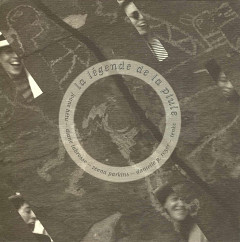
  • La légende de la pluie, Musique d’hiver, Seule dans les chants, Langages fantastiques, Face cachée des choses, Tricotage, Les contes de l’amère loi, Prairie orange, Ravir, Simoneda, reine des esclaves, Joane Hétu, Diane Labrosse, Les Poules, Danielle Palardy Roger in actuellecd.com

    “Chicks and Other Barnyard Fauna”, François Couture, actuellecd.com, September 16, 2003
    Tuesday, September 16, 2003 Press
    With the notable exception of sugary pop, all music styles are dominated by the male. Whether he’s grunting into the microphone, strumming his guitar, or blowing his lungs out on the saxophone, the manly man monopolizes the image of the musician, be it in corporate rock or on the new music scene. When women venture into his domain, they are often coerced into fitting the mold of the industry.

    That’s why it is so surprising to find this many creative, challenging, talented women in DAME’s catalog. But one should not forget that early in its lifetime the collective Ambiances Magnétiques welcomed three artists whose musical activities, organizing minds and determination provided a force of attraction for other women. Of course, I am talking about Joane Hétu, Diane Labrosse and Danielle Palardy Roger.

    Our three protagonists met at the turn of the ‘80s in Wondeur Brass and pursued their association into Les Poules and Justine. First an anarchist/feminist big band, Wondeur Brass was a laboratory to Joane, Diane and Danielle. They honed their skills — Joane, self-taught, literally learned to play music while playing music in it. Their own blend of modern poetry, free jazz and rock-in-opposition already took center stage on the LP Ravir. From the sextet featured on this first effort, the group scaled down to a quartet (with bassist Marie Trudeau as the fourth member) by the time of Simoneda, reine des esclaves. This line-up soon took the name Justine for three more albums (credited to the name of the individual musicians, La légende de la pluie can be seen as a collaboration between Justine, Zeena Parkins and Tenko) and the feminist discourse got gradually subsumed, making way for a growing playfulness that reached its peak on the phenomenal album Langages fantastiques.

    Soon after the release of Langages fantastiques, the three girls launched their solo careers. Linguistic marvel and a rough delivery keep singer and saxophonist Joane Hétu close to the field of outsider art. First she formed her own group Castor et compagnie (with Labrosse, Jean Derome and Pierre Tanguay) which has recorded two albums of sensual and twisted songs in direct relation to Justine’s music. Later she turned to improvisation, first in a duo with her life partner Jean Derome as Nous perçons les oreilles (We Pierce Ears) and later solo with the intensely intimate album Seule dans les chants. She recently proved her worth in large-scale composition with her marvelous Musique d’hiver.

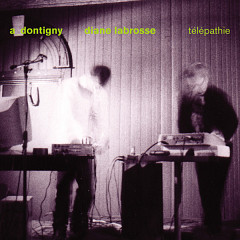
    Toward the end of Justine’s life, Diane Labrosse traded in her keyboard for a sampler. After a solo album, Face cachée des choses, a duo album with percussionist Michel F Côté (Duo déconstructiviste) and a guest spot in the latter’s group Bruire (on Les Fleurs de Léo), she wrote a piece for improvisers (Petit traité de sagesse pratique) before devoting her time to improvisation. Parasites (her ongoing collaboration with Martin Tétreault) and Télépathie (with Aimé Dontigny) show how it is possible to handle a sampler with grace and sensibility.

    Since the disbanding of Justine, Danielle Palardy Roger’s discography has been growing slowly — she’s very busy organizing concerts as head of Productions SuperMusique. Her children’s tale L’oreille enflée (featuring the voices and instruments of Derome, Hétu and André Duchesne among others) speaks to a young audience with an intelligence too rarely found in such projects. And Tricotage, her improv session with French bassist Joëlle Léandre, reminds us how refined her drumming can be.

    In 1986, Joane, Diane and Danielle took a vacation away from Wondeur Brass to investigate the limits of the pop song format under the name Les Poules — The Chicks (Contes de l’amère loi, freshly reissued). Recently they reformed the trio, this time pushing the music toward a form of improvisation rich in subtle textures, blending quiet noise, active listening, and lyricism. Prairie orange is the first effort from this awaited return to collective work.

    The presence within Ambiances Magnétiques of these three creators has attracted to the label other female artists with similar interests. The first one to join the roaster was Geneviève Letarte, who has recorded two beautiful albums of poetic songs (Vous seriez un ange and Chansons d’un jour). Lately, DAME’s catalog has welcomed performer Nathalie Derome, guitarist Sylvie Chenard, pianist Pui Ming Lee, along with Queen Mab members Lori Freedman and Marilyn Lerner who each delivered a solo album (À un moment donné and Luminance).

    So, is musique actuelle a man’s world? Listen to these few hints and you’ll see for yourself.

    Télépathie in Coda Magazine

    “Critique”, PR, Coda Magazine, September 11, 2003
    Thursday, September 11, 2003 Press

    Pour produire la musique globalement ambient et sereine, bien que continuellement parcourue de craquements minimalistes et d’impressionnants bruissements qui zèbrent l’espace sonore du bien nommé Télépathie, Diane Labrosse (des groupes féminins Wondeur Brass et Justine) et a_dontigny (connu pour son travail au sein du collectif Napalm Jazz), en parfaite osmose, ne se servent respectivement que d’un échantillonneur et d’un ordinateur portable, dont ils font des instruments à part entière, au-delà des seules idées de détournement et de piratage souvent à l’œuvre chez nombre de leurs confrères. Sur cet opus dans la lignée du remarquable Île bizarre justement réalisé par Diane Labrosse en compagnie de la percussionniste électronique Ikue Mori, le duo développe et explore des formes à l’expressionnisme abstrait mixées en direct à la Casa Del Popolo en avril 2002. Ce disque témoigne d’une créativité jamais prise en défaut et d’un immense plaisir à jongler avec les sources, au point que l’écoute sera forcément jubilatoire pour qui se laisserait transporter par ces ambiances.

    … une créativité jamais prise en défaut et d’un immense plaisir à jongler avec les sources…

    Studio — Analogique — Numérique in Vital

    “Review”, Dolf Mulder, Vital, September 11, 2003
    Thursday, September 11, 2003 Press

    More splintered and fragmented sounds from this duo that we already know from earlier work (21 Situations). We find their new work physically not on one CD but distributed on three mini-CDs. Objectively there was no reason to do so. All the music would perfectly fit on one CD. At the center of this triptych is the Studio CD. It is recorded live in the studio and has Tétreault and Yoshihide playing turntables and electronics. No reprocessing afterwards took place. After this job was done both gentlemen split. Tétreault took the analogue road and Yoshihide the digital one. Both used recordings that were not used for the Studio CD. On Analogique Tetréault used obsolete tape recorders and created a flowing analogue remix, resulting in 5 short pieces. Yoshihide choses for another approach. With the newest facilities computers have to offer he created a heavy reconstruction, called Numérique. It that lasts some 20 minutes. So the left and right panel of this triptych are both soloworks. They knead their analogue and digital sound material into objects that are hard to judge and compare. What point of reference shall I and can I take? Is this music? The answer makes no difference. But as a listerner I want to conquer this strange sound object one way or another. In order to give it some meaning, etc. But concerning this release, I’ll try again another time. For this moment the sounds remains sounds, although manipulated by both gentlemen in a bruitiste way

    Un moment de bonheur in Cadence

    “Review”, Frank Rubolino, Cadence, September 9, 2003
    Tuesday, September 9, 2003 Press

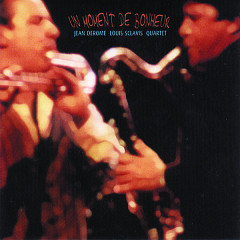
    French Canadians and Frenchmen matched firepower at the Victoriaville fest in 2001 under a flag of mutual leadership and respect on Un moment de bonheur. The encounter brought together two standout woodwind players and an equally strong support team. Multi-faceted flutist/saxophonist Derome and explosive drummer Tanguay represented the Canadian contingent, while stellar clarinetist/saxophonist Sclavis and inventive bassist Chevillon carried the colors for France. Unusual sounds abound on this set. Besides the multiplicity of horns played by Derome and Sclavis that continually change the color and texture of the music, special effects are added through Derome’s and Tanguay’s playing of the guimbarde (Jew’s-harp) and the various sound-producing objects handled by Sclavis.

    Interestingly, Derome is the composer for five of the six tunes. His songs are multi-layered suites that pass through many tempo changes and structural variations. Derome’s compostions have European leanings; they are typically devoid of tangible ties to the blues. The music evolves as in a mathematical equation, producing sharp edges that jaggedly worm their way through a complex improvised maze with Braxton-ion efficiency. It turns into a power session of intense heat when the two leaders take their horns to far-reaching places and Chevillon and Tanguay spur the ride. On Sclavis’ lengthy Suite pour un bal, his bass clarinet establishes a carnival stage where the band merrily follows the piper into realms where there is no turning back to normality. Heavy motive bass/drum forces push the multiple-phased piece in ever-changing directions, and Derome and Sclavis excel at exploring the extensive improvising possibilities.

    On all selections Derome and Sclavis become aggressively combative and take the music up several notches with their intense blowing. This study in contrasting styles boils down to a jostling match of heavy reed hitters pouring fuel on the creative fire. Multiple exposures to the disc will garner the many subtleties in this music as well.

    … a power session of intense heat when the two leaders take their horns to far-reaching places and Chevilion and Tanguay spur the ride.

    Télépathie in Satelitepop

    “Discos”, Alfonso Méndez, Satelitepop, September 7, 2003
    Sunday, September 7, 2003 Press

    La escena musical canadiense concentra a un buen número de músicos abonados a la experimentación. Existe una escena que profundiza en los impulsos de la música y los reconstruye ya sea con nuevos recursos tecnológicos o de manera clásica . A_Dontigny y Diane Labrosse llevan años haciendo individualmente aportaciones a la música avanzada y ha tenido que ser en la ya mítica sala Casa del Popolo donde estos dos particulares músicos se han encontrado y fusionado su talento. Dontigny con su ordenador y Labrosse a manos de un sampler grabaron una actuacion que ofrecieron en dicho lugar, el 20 de abril del 2003, y en la que interpretaron cuatro largos temas donde improvisan uno sobre el otro y en el que la particular conexión entre ambos da lugar un disco de electrónica experimental equilibrado, ordenado, con cierta abstracción y momentos acertados, algo presumiblemente dificil, al contrario de lo que pueda parecer.

    El trabajo de Dontigny y Labrosse es todo un experimento en el que ponen a prueba esa Telepatía que aguran en el título. Sin duda una puesta arriesgada no apta para todos los oídos.

    Sin duda una puesta arriesgada no apta para todos los oídos.
  • 5
  • 6
  • 7
  • 8
  • 9
  • 10
  • 11
  • 12
  • 13