Reed sections have been part of jazz’s performing vernacular since its earliest days. But only with the freedom that arose with modern improvised music in the 1960s were the woodwinds able to stand on their own. In the right hands, with the right ideas, a group consisting only of saxophones and/or clarinets can produce satisfying sounds that don’t need the intervention of a rhythm section or even brass for additional colors. All of the fine discs here demonstrate that. […]
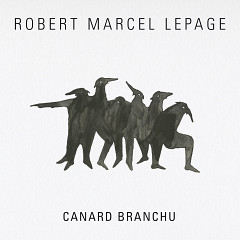
The difference may result from geography or personality, but in sharp contrast to the concentration on solemn experimentation which characterize the Double Trio and Keefe Jackson CDs, Montreal clarinetist Robert Marcel Lepage’s Canard branchu in the main promotes unselfconscious merriment. With his reputation for creating soundtracks, Lepage sets his compositions here in a fanciful swamp populated by the insects, birds and amphibians. Moreover while many tracks on the other CDs appear to be evolving improvisations, Lepage’s are self-contained, songs. Nonetheless while the sounds may be decorous and controlled, they’re not formal and mix good fun alongside technically clever improvisations. The band make up is different as well. The core band is Jean-Sébastien Leblanc and Pierre Emmanuel Poizat on clarinets, Guillaume Bourque, bass clarinet, André Moisan on basset-horn plus bassist Fraser Hollins, and drummer Pierre Tanguay, with Nicolas Borycki adding electric organ on three tracks. Bass clarinetist Lori Freedman joins the band on one track and plays another unaccompanied; while the composer plays solo and duets with Moisan on two different cuts. With steady rhythm section work, the others are freed for supple, contrapuntal work, resembling the score for a kids’ show on one hand and Duke Ellington’s arrangements for clarinet trio on the other. Characteristic is Le Pelleteur de nuages, whose church-like harmonies courtesy of Borycki underlie a theme that touches on Can’t Help Falling in Love plus Creole Love Call. Bourque shines on Maringouins en escadron as tremolo horn parts sound as if they come from an accordion; whereas Fondation: qui sommes-nous is a pseudo-tango that contrasts the basset horn’s serene chalumeau with slick drum patterns. Chalumeau is also in use on Mi-figue, mi-bémol, Lepage’s solo feature, that improvises succinctly on the melody line, whereas on her own feature, Freedman’s variants on Le Grand héron et la demoiselle use hectoring cries, irregular vibrations, split tones and spetrofluctuation to deconstruct the theme into individual atoms, then reconstructs in a pointillist fashion. […]
In trio or larger formations, each of these CDs confirms the long-term viability of woodwind groups creating exhilarating sounds.