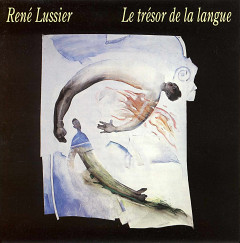
A growing interest for
Perhaps
••• You use Québec traditional music in your work, often with humor. Why
I started to stamp my feet when I was playing reels with
That was at the time of the 1976 nationalism growth, during the last stretch to the 1980 referendum that I was discovering traditional Québec music. I was thrilled by it, for was it was. I even build an electric footboard so the stamping can be amplified.
The defeat of the referendum caused the death of traditional music. It was dropped quite violently. A total reject. So I was learning to play that music at a time when the majority in Québec was renouncing its musical origins which were associated with the independence movment. When the referendum was lost, tradional music was representing a failure and it went down the drain.
In the case of the duo with
••• In those cases, it is a Folk “flavor” but
It continued to develop. I met Jean Derome who’s a fan of Soldat Lebrun, of French Canadian songs from the beginning of the century. One day he said
We naturally came to look into that repertoire. But we don’t play that many songs. If we were doing any at the time, if we were inspired by them, it is because we like them. It was somewhat against the current since most Québécois were pushing that music away. I felt it was strange to disregard our roots, our origins, the stuff we’re made from… so I still play Folk songs.
••• There are also originals songs that are “ Folk”. I am referring to the song about unemployment insurance (on the Absolute CD)… It’s in the style of a fun fair.
•… where the lyrics are part of the “contemporary folklore” of Québec, of Canada…
The text was written by the Department of Employment of the Government of Canada.
••• But is Folk music only another sound source
It is one sound source amongst many others. I’m interested in Folk music as much as I am in contemporary music, progressive rock or Ornette Coleman’s Free Jazz. I equally like Messian — in the right context — Louis Tipou Boudreau, Johnny Winter, or Naked City. It’s the idea to not refuse anything. Æsthetically, I do not reject anything. It is quite clear that by playing those pieces we are making a link with folklore. But we somewhat stay off-mainstream. Instead of trying to have the same sound as everybody else, we have our own material and background, our own references. It is attached to our national identity. Somewhere we’re still for the independence. We were born in that environment
••• And politics
The work we do is to compose, to perform and to improvise our music which deals with a large variety of issues. This being said, there is a political side if one wants to see one. We talked about political issues in our music with humor, with Folk, with out of control things and incontrollable things too. There are pathetic moments as well. We have fun when playing the song about unemployment insurance with the polkas… but it also has its moments with incredible chaos. I never considered myself as a politically involved musician. I feel more involved now, but that is because I am hired more. But I was never given any gifts. If we made albums, shows and tours, it is because we created our own gigs. We made a lot of music for film, making our living for a while.
What’s special in Québec, because we’re French speaking, is its isolation both on the cultural and geographical levels. The door isn’t that open to go to the USA (where we have performed because we were playing with other musicians). In Canada, we just started to play there.
So you either stay in Québec or you go a little bit in Europe (and that’s every time a big thing). The musicians who write and perform are obliged to renew/refresh themselves quite often. You cannot play the same show a large number of times here. It isn’t like in the USA or in Europe. Thus the musicians have written a lot and been through all kinds of musical experiences.
Elsewhere in America — and that’s very surprising — it isn’t as strong culturally. Not because they don’t have any talent. It is rather because their cultural environment has not put as much pressure on them as our own has here. It think that’s important, I may be wrong…
••• When you perform Folk flavored songs (such as the unemployment insurance one) in French in… Winnipeg, what is the reaction of the public
When we play in places where they don’t speak French, we try to make ourselves understood. I don’t want to be cut from anyone. I want the people to be concerned with what we’re doing, when we’re there, with them. We’ve succeeded in bringing them in the room, that’s already something. So we take care of them. In the case on the song on unemployment insurance, we tell them that, anyway, it’s the same thing. We’re singing in French, but it is the same thing in English. There’s enough people on unemployment insurance in Manitoba for them to know what we’re saying. The questions are also in French on their cards.
••• What about humor in your music
It is a key. We don’t prepare jokes. We places ourselves in a humorous mood, just like we place ourselves in a improvisation mood or in a performance mood. Humor is used also to have fun and to reach the public. Sometimes we really need all of our resources, including humor, but not only humor. It is like Eugene Chadborne who uses humor to make his music reach out. I, too, don’t do stand-up comedy, I do music.
••• And with
The so-called alternative music and improvisation sphere is quite a harsh environment. For many, being a musician it’s dealing with career plans. We don’t care much about our careers. We continue to play. We’ve been on our own since the beginning… We did get support, at times. We’ve always done our music our way, without compromise and trying to have fun doing it.
•••
But there is something that is clear
••• Where do you place yourself in the musical panorama of Montréal
Between four chairs… I’ve never associated myself to the world of Jazz music because I don’t know how it’s made. I don’t have neither the background nor the ability as a performer for Jazz. I listen to it… Mingus, Ellington, Dolphy… and I appreciated it too, but without associating myself to that style.
But I’ve improvised with Jazz musicians. I think that improvisation is a common ground for many styles. Musicians interested in improvisation may eventually work together. The common ground is the liberty, the maximum of openness.
In Montréal, I fell like an “illegitimate” musician
••• How do you see Montréal’s music panorama
The Jazz becomes more and more sophisticated. There are very clever and skillful Jazz composers, very solid musicians in Montréal (such as Pierre Cartier, Jean Baudet, Michel Ratté), super musicians who are associated to Jazz because it’s the style that resembles most what they do. There’s the new music community, with composers, which has certain similarities to Rock or improvisation (to name three
For example Alain Thibault fills in the gap between contemporary music, electroacoustics and… pop. With
There are many musicians and there is a lot of music created in Montréal. As I say earlier, musicians are forced to compose more because of the small size of the community and to renew their material a lot to be able to live. The musical community in Montréal is in good health but the industry didn’t follow (and that’s not unique to Montréal). In Canada, outside Québec, there are not as many musicians working in free improvisation. Jazz is quite strong in Canada. But I don’t know everybody. Most of the interesting people are hidden. Hidden because the industry is to impermeable/impervious to them or because they’ve abandoned the idea of making themselves heard and have preferred to continue to do what they want to do.
••• What are the differences in support from the governments, the institutions or the concerts societies for the “composers” and the “improvisers”
There are all of the differences. The composers are a lot more supported. It’s always been a management anarchy for the improvisers. Usually, improvisers don’t play in a band on a permanent basis. Musicians get together to share a language which is improvisation. There has been sporadic projects, but none were ever “institutionalized.”
On the other hand, composition — we know — is a lot more supported. Another difference is that composers work alone. The solitary composer
Furthermore, the performing rights societies don’t give anything to improvisers because they consider that on an eight minute piece there is about 30 seconds of composition.
••• So, economically speaking, improvisers are on their own
We’re on our own. It’s a sideline. I don’t make a living with it, but it makes me alive. It is with composition for film, for the concert that I make a living. Improvisation brings in a little bit of money, but never as much as film music does.