Sauter au contenu principal
actuellecd
  • This website is also available in English.

Blogue

3585 résultats
  • 459
  • 460
  • 461
  • 462
  • 463
  • 464
  • 465
  • 466
  • 467
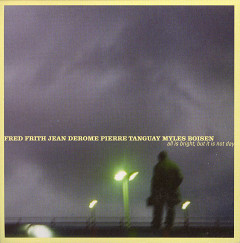
  • All Is Bright, But It Is Not Day dans Jazz Notes

    «Critique», Jazz Notes, no 41, 1 janvier 2003
    mercredi 1 janvier 2003 Presse

    Friths’entoure de Derome (sax, fl, divers), Tanguay (dr) plus un preneur de sons Myles Boisen très inventif. Notre génial bricoleur et sa guitare, assisté de ses deux autres acolytes font dans le délire, un impressionnant voyage. C’est tout à fait déjanté. On les entend créer in situ un enchaînement d’assemblages totalement iconoclastes. C’est totalement hybridé. En fait, Frith dont l’aisance dans la technicité et le gag démontre tout son talent, soutenu par deux compères qui ne se forcent pas pour en rajouter. Totalement lumineux dans le délire.

    Totalement lumineux dans le délire.

    liberum arbitrium dans Ici Montréal

    «Compact!», François Couture, Ici Montréal, 19 décembre 2002
    jeudi 19 décembre 2002 Presse

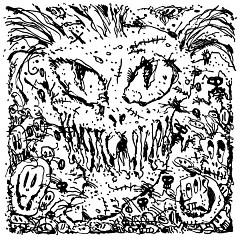
    Le bruitisme hardcore renferme en son sein un germe de facilité, comme en attestent les tonnes de productions maison qui cherchent à renchérir sur le style de Merzbow et des Haters. Heureusement que morceaux_de_machines nous ont livré le superbe liberum arbitrium. Bruitiste sans être extrême mais surtout éminemment intelligent, ce disque élève l’art de l’assaut sonore dans les hautes sphères grâce à de sévères retournements dynamiques et à une réserve inépuisable de sources sonores. Tout est à aimer: le contrôle des musiciens sur la brutalité de cette matière, la réalisation exquise, la pochette de Guy Boutin.

    Bruitiste sans être extrême mais surtout éminemment intelligent, ce disque élève l’art de l’assaut sonore dans les hautes sphères…

    Océan pour la suite dans Splendid E-Zine

    «Review», Mike Baker, Splendid E-Zine, 16 décembre 2002
    lundi 16 décembre 2002 Presse

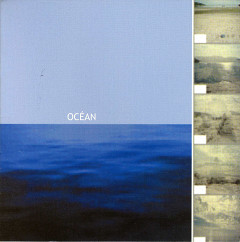
    This album of collaboration between Sylvie Chenard (electric guitar), Maryse Poulin (saxophone), Alexandre St-Onge (electronics) and Martin Tetreault (turntables) marks another in Ambiances Magnétiques’s grand series of improvisational avant-garde releases. In keeping with the label’s unspoken promise to abstain from melody, standard time and logical coherence, Océan pour la suite is comprised of duets, featuring Chenard and her invited guests, that bend and break the rules of structured improv. No amount of intellectualizing is going to make most of this noise sound like anything other than noise. That’s not a value judgement, but it is related to my feeling that the key to understanding Chenard’s intensely subjective and ambiguous approach to music is in the creation and performance of the pieces, not necessarily the recording. As a result, one is left to wonder how often a disc like this will find its way off of the shelf and into the stereo. While conceptually stimulating and somewhat rewarding as an end product, Océan pour la suite functions as a reminder of how essential it is to experience work such as this in a live setting rather than striving to capture the feeling at home.

    «Dis, Blaise…» chanson du Transsibérien dans Outsight

    «Review», Tom Schulte, Outsight, 15 décembre 2002
    dimanche 15 décembre 2002 Presse

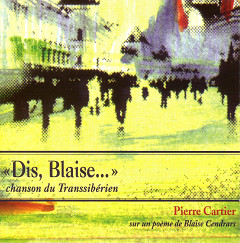
    On this CD, the accompaniment of reeds (Jean Derome), viola (Jean René), trombone (Tom Walsh), guitar (Bernard Falaise) and drums (Pierre Tanguay), Pierre Cartier sings the epic poem by Blaise Cendrars. This piece is Prose du Transsibérien et de la Petite Jehanne de France. Cendrars wrote the ode in Paris in 1913. It is the tale of a teenager’s journey across Russia in 1905 as the Trans-Siberian railroad is being built and the Russo-Japanese war goes on. In presenting this poem (in French), Cartier mixes rock in opposition style avant-jazz with underpinnings of medieval liturgical music. 4.5/10

    Cartier mixes rock in opposition style avant-jazz with underpinnings of medieval liturgical music.
    4,5

    All Is Bright, But It Is Not Day dans Hour

    «Review», Mike Chamberlain, Hour, 12 décembre 2002
    jeudi 12 décembre 2002 Presse

    There’s a scene in the 1990 film Step Across the Border that shows Fred Frith playing with his daughter. The two take turns shaking a rattle and the child pecks away at a keyboard to Frith in clear delight.

    In another scene, Frith buys supplies in a Japanese grocery — chopsticks, rice, etc. — but when he gets home, he doesn’t use them to prepare dinner. Instead, he experiments with the sounds his groceries make when they are brought in contact with his guitar.

    Taken together, the two scenes illustrate as much or more about Frith is music than any two or three of the hundreds of recordings he has had a hand in over the past 30-odd years, beginning with Henry Cow in the late ’60s and continuing since in collaborations with virtually everyone in the international “popular” avant-garde.

    For at the heart of everything that Frith does is a sense of playfulness, and a curiosity about just what he can make happen in the world of sound.

    Had he wanted to, Frith, who grew up with a classical education on the violin, could have been a successful rock guitarist. But his restless curiosity and aversion to tried-and-true habits made that question moot from the start. He has been inclined to dissolve projects when they seem to be slipping into formula, without regard for the critical or commercial success involved.

    This is not to say that Frith doesn’t have precccupations that have remained consistent over the years. One is the possibility of the recording studio. Another is a concern for the relationship between composifion and improvisation. Which brings Frith to Montréal this week for a pair of concerts and a CD launch with Jean Derome and Pierre Tanguay, as well as a lecture / workshop on improvisafion titled Trouble With Traffic as part of the inaugural week of Project Improvisation, organized by McGill professor Eric Lewis.

    The recording with Derome (reeds) and Tanguay (drums) came out of a workshop and concert that the two Montréalers did with Frith’s improv students at Mills Colleqe in Oakland, California. Following the student performance of Derome’s Canot Camping, the three decided to do an improvised performance at a club in Oakland. The next day, they got together at the recording studio of Myles Boisen, with whom Frith has worked since the 1970s.

    Frith explains his approach to the recording: “I’m interested in the idea of taking improvised music and composing with it after the fact. Every once in a while I come back to this idea, which I first did with Henry Cow.

    “This time, I wanted to do something a little different, so I allowed Myles free rein to do what he wanted with what we were playing by mixing it live and recording it directly to two-track. So as we were playing, we didn’t really know what the final product was going to sound iike, even though there were no overdubs or anything else afterward.”

    In Montréal, Derome / Frith /Tanguay will perform twice. The first, Dec. 13, 9 p.m., at La Sala Rossa (the lecture/workshop is at La Sala at l p.m.) will use the same process as on the album, with Bernard Grenon electronically manipulating what the trio plays in real time. The second 2 performance, at Va-et-vient on Saturday evening, will be an “acoustic” presentation.

    All the music is improvised, so don’t expect to hear them play it “just like the record.” Not that Frith ever would. But he will make one concession to commercialism.” I think it’s a great idea if people go to both concerts.”
  • 459
  • 460
  • 461
  • 462
  • 463
  • 464
  • 465
  • 466
  • 467