Sauter au contenu principal
actuellecd
  • This website is also available in English.

Blogue

3585 résultats
  • 454
  • 455
  • 456
  • 457
  • 458
  • 459
  • 460
  • 461
  • 462
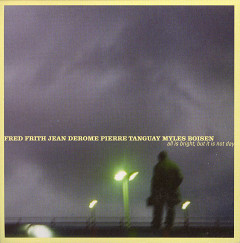
  • All Is Bright, But It Is Not Day dans Vital

    «Review», Dolf Mulder, Vital, no 364, 21 mars 2003
    vendredi 21 mars 2003 Presse

    On February 18th 2002, these four gentlemen came together in a studio in Oakland. Frith had brought his guitar with him. Derome had his saxophone and many other wind-instruments as well as some little percussion instruments in his suitcase. Tanguay arrived with his drums and all kinds of objects. The fourth musician, Boisen came with empty hands and did the real-time sound manipulation.

    The idea was to spend the day with spontaneous improvisations, to be processed in real time by engineer Myles Boisen. 8 pieces found their way to the CD format and are availbale now on this new release on Ambiances Magnétiques.

    Frith’s first release of improvised music was his album “Guitar Solos”, released in 1974. This one was engineered by David ‘White Noise’ Vorhaus. The liner notes say: “No overdubs were used, the music is heard as it was played… The only sounds not produced ‘naturally’ by guitar or prepared guitar are those of the fuzz box… ” So the task of the engineer here was only to register. To the listener these quotes want to make sure that he trusts his ears: yes, you hear it as it was played. And yes, it is the guitar that produces all these strange sounds. So don’t question it.

    With All is bright, but it is not day we have a situation that is very different. Here the engineer is the fourth musician. “Real-time processing is a fundamental asset here, as the new sound matter it brings forward have a radical effect on the perception of music.” I’m not sure what kind of technology is involved here and what use Boisen made of it. I suppose that during the playing of the trio he alters the music according to his own musical intuitions and gives the music it’s definite shape. So on the one hand it may remain a question if we hear the music as it was played by Derome, Frith and Tanguay. But on the other hand it is no question at all if we emphasize the role the fourth player: engineer Boisen. He is responsible not only as an engineer but also as a musician in the recording of the music.

    By the way Myles Boisen is also guitarist, member of the Splatter Trio and played with many West Coast improvisors, Rova, Club Foot Orchestra, etc. As a recording engineer, Myles started in 1979 and worked since on about 150 productions. Derome and Tanguay know each other from numerous cooperations since 1980. Allthough the four know each other from other occasions, they work together here for the first time. Together these four musicians present here their first cooperation. The cd opens with somebody laughing painfully. Another voice says: “that’s an interesting technique” Gradually the laughing is adopted by the players and the music starts to develop.

    Does all technique and technology end up in interesting music? Yes, some brilliant moments are catched here: strange magical sounds, dark atmospheres. At other moments humour and childlike tunes takes over. But I like it most because it is an convincing experiment. Ending up in interesting blend of live impro music and real time processing.

    Yes, some brilliant moments are catched here: strange magical sounds, dark atmospheres.

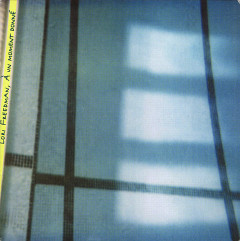
    À un moment donné dans Splendid E-Zine

    «Review», Christian Carey, Splendid E-Zine, 21 mars 2003
    vendredi 21 mars 2003 Presse

    One of the most difficult tasks a composer can set for himself is to construct a solo work for a melodic, single line instrument. There are no chords and harmony to hide behind; there are no ensemble collaborators to engage in contrapuntal dialogue. The composer must endeavor to hold the listener’s interest with naught but the development of a single melodic line. For author and performer alike, this is some of the most exposed and naked music to present to the public — it is like walking the tightrope without a net beneath you. For an improviser like Lori Freedman, this must be even more so the case — not only is she up there alone, but she’s also trying to extemporize.

    The Canadian clarinettist presents 13 improvised pieces here. Many of the works seem to have some affinity for the pointillistic and angular characteristics of avant-garde classical pieces like Stockhausen’s Amour (a 1976 set of pieces for solo clarinet). Others, like the bass clarinet solo Slappyspazzgruv, are imposing in an almost Eric Dolphy-esque grandeur, squalling and shredding a high melodic line almost to the point of disintegration. Freedman’s most distinguishing musical characteristic is her tendency to select a small cell of pitches as a central part of each piece (see ab). Rather than dealing with them in an ostinato/minimalist approach, she tends to use these fragments as a springboard for musical development, transforming seemingly limited pitch materials through transposition, inversion, registral displacement, and timbral effects such as microtones, rasps, and glissandi (the bending of pitches). From a minimal palette of material, Freedman creates a maximal amount of variety and invention.

    … this is some of the most exposed and naked music to present to the public…

    Montréal Free dans Ici Montréal

    «No Type», François Couture, Ici Montréal, 20 mars 2003
    jeudi 20 mars 2003 Presse

    Cette semaine, l’étiquette No Type organise deux concerts-lancements gratuits pour souligner la parution du coffret Montréal Free. Ce monstre documente la scène d’improvisationlibre de la Casa del Popolo en consacrant un disque à chacun des groupes ’Gypt Gore, Po, Balai Mécanique et au duo Chris Burns/Nicolas Caloia/John Heward. «Ce coffret définit éloquemment un son qui est unique à cette ville», explique David Turgeon, directeur artistique du projet. «Ce n’est pas Chicago, ce n’est pas New York. C’est Montréal et pas ailleurs!»

    Ce n’est pas Chicago, ce n’est pas New York. C’est Montréal et pas ailleurs!

    Montréal Free dans Voir

    «Critique», Réjean Beaucage, Voir, 20 mars 2003
    jeudi 20 mars 2003 Presse

    La compilation Montréal Free vise à documenter l’émergence d’une scène d’improvisation radicale dont les artisans sont fréquemment aperçus sur la scène de la Casa del Popolo. Avec quatre formations sur autant de disques, le coffret offre de la matière à l’amateur. On y trouve le quatuor PO (Provocative Operations), le duo ’Gypt Gore, le trio Presence et le sextuor Balai mécanique. S’y croisent Philémon (sax), Jacques Gravel (trombone), Jesse Levine (claviers), John Heward, et Will Glass (batterie), Alexandre St-Onge, Thierry Amar et Nicolas Caloia (contrebasse), Sam Shalabi, Rainer Wiens, Chris Burns et Andrew Dixon (guitare). Toute la joyeuse bande procédera au lancement de la chose le 25 mars à La Sala Rossa.

    … émergence d’une scène d’improvisation radicale…

    All Is Bright, But It Is Not Day dans Splendid E-Zine

    «Review», Christian Carey, Splendid E-Zine, 19 mars 2003
    mercredi 19 mars 2003 Presse

    From the first sounds on All Is Bright, But It Is Not Day, Jean Derome’s extremely prolonged maniacal laughter through a megaphone, it’s clear that there is rough terrain ahead. But for those who don’t mind the musical equivalent of off-roading, this disc contains some fine material, played by strong exponents of the avant-garde.

    When Montréal-based musicians Derome, Tanguay were playing on West Coast of the US last year, they teamed up with guitarist Frith at his home base, Mills College, to produce some improvised pieces. In addition to the copious presence of live electronics, the tracks were subsequently given additional electronic treatments by engineer Miles Boisen. The results bring together a myriad of approaches to music-making. Much of the disc seems to be influenced by the sounds of post-War electronic music — Stockhausen, Varèse, Xenakis, etc. There are even jocular moments which resonate in the realm of psychedelia and Zappa’s Freakout, music also heavily influenced by the aforementioned electronic pioneers. This evocation of analog-era electronic music is perhaps most due to the skillful blend of live instrumentation and electronics, which gives the material a more organic sound than many digital efforts. Some of the pieces, especially the studiously Coleman-esque “Ornettology” (a pun on the Bird tune “Ornithology”), also show the influence of ’60s-era free jazz.

    The players use a wide range of instruments, from guitars, synths, and saxes to the more exotic, such as game calls and Jew’s harp. Vocal yowls and screams are present in the texture as well. As with most improvisation, some moments seem more inspired than others, but the high caliber of the players involved and, undoubtably, the post-production phase have given this album a strong sense of formal design and musical continuity. It also has tons of personality and a liberal dose of humor — both qualities sorely needed in today’s somber musical landscape. If you hang in there, Frith and company may yet persuade your ears to become the musical equivalent of All Wheel Drive.

    … this disc contains some fine material, played by strong exponents of the avant-garde.

    Quatuor Bozzini dans La Presse

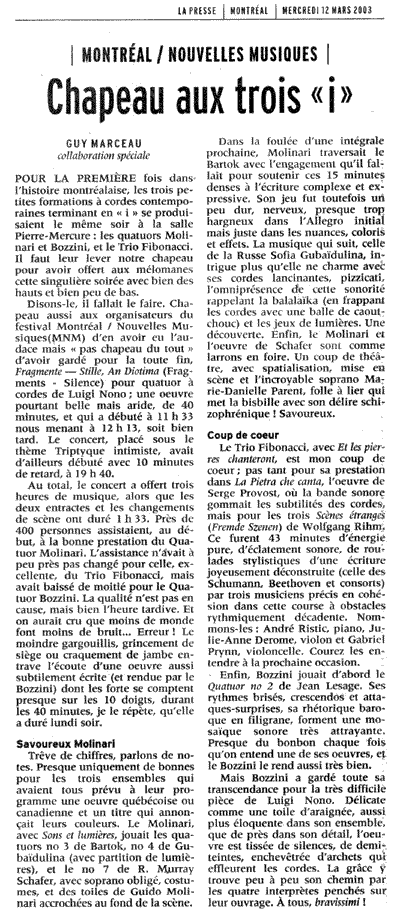
    «Chapeau aux trois «i»», Guy Marceau, La Presse, 12 mars 2003
    mercredi 12 mars 2003 Presse
    … le Bozzini a gardé toute sa transcendance pour la très difficile pièce de Luigi Nono… La grâce y trouve peu à peu son chemin par les quatre interprètes penchés sur leur ouvrage. À tous, bravissimi!
  • 454
  • 455
  • 456
  • 457
  • 458
  • 459
  • 460
  • 461
  • 462