Sauter au contenu principal
actuellecd

Blogue

3585 résultats
  • 453
  • 454
  • 455
  • 456
  • 457
  • 458
  • 459
  • 460
  • 461
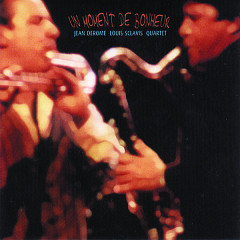
  • Un moment de bonheur dans Musica Jazz

    «Recensione», Alberto Bazzurro, Musica Jazz, 1 avril 2003
    mardi 1 avril 2003 Presse

    Canadese del Quebec (quindi francofono), Derome e senza dubbio il principale artefice e promotcre del progetto cocumentato da questo ottimo album dal vivo, mentre Sclavis ne e il prestigioso ospite. Eppure nessuna casualita, cosi tipica di situazioni del genere, vi aleggia. La musica parte ruvida, verrebbe da dire turgida, per incamminarsi tuttavia Jungo tracciati piu lineari, fortemente suggestivi, fin dal secondo brano, che rifluisce nel seguente senza soluzione di continuita. Qui la particolarità sta nell’incrociarsi dei tre strumenti gravi — flauto, clarinetto e contrabbasso archettato — con un effetto di notevole forza evocativa.

    Nelsuccessivo Pas à pas, aperto da un nervoso annodarsi tra clarone e sax alto, il clou coincide con un febbrile assolo di contrabbasso, in cui Chevillon sforna gran parte della sua non indifferente scienza strumentale. A seguire, arriva l’unico episodio a firma di Sclavis (tutto il resto si deve alla penna di Derome), una dinamicissima suite di oitre venti minuti dove — incastonati in una sorta di puzzle dalle mille diramazioni, con voltapagina continui e spesso sorprendenti — s’incontrano un contrabbasso che si fa chitarra distorta e un soprano che si fa cornamusa, un flauto basso che si liofiliza in puro soffio e ancora intrecci vorticosi fra contraito e clarone.

    Chiude il disco un episodio in cui tutto sembra acchetarsi sullamorbidaspinta, nuovamente, dei due fiati piu gravi. Di fatto si tratta pero di un’impressione fallace, visto che sia Derome sia Sclavis, in assclo, hanno impennate di grande vivacita.

    Un moment de bonheur dans AllMusic

    «Review», François Couture, AllMusic, 1 avril 2003
    mardi 1 avril 2003 Presse

    The album title is trite, but the concert was marvelous (yes, this reviewer was there) and the recording preserves all of its intensity and charm. This was a first meeting between Jean Derome (flutes, alto sax) and Louis Sclavis (clarinets, soprano sax). Although different, their sound worlds are highly compatible. They have both dug their way out of the jazz realm and into new, largely unexplored music trenches while keeping ties to jazz. They both use other idioms to transform jazz and turn it into something completely new. They both favor an approach that combines clever writing, wild improvising and a touch of humor and emotion. To put the project on firm ground, they agreed on a solid rhythm section of bassist Bruno Chevillon (Sclavis’ most trusted sideman) and drummer Pierre Tanguy (a regular of Derome’s bands for two decades). The quartet hit it off incredibly well. Derome penned five of the six pieces presented here. His tunes show his usual taste for elegance in odd designs and tenderness im comical gestures. The basic motif in Tu dis tout de travers, would fit nicely in the repertoire of his group Dangereux Zhoms, while his gripping bass flute solo in Jonas ranks among his best moments on record. Sclavis displays unusual levels of playfulness in Le baiser and Pas à pas. He contributes the 21-minute Suite pour un bal a cross-stylistic composition of epic proportions — including a passage where Chevillon adds a distortion pedal to his double bass. Tanguay’s lumbering rhythms (his sense of out-rhythm is unique) match Chevillon’s power plays in a quasi-rock way. The enthusiasm of the crowd is well deserved.

    The quartet hit it off incredibly well.

    All Is Bright, But It Is Not Day dans The Wire

    «Soundcheck», Julian Cowley, The Wire, no 230, 1 avril 2003
    mardi 1 avril 2003 Presse

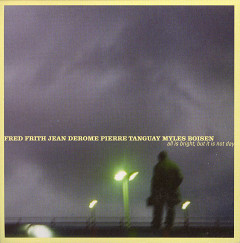
    In 2001 Canadian alto saxophonist Jean Derome and drummer Pierre Tanguay stepped across the border to Oakland, California, to link up with Frith at Mills College, where he holds a professorial post. Engineer Miles Boisen completes the quartet, engaging the others in real-time sound manipulation. Frith’s approach to improvising tends to dissolve focal points, creating a continual sense of solidity melting into flow. He leaves little for the memory to cling to, but you know you’ve been there. The sleevenotes to All is bright but it is not day speak of this CD as a “psychedelic dream”, which may point to one source of Frith’s taste for diffuseness. His electric guitar playing can be fiercely concentrated as well as nebulous and drifting, but even then it sounds like it’s on its way somewhere else. Derome and Tanguay play small instruments on the side, further decentring attention. Boisen’s processing does the rest.

    … a continual sense of solidity melting into flow.

    Chemin de fer dans e/i magazine

    «Off the Spine», Darren Bergstein, e/i magazine, no 1, 31 mars 2003
    lundi 31 mars 2003 Presse

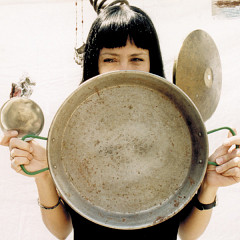
    Babin, for all intents and purposes, is a sonic metallurgist, warping surface alloys into soft, pliable mica. Chemin de fer is rank experimentation: corralling her aluminum cones, steel pots, guitar pick-ups and wirewheels, Babin strums, rubs, massages, and fondles them with fingers, bows and additional implements, then runs him through her spirited banks of software. More often than not, she settles for some basic improvising, producing sounds at random, basking in the natural feel of the materials; E is as ambiguous as its title, Babin picking, plucking, prodding and poking her metallic foils to produce disconnected tonalities hovering in the soundheld — they share little in the way of common coin, symptomatic of the disease improv’s critics have warned infects too much of the genre; they’re not necessarily wrong. L’entonnoir allows the laptops’ discreet parameters to work its magic by transforming the composer’s acoustic language into a more tactile wall of sound. Jogging dans la maison hantée beckons glitch into the arena, mouse-clicks and keyboard strokes distorting what little decay there is into a full-on occupational accident. No reason to fault Babin’s choice of soundmaker; however, the ‘rank experimentalist’ ethic has dampened many an improviser’s pursuits, and Babin is far from immune. Chemin de fer is a textbook example of concept overriding execution; great on paper, feckless in resolve. Spread out over 50 minutes, the disparate motions of the metallurgist’s noises fail to cohere. Okay to be avant provided you don’t drop your garde.

    … a sonic metallurgist, warping surface alloys into soft, pliable mica.

    Montréal Free, Sam Shalabi dans Le Devoir

    «Voyage au bout de Shalabi», David Cantin, Le Devoir, 22 mars 2003
    samedi 22 mars 2003 Presse

    Osama est un objet solo non identifiable qui explore l’arabophobie

    Il est toujours fort agréable de discuter avec Sam Shalabi. L’homme sait de quoi il parle. Lorsqu’il ne se range pas avec le quatuor Shalabi Effect, l’improvisateur-compositeur mène de front une bonne douzaine de projets: du jazz libre de Balai Mécanique à la chanson déraillée au sein de Molasses. Vers la fin de 2001, Shalabi entreprend l’écriture de pièces autobiographiques et dissidentes à propos des attentats du 11 septembre. Après six mois de travail acharné, une certaine confusion s’empare toutefois du processus créatif.

    «Je voulais absolument me prononcer en tant que musicien, explique-t-il, puisque la plupart des artistes semblaient mal à l’aise de dire quoi que ce soit. Personne ne réagissait. Avec l’aide d’Éric des Donkeys, j’ai d’abord eu envie de quelque chose de très prosaïque et d’organisé. Mais, peu à peu, je me suis demandé si la protestation n’était pas finalement un leurre en soi.» L’aventure aura duré plus d’un an, mais Osama (sur Alien8 Recordings) en valait sans doute la peine. Comptant sur l’apport d’une trentaine de musiciens de la scène locale (des membres de GY!BE à un chœur soufi), les cinq morceaux vont du rock lourd à la narration la plus absurde. Toutefois, Shalabi insiste pour dire qu’il a voulu atteindre le plus grand nombre d’auditeurs. «Contrairement à On Hashish, ces pièces sont jouées live. J’ai ainsi tenté de faire un album rock dans la plus pure tradition. Une sorte de documentaire mis en musique où l’on passe d’un extrême à l’autre. Je crois avoir obtenu le reflet d’un certain état d’esprit durant cette période, plutôt qu’un message politique quelconque.»

    L’excès

    Moins hermétique que son premier effort, Osama déstabilise, inquiète et dérange celui qui s’attend à une trame familière. On découvre plutôt un album où l’imprévisible est à l’honneur: de la construction minutieuse au chaos le plus élégiaque. Encore une fois, Shalabi prêche par l’excès. La paranoïa, la crainte, la joie, la révolte, de même que l’humour se retrouvent dans un même souffle tentaculaire. L’idée reste, sans doute, de pervertir la culture au sens le plus large. Comme le signale Shalabi à l’autre bout du fil, «je n’ai pas eu l’intention de produire un truc cynique. J’imagine plutôt une sorte de polyphonie étrange avec l’apport des nombreux collaborateurs sur cet enregistrement, sans avoir à rendre compte d’un message universel. Bien sûr, je m’oppose à la guerre ou à la haine raciale. Cela va de soi, mais il m’est impossible de penser en fonction d’un agenda artistique».

    Alors que paraît cet album sans la moindre concession, Shalabi se distingue aussi sur trois des quatre CD (chez No Type) qui documentent la très active scène d’improvisation free montréalaise. Justement intitulé Montréal Free, ce coffret réunit les groupes Po, ’Gypt Gore, Burns/Caloia/Heward, ainsi que Balai Mécanique pour une confrontation pure et dure. «Cet autre versant de ma recherche musicale me stimule et me passionne plus que jamais», confie Shalabi. Pour entendre le guitariste d’origine anglophone avec une dizaine d’improvisateurs sur scène, vous pouvez assister aux concerts-lancements, qui se tiendront les 25 (à La Sala Rossa) et 26 mars (au Va-et-Vient), pour coïncider avec la sortie officielle de l’imposant coffret. Par ailleurs, Shalabi a également d’autres projets en vue. «On termine présentement le troisième album de Shalabi Effect avec une sortie éventuelle cet automne. Ensuite, j’aimerais entreprendre une séance d’improvisation avec des chanteurs tout comme des field recordings en suspens. Il y a aussi un projet de transcription des musiques de Morton Feldman pour guitares.» Beaucoup de boulot en perspective, donc.

    … ce coffret réunit les groupes Po, ’Gypt Gore, Burns/Caloia/Heward, ainsi que Balai Mécanique pour une confrontation pure et dure…

    Unison Rituals dans Vital

    «Review», Dolf Mulder, Vital, no 377, 21 mars 2003
    vendredi 21 mars 2003 Presse

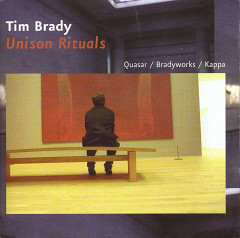
    Unison Rituals is Brady’s second release on Ambiances Magnétiques and number x in a series of releases on Apparition, Justin Time and other labels. Brady is a composer and guitarist from Canada who is lucky to have many of his works available on lp and cd. He composed chamber and orchestal music, plus electroacoustic music. Also he created works for theatre, dance, etc. Since the beginning of the 90s Brady has his own ensemble: Bradyworks. Brady produced several cds with this ensemble. Here on this new cd, they play three of the five compositions. But first things first. The cd opens with Unison Rituals, a strong and powerful piece for saxophone quartet, playing 6 different saxophones. This composition shows Brady’s affinity for minimal music. Parts of this work are very similar to Music in twelve Parts by Philip Glass. But Brady does not straightforward copy this unisonic, melodic and harmonic music. His version of it is full of twists and turns, complex rhythm changes. This makes this work comparable to the work of the long defunct belgian group Maximalist, who also tried to maximile or totalize minimal music. The CD continues with three works Double Helix, Two chords less than a Blues and Escapement that are — as said — performed by the Bradyworks ensemble. Instrumentation differs from piece to piece. We hear piano, percussion, cello, alto, baritone and soprano sax and electric guitar (in Escapement only). The first work is a post-minimal composition using jazzy syncopations. Two chords less than a Blues is a totally different work. With strong percussive parts at the beginning and end. Escapement is the only piece where Brady is also present as a player (on retuned ‘scordatura’ electric guitar). A quiet and lyrical piece. Jazz is not far away here. With solos for guitar and sax. The CD closes with Sound off played by some 100 wind instruments and 8 bass drums. Originally a 45-minute work, it is condensed here in 12 minutes. It is meant to be played outdoor as you can imagine. Starts very silently with unison playing, but gradually moves towards some very dissonant and noisy outbursts. Impressive. Because Brady departs from the (post-)minimal tradition and stays within tonality you might expect he is to be classified with New York down town composers like Michael Gordon and other of his Bang on a Can colleagues. But his work — on this cd — give me the impression that he is much more an ‘european’ composer. This is also often the case with french-speaking composers from Canada. The music has a romantic, lyric feel and mood. But why not say this typifies (some) Canadian composed music.

    The music has a romantic, lyric feel and mood.
  • 453
  • 454
  • 455
  • 456
  • 457
  • 458
  • 459
  • 460
  • 461