Sauter au contenu principal
actuellecd
  • This website is also available in English.

Blogue

3585 résultats
  • 441
  • 442
  • 443
  • 444
  • 445
  • 446
  • 447
  • 448
  • 449
  • Ambiances Magnétiques dans Le Devoir

    «Musiques émergentes — Non conforme et fier de l’être», David Cantin, Le Devoir, 23 août 2003
    samedi 23 août 2003 Presse

    Encore cet automne, les musiques émergentes retiennent l’attention. La scène indépendante québécoise se démarque et revendique plus que jamais sa différence face à l’industrie dominante. À quoi peut-on s’attendre au cours des prochains mois? Quels seront les artistes ainsi que les albums à surveiller? De l’électronique au rock expérimental, on dresse un portrait des sorties importantes et attendues.

    Du côté de DAME, on prévoit neuf titres d’ici la mi-novembre: Speaking In Tongues d’Anandan, Golstein et Wiens, Luminance de Marilyn Lerner, Risque et pendule de l’ensemble Pierre Labbé. Également, des nouvelles sorties pour le duo Langevin-Tanguay, Robert Marcel Lepage, les jeunes musiciens de Sang9, de même que Frank Martel, Tom Walsh, ainsi que Guido del Fabro.

    Asymétries dans Splendid E-Zine

    «Review», Dave Madden, Splendid E-Zine, 21 août 2003
    jeudi 21 août 2003 Presse

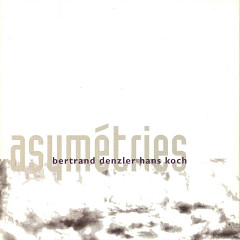
    What images form in your mind when you read the word “saxophone”? Denzler and Koch’s sole instrumentation is tenor sax, bass clarinet and soprano sax. What kind of mental picture does that create?

    You’re almost certainly wrong.

    From the bio:

    “Their duo playing reveals, beyond their qualities as instrumentalists, and understanding of how to position themselves, how to decode, and when to communicate — and when not to communicate — instantaneously.”

    As with the majority of Ambiances Magnétiques, the remainder of Denzler and Koch’s bio continues in the same fashion, describing an aesthetic instead of offering hints regarding their actual sound. There isn’t really anyone to compare to them with — I think that’s the point.

    For lack of a better term, Denzler and Koch work in the realm of jazz improvisation, but unlike many who hang this sign above their groups at Barnes and Noble’s cafe, Denzler and Koch are truly forging new works, never resting in the past or even the present. However, to say that they are simply doing what others aren’t — experimenting for the sense of being different — is an insult to their work.

    Though Asymétries steps outside the bounds of what many would call “music”, the artists clearly know what they’re doing — substituting creativity for theory and leaving the Coltrane riffs at the door. Truly, there isn’t a trace of conventional “sax music” to be found here — none of the things for which the instrument is known: melodies, lightning fast runs, blaring brassy energy. Instead, the focus is on texture, color, tone and above all, sound. Asymétries explores breath, breathing, what it sounds like to pucker your lips on the reed of the instrument, to blow kissing sounds into the body, to slowly trill without involving pitch; it explores the difference between moist and dry attacks, what happens when you play the horn at different angles, how many colors of squeaks there are, and so on.

    The lack of direction here is interesting. Typically, such “aimlessness” can be a huge problem; it would be so here, if the music actually “began”. That is, the music hovers around the idea of actually starting for… well, its entire length. The album’s delicate minimalism is a bit unnerving the first time around, and you’ll either sit in anticipation for it to “take off” (that’s what a sax is supposed to do, right?) or get up and fast-forward in an attempt to find a spot where the sounds actually progress from the developmental state. However, this is the point: it’s not going to develop, at least in any sort of traditional way, and like a meditative practice, patience is required to endure 37 minutes of otherworldly sounds. Then it leaves you as subtly as it began — no bang, no warning.

    Again, the adventurous nature of this work makes it difficult terrain for most, but those who choose to really listen, and give time to understanding these works, will be rewarded with a truly sublime experience.

    … those who choose to really listen will be rewarded with a truly sublime experience.

    Asymétries dans Vital

    «Review», Dolf Mulder, Vital, no 385, 20 août 2003
    mercredi 20 août 2003 Presse

    Denzler (tenor sax) and Koch (bass clarinet, soprano sax) blow their way through four pieces all entitled Asymetries. Both are exponents of the Swiss impro scene. Denzler is a player from Geneva (Switzerland). His cooperations are to numerous to mention them all. All in the field of improvised music. He is for instance member of Hubbub an improvisational collective. Koch is known for his work with celloplayer Martin Schutz. Denzler and Koch met in 1996 at one of Butch Morris ‘Conductions’ workshops. Since 1999 they established themselves as a duo. With this cd they make their debute on cd. It’s instantly clear that both players are not satisfied with the conventional playing of these instruments. They use different kinds of technique in order explore and expand the spectrum of sounds that can come from these instruments. They do not use electronics, all is done by mouth and fingers. All this done not just for the sake of discovering more technical possibilities, or to add some more pages to the catalogue of sounds. They are means in a musical process that aims at communication. Denzler and Koch give room to each other, letting the other act or react. The result is a set of well balanced duets. The CD starts with very soft sounds. Short lines and figures come from and disappear into silence. Overall the music is contemplative, concentrated and controlled. It switches from soft and subtile to jerky and growling. For some reason I compare their music with Schwitters’ Ursonate. Something completely different, be sure of that. But on the other hand both could be described as examples of soundpoetry that stay close to breath.

    Overall the music is contemplative, concentrated and controlled.

    Prairie orange dans wReck thiS MeSS

    «Review», Bart Plantenga, wReck thiS MeSS, 20 août 2003
    mercredi 20 août 2003 Presse

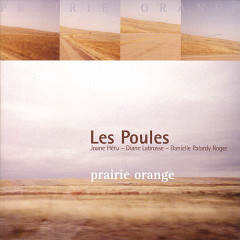
    Les Poules is made up of 3 Canadian musicians who have managed a quirky and moody CD of controlled improv that avoids self-indulgence as it creates emotional landscapes composed of a sack full of highly varied sounds. Nice.

    … full of highly varied sounds.

    Télépathie dans Vital

    «Review», Frans de Waard, Vital, no 384, 13 août 2003
    mercredi 13 août 2003 Presse

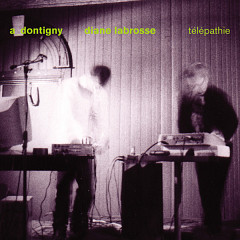
    Two more releases on No Type, the label with some slight connections to empreintes DIGITALes. Upon until now most of the releases were rhythm based, the one by A_dontigny and Diane Labrosse is more along the lines of improvised, electronic music — dare I say, more along the lines of labels like Grob and Erstwhile? Of course, in matters like this, this is a live recording, of a year ago in the neat place of La Casa Del Popolo. It’s hard to guess what goes into the computer and sampler, source-wise I mean, but it’s all closely linked together. A broading atmosphere, sizzing drones open up here and only half way the more typical laptop sounds come alive, those that sound like tweaking sounds through max/msp programs. The two stay together throughout the entire disc, finding sounds that are alike, but each works on their own level. They work with a sound palette that is quite supplementary to each other. In the final track média tactique, they even offer a very slow dub piece that drowns in the use of the extra sounds. It’s good, sturdy improvised electronic music, with not much news under the sun, alas.

    It’s good, sturdy improvised electronic music…

    Soshin dans Splendid E-Zine

    «Review», Jennifer Kelly, Splendid E-Zine, 12 août 2003
    mardi 12 août 2003 Presse

    Say you’re 24 years old, you live in Montréal, you’re studying improvisational guitar, and someone asks you who, out of all the giants in the field, you’d like to duet with? You might, quite possibly, respond just as Antoine Berthiaume did, and say “How about Derek Bailey and Fred Frith?Bailey, after all, is the grand old man of the collective improvisatory movement, known for eliciting an extraordinary array of unguitarlike sounds from his instrument. Frith was a founder of semi-mythical prog pioneers Henry Cow and has since moved on to a whole range of experimental ensembles, including, most recently, the Fred Frith Guitar Quartet. If your fairy godmother was working that day, you might even fulfill your wish in something like Soshin, wherein Berthiaume trades odd sounds, lyrical flights of fancy, strange distortions and generally gorgeous not-quite-conventionally-musical excursions with these two elder statesmen.

    The album opens with its title track, the only cut to feature Berthiaume alone and by far the quietest, most meditative piece on the album. Soshin is clearly a layered multi-track affair; Berthiaume interacts with himself, bowing, plucking, scratching and pounding on his guitar to produce a free-floating sculpture of sound. There are points during this track (about five minutes in) where he sounds like an entire string section, augmented by drums, and others where the unvarnished sound of guitar seems almost nakedly natural. This is also the only track based on any sort of written composition, a collaboration between Berthiaume and Denis Gougeron, yet like the others it captures an unrepeatable, self-evolving moment in time.

    The title track is followed by two very different duets with Frith. Morning Froth layers plaintive, pitch-changing bowed notes with nearly conventional sprays of flamenco-esque plucking. The experimental moan flits through the piece like an apparition, along with spectral knockings and overtones, introducing a ghostly spiritual tone. Then the louder plucked guitar takes on an Eastern coloring, spinning fast world-leaning threads of sound into an echoing void. The effect, as a whole, is mysterious and electric, just a half shade off from the familiar. The much longer Indicateur d’assiette is, by contrast, more agitated and driven. Again, you have many, many sounds that don’t sound like they should be coming from guitar: a shuffling, frictive percussion, the swoop of viola, the building patter of helicopter rotors, the rasp of wires against each other, the electric buzz of machinery. There’s nothing here that resembles traditional chord structure, melody or even repetitive motifs — just a complex, free-flowing exchange of sounds, sometimes distinct and sometimes affecting each other in unexpected ways. The use of silence is also interesting here, setting off the musical equivalent of sentences and paragraphs, signalling the advent of something new. It makes you wonder how improvisers coordinate silences, which must in some ways be more difficult than merging sounds.

    The final Frith duet, Wolf’s Wood, uses a similar palette of unusual sounds — the growl and twitter of finger stretching strings, a curious muted sawing and the insistent drumming of fingers on wood. It’s an extremely rhythmic track, anxious and somewhat claustrophobic. You realize several minutes in, when an echoing, chiming sound breaks through, that up to this point almost none of the guitar strings have been allowed to vibrate freely.

    The Bailey/Berthiaume pieces are somewhat more tonal, but equally interesting. Afternoon Tea builds tension by layering long, sustained notes over their more staccato, plucked counterparts. The result is far more lyrical, more like music as we expect to hear it, but with the added edge that comes from a collaborative effort. Aquathèque, the album’s last and shortest cut, blends an interesting bubbling noise with the pizzicato tones of guitar strings choked up about as far as they will go. Again, there are tones that sound just like violin or viola, and others that evoke the no-human-hand tones of the synthesizer. It all blends in a calming musical meditation — a restrained melding of the two musicians’ thoughts and sensations.

    Soshin requires your whole attention. It won’t work as car music or cooking music or any sort of background. To appreciate it, you’ll need a dark room, a soft floor and plenty of unhurried time to think. You may find, as I did, that it’s hard to put all of these elements together, but believe me, it’s worth it.

    … believe me, it’s worth it.
  • 441
  • 442
  • 443
  • 444
  • 445
  • 446
  • 447
  • 448
  • 449