Sauter au contenu principal
actuellecd
  • This website is also available in English.

Blogue

3585 résultats
  • 437
  • 438
  • 439
  • 440
  • 441
  • 442
  • 443
  • 444
  • 445
  • Montréal Free dans Exclaim!

    «Reviews — Improv & Avant-Garde», Eric Hill, Exclaim!, 3 septembre 2003
    mercredi 3 septembre 2003 Presse

    No Type presents a four-CD set featuring four free jazz ensembles from a scene centred at Montréal’s Casa Del Popolo. Two elements that immediately impress about these groups is a prevalence of electric guitar, an instrument not widely used in free jazz. Secondly is a marked absence of any electronics whatsoever in a time where most new jazz seems to put electronic elements centre stage. ’Gypt Gore is the duo of saxophonist Philémon and Sam Shalabi on guitar. Both play their instruments with a restless energy bordering on attention deficit disorder, occasionally rising to the point of eruption into angry beehives of noise. The fiercest and largest of the ensembles is Balai Mecanique, a sextet that includes the duo from ’Gypt Gore plus Thierry Amar. Unlike some larger groups they are not “led” by a specific member, making the directions taken and changes made much more spontaneous. The changes within the undulating chaos are deceptively subtle. PO (or “Provocative Operations”) is a quartet featuring Mr. Shalabi for a third time, as well as Rainer Wiens on electric guitar. Wiens is a 15-year veteran of the jazz scene and has truckloads of tricks and treats to splinter the guitar’s usual sound. John Heward and Alexandre St-Onge round things out on drums and bass; their music is the most delicate and introspective of the lot, featuring much more air and space surrounding each note, but also the most daring in terms of improvisation. Finally there is the trio of Chris Burns, Nicolas Caloia and John Heward (trio Presence). Chris Burns’s guitar is more subdued and classic, playing full chords rather than picking notes and generating noise, but also perceptively detached from the bass and drums of the other players. Each of the three musicians often picks their own course and seems to cross paths only occasionally and accidentally at that.

    Télépathie dans KindaMuzik

    «Kritiek», Joris Heemskerk, KindaMuzik, 1 septembre 2003
    lundi 1 septembre 2003 Presse

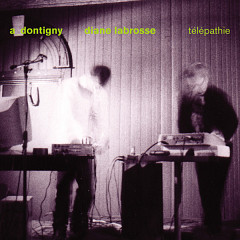
    Dit is een fijn staaltje live opgenomen noise-improvisatie. A_Dontigny (Aimé Dontigny) free noised al een tijdje met zijn speeltjes Napalm Jazz en Morceaux_de_machines. Diane Labrosse is een liefhebster van abstracte noise en samples. In de avantrockkringen maakte ze eerder deel uit van de Wonderbrass en Justine. Arty rock met een duidelijk aanwezige feministische inslag. Van dat feministische is gelukkig niks te horen op Télépathie. Beide artiesten laten zich lekker gaan achter een computer en sampler om zo heerlijk abstracte noisecomposities te brengen.

    Zoals het bij een live-voorstelling hoort wordt de spanning langzaam opgebouwd. Langs opborrelende white noise-bellen en filmische, felle geluidsfragmenten op t.s.f. naar de steeds intenser wordende noisevlakken van photo satellite. Als de maximale intensiteitsfactor wordt gehaald, schakelen de twee terug om zo weer te beginnen met het creëren van een nieuw spanningsveld. Langzaam maar zeker komt photo satellite weer op gang met een langgerekte toon die wordt onderbroken door steeds sterker wordende noisewindvlagen.

    média tactique start met een een Frans gedicht van Denis Vanier, op de achtergrond onheilspellende ruis en verstorende mokerslagsamples. De stem vervaagt en een storm van fluitende noise steekt op. De wirwar van lawaai gaat over in een zowaar herkenbaar noiseritme waarmee de live voorstelling en daarmee ook dit album eindigt. De storm die je eigenlijk al aan zag komen heeft je toch verrast. Ik ben benieuwd wat No Type nog meer met deze twee van plan is.

    Montréal Free dans e/i magazine

    «Review», Marc S Tucker, e/i magazine, no 2, 1 septembre 2003
    lundi 1 septembre 2003 Presse

    Ostensibly a showcase for a quartet of groups, this 4-CD ‘box’ is actually a rostrum for Sam Shalabi (better known in the eponymous and justly lauded Shalabi Effect) and friends. It’s also ostensibly ‘free jazz’, as far as that tired old sobriquet will go, though ‘free music’ would probably be more apt, but suspicious. Even more to the impalpable point, the first CD documents the Po foursome, wherein the far fringes of a transmutational psychedelic consciousness invade the proceedings, so what we open with is an organic free interplay effort somewhat akin to portions of old Amon Duul II anarchy. With two guitars and a drumset capturing the front stage, what’s actually of seminal import is Alexandre St-Onge’s undercurrent contrabass work, the very plasma of each song, where and when it occurs. Feedback supplies surrogate keyboards and the group pays close attention to every shift in dynamics, thus this isn’t a completely random affair by any means. One merely need pay attention to follow the lines. The ’Gypt Gore disc dives straight into Philémon’s gabbling sax, with Shalabi tweedling his axe like an undistorted James Ulmer, both scampering for rabbit holes and skyhooks, jetting off in seven directions at once. Five of the nine tunes feature the pair racing through surprisingly coherent colloquy, not at all the disparate individual self-indulgences that might be expected, the otherfourfeature either Thierry Amar, bassist, bringing a more fidelitous mainstream taste into contrastive play, or a second guitarist. Stymie Stime is of immediate interest, as it pays tribute to and mocks rock and fusion guitarwork. Again, in each selection, a concentrated listen reveals the subtleties of intercourse within the duet. The Burns, Caloia, and Heward Trio populates the third disc and comes the closest to recognizable forms, but their deviational twist is what makes the seven cuts attractive. The trio, like ’Gypt Gore, breaks down fusion (little of this could be called jazz) with some reverence and a lot of sloppy grace but also a knowing grin, slowing it way down and presenting the measures in connected packets, seasoned with lightly scattered noise, though some cuts are pure sound generation and just as fetching. In sum, a lazy quaalude reverse-dithyramb for zoned essences. Balai Mécanique, a sixheaded hydra, closes out the set in riotous Trummerflora-ish fashion, a convocation of Jovians down for a weekend freak-and-gossip session. Four long songs, and three very short ones, give the visitants all the room they need to ramble, argue, hght, philosophize and loll about, which they do with uninhibited abandon. The most noticeable vibe to this is its collective nature, more intense and much thicker than the mating discs. Saving it as the final installment was a good choice; the listener (and the critic) exeunts flushed and sated.

    … not at all the disparate individual self-indulgences that might be expected…

    Soshin dans BBC Music Reviews

    «Review», Peter Marsh, BBC Music Reviews, 1 septembre 2003
    lundi 1 septembre 2003 Presse

    On the face of this lovely record, Canadian improviser Berthiaume is one to watch. Soshin opens with a gorgeous study for prepared guitar(s), but the bulk of the record is given over to duets with fellow axemen Fred Frith and Derek Bailey. He’s a brave man.

    Berthiaume’s empathy with Frith is obvious; Fred is ever restless and relentless, but Berthiaume matches him move for move. Both are unafraid to be melodic, ranging from sweet, jazzy melancholy to industrial strength noise or furious insectoid scratching. They’re a good pair.

    The two duets with Derek Bailey are equally rewarding. Berthiaume shadows Bailey’s usual spindly, ornery lyricism with sweetly ambiguous chords; the results sound like one guitar played with four hands but guided by one brain. Highly recommended.

    Highly recommended.
  • 437
  • 438
  • 439
  • 440
  • 441
  • 442
  • 443
  • 444
  • 445