Sauter au contenu principal
actuellecd
  • This website is also available in English.

Blogue

3585 résultats
  • 349
  • 350
  • 351
  • 352
  • 353
  • 354
  • 355
  • 356
  • 357
  • Sur une balançoire dans All About Jazz Italy

    «C’est ça… Joelle Léandre…», Francesca Odilia Bellino, All About Jazz Italy, 5 mars 2006
    dimanche 5 mars 2006 Presse

    […] Diversissime le atmosfere di Sur une balançoire con la Léandre (contrabbasso e voce) e il pianista Gianni Lenoci (pianoforte e oggetti). Il titolo evoca una musica in sospensione, che si muove in quattordici tracce anonime come su un’altalena. Quattordici immagini scattate veloci, mosse, estemporanee, in bianco e nero. Il retroterra di Lenoci, pianista da sempre attento alla musica contemporanea, permea abbondantemente sonorità che ricordano a tratti un Morton Feldman, un Sylvano Bussotti e anche qualche rarefatta nota di Érik Satie. La potenza del suono della Léandre pare piegata. Coglie l’atmosfera rarefatta del piano, vi ci si avvicina, senza tuttavia mai sembrare completamente assorbita. È questo l’equilibrio instabile? È questo il vero (dis)equilibrio in Duo? È questo il gioco dei diversi in perenne rincorsa l’uno dell’altro? (3,5/5)

    3,5

    Arrêter les machines dans La Presse

    «Arrêter les machines, trouver l’essentiel», Alain Brunet, La Presse, 4 mars 2006
    samedi 4 mars 2006 Presse

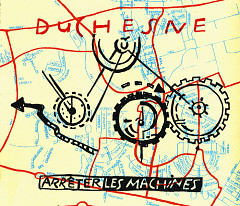
    Longtemps après avoir été leader de Conventum (groupe alternatif parmi les plus allumés de nos années 70), après trois décennies émaillées d’albums en solo ou en formation (Les 4 Guitaristes de l’Apocalypso Bar, Locomotive), de musiques de films et de compositions «sérieuses», de passages à vide et de précarité matérielle, André Duchesne signe ici un disque magnifique dans ce qu’il fait de mieux: la chanson. Arrêter les machines évite le piège de la surcharge poétique, ce disque fait aussi valoir le talent du compositeur (après tout, il fut recruté pour la Symphonie du millénaire), sans que la complexité ne l’emporte sur la clarté — ce qui n’empêche pas les mesures composées, la complexité harmonique, l’atonalité passagère, la tenue impeccable de Jean Derome aux flûtes et saxes, de Pierre Tanguay à la batterie, de Patrick Hamilton à la basse. À 57 ans, Duchesne peut être fier d’avoir ainsi épuré son expression, trouvé l’essentiel au cœur de l’âme rock qu’il a toujours. Voilà un disque qui traite de la beauté jaillissant de l’adversité.

    Duchesne peut être fier d’avoir ainsi épuré son expression, trouvé l’essentiel au coeur de l’âme rock qu’il a toujours.

    Three Cities in the Life of Dr Norman Bethune dans Vital

    «Review», Dolf Mulder, Vital, no 515, 3 mars 2006
    vendredi 3 mars 2006 Presse

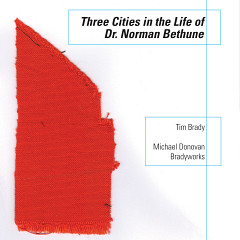
    This cd introduces the newest work of canadian composer Tim Brady, played by his ensemble Bradyworks and baritone Michael Donovan. It is a one-act chamber opera written for voice, electric guitar, piano, percussion, saxophones, string quartet and tape. The work is inspired on the life and work of Norman Bethune (1890-1939) who was a talented surgeon and medical inventor who left his comfortable life in Montréal to fight with the Republican International Brigade in Spain in 1936, and finally to join the Chinese Army in early 1938. For this composition Brady used writings of Bethune that are sung by baritone Donovan. The opera has three parts, each one representing a phase of the life of Bethune: Montréal, Madrid and Chin Ch’a Chi. Evidently the texts play a central role in this work and because of that the voice of Donovan also. The composition and the instrumentation fulfill a serving role in evoking Bethune’s life through the texts. Brady makes good use of the different instruments from the ensemble. It’s a very colorful work and very well arranged and performed. And the composition is a successful dramatization of the story. Track eight for instance is almost rock-music reminding of the work of Louis Andriessen. Through tape Brady introduces sound-material that evokes the different geographical locations. For my ears this is most apparent in the part that tells of Bethune’s chinese adventures. I needed repeated listening before this opera began to talk to me. But in the end this thoroughly composed opera revealed its beauty for my ears.

    … this thoroughly composed opera revealed its beauty for my ears.

    Bruiducœur, prières des infidèles dans Vital

    «Review», Dolf Mulder, Vital, no 515, 3 mars 2006
    vendredi 3 mars 2006 Presse

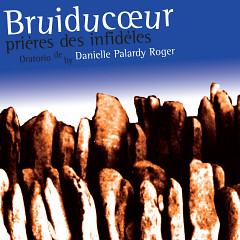
    Danielle Roger is known for her work with all-women groups like Wondeur Brass, Les Poules and Justine. With these and many other projects she became a leading force as a percussionist and composer in the new music scene of Montréal since early 80s. In recent years she concentrated more and more on composing music. On her new cd Bruiducoeur Roger presents an extensive vocal composition, recorded live in june 2004. It’s a vocal work for two narrators, two soloists, two percussionists and a thirteen-piece mixed choir. An oratorio to be more exact. Not a very regular musical form. I know Florian Fricke of Popol Vuh always wanted to write one. The oratorio is a musical composition that was at his peak in the 17th and 18th century. Most oratorios had religious themes. This seems to be case with Bruiducoeur also as it is subtitled “Prières des infidèles”. “This secular ceremony revolves around three characters: LUI, who is dying, scared and delirious; ELLE, who acts as an ironic witness, describing his fears and his struggle; and the CHOIR and SOLOISTS, empathic, representing us, the others, as we too will die one day.” For full enjoyment of this cd it helps if you understand french, but the booklet helps as it contains the full text in french and english. Voices sing, speak, scream. Sentences, words, but sometimes only syllables, or just sounds. The soloists and narrators do a great job. The whole is sparsely instrumented with percussion. Overall the music is not very melodic. At moments medieval sounding melodies appear at the surface, like in track one and three. Track six starts with mongolian throat overtone singing. In general it is a kind of ‘sprechgesang’ that dominates.

    Bernard Falaise dans La Scena Musicale

    «Bernard Falaise, guitare qui veut veille», La Scena Musicale, no 11:6, 1 mars 2006
    mercredi 1 mars 2006 Presse

    Quoi de plus flatteur pour un artiste que de se voir accorder une carte blanche, d’avoir entière liberté pour jouer ce qu’il veut… avec qui il veut. Telle est la chance accordée au guitariste Bernard Falaise, qui se produira trois soirs de suite à la fin du mois. Musicien polyvalent s’il en est, ce fieffé aventurier des cordes (et autres accessoires électriques) parcourt un peu tous les genres, allant du pop québécois — comme accompagnateur de Marie-Jo Thério — à la musique psychédélique — dans son groupe Foodsoon — sans oublier ses incursions en musique contemporaine. Pourtant, cet improvisateur aguerri est surtout reconnu pour son travail en musique actuelle, créneau dont l’éclectisme lui va comme un gant.

    C’est donc sous le signe de la diversité que se déroulera, au Théâtre la Chapelle, la dite carte blanche. À tour de rôle Falaise se fera improvisateur libertaire, compositeur total et maître d’œuvre d’un tout nouveau groupe présenté en première. «L’idée de cet événement vient du directeur du théâtre, Richard Simas, précise le musicien. Il me l’a proposé il y a un peu plus d’un an et j’ai mijoté cela pendant un moment, avant de décider que je voulais miser sur les différents volets de mon travail.»

    À en juger par le programme de ces soirées, le guitariste a respecté son mandat. En ouverture, ce sera de l’impro sur toute la ligne: en première partie, duo avec le platiniste Martin Tétreault (la seule consigne pour lui étant de faire tourner des plaques de guitaristes) suivi d’un spectacle retrouvailles avec trois Torontois (Christine Duncan, voix; Jean Martin, batterie et tables tournantes; Justin Haynes, guitare), ensemble connu sous le nom de Barnyard Drama (formation qui reviendra en mai prochain lors du FIMAV à Victoriaville). Le second soir sera dévolu à ses musiques composées, interprétées à tour de rôle par l’excellent Quatuor Bozzini (quatuor à cordes) et le tout aussi magnifique quintette à vents Pentaèdre. Qui plus est, il a prévu une improvisation structurée pour ces deux formations, rejointes par Diane Labrosse (échantillonneur), Alexandre St-Onge (basse électrique et électroniques) et lui-même. Ce même bassiste sera de retour pour la finale du dernier soir, à la suite d’un second duo entre Falaise et Tétreault (qui ne feront que des électroniques bruitistes). Pour boucler le tout, le guitariste proposera un genre de quatuar rock actuel dont le libellé («Vache qui veut vole») mérite d’être expliqué. «Cela provient en fait d’une expression portugaise qui signifie ‘je vous en prie’: du moins ça sonne un peu comme ça à mes oreilles. Je monte un tout nouveau répertoire comprenant des paroles de mon cru, et que je chanterai d’ailleurs, une premiere pour moi.

    Pour l’avenir, Bernard aimerait bien faire un autre disque cette année. «Je ne sais pas quoi au juste, mais j’aimerais faire ça avec quatre ou cinq autres musiciens. Mon premier chez Ambiances était en solo (Do en 2000), alors là je voudrais faire quelque chose de tout à fait différent, moins produit, plus direct, quoi.»

    Musicien polyvalent s’il en est, ce fieffé aventurier des cordes parcourt un peu tous les genres…

    Ensemble SuperMusique (ESM), Joane Hétu dans La Scena Musicale

    «Joane Hétu’s Filature: Theatre of Sound», Paul Serralheiro, La Scena Musicale, no 11:6, 1 mars 2006
    mercredi 1 mars 2006 Presse

    The role of music in the theatrical arts is usually a secondary one, used to highlight dramatic action or inspire a choraographer’s vision. Music seems mone abstract than words or gestures to most people. With her latest creation, Filature, premiered this month at Usine C, musique actuelle composer, vocalist and improvising saxophonist Joane Hétu sets out to show the theatrical potential of music and how other arts can be put to its service.

    During a recent conversation held at the offices of Ambiances Magnétiques, of which she is the label’s chief adminstrator, Hétu explained her vision as being inspired by the art of weaving, once an occupation of hers. “Musique actuelle is a hybrid form, born of mixing disparate things. Weaving has similar principles — the craft involves mixing various threads to create a pattem, a pleasing artistic form.”

    In this “Théâtre sonore” of hers, the threads are the instrumental “voices” of the musicians, with counterpoint provided by a pair of dancers, and important visual components including costumes, lighting and video projections. Still, the musicians are at the heart of this project, a point Hétu further elaborates upon. “I have to know who I’m writing for. I’m not just writing for a particular instrument — it starts with a particular musician.” The work is dividad into three acts, each based on a principle of weaving: Act I is titled Chaîne, Act II Trame and Act III Motif, weaving terms that translate as “warp”, “weft” and “weave”. “In the opening act, male musicians are on stage with a male dancer, followed by an all-female cast in Act II and all 10 musicians share the stage in Act III, their lines interweaving with each other’s. Most importantly, everything grows out of the music.”

    Even if there are improvised parts, Hétu hastens to add, “The music is mostly written, with the visuals borne out of the music.” In this way, the contributions of video artist Pierre Hébert, lighting designer Guillaume Bloch, costume designer Louis Hudon and sound engineer Bernard Grenon are all in keeping with the music. “So this is a turning of the tables, at least with respect to what usually happens with music and other performing arts,” explains Hétu.

    The musical component will be handled by some of musique actuellets best know characters, among them Jean Derome, Diane Labrosse, Pierre Tanguay and Normand Guilbeault, the featured dancers being Daniel Soulières and Séverine Lombardo. “We’re working with textures,” Hétu reminds us, “but the underlying structure behind these are the music. Always.”

    Musique actuelle is a hybrid form, born of mixing disparate things. Weaving has similar principles — the craft involves mixing various threads to create a pattem…
  • 349
  • 350
  • 351
  • 352
  • 353
  • 354
  • 355
  • 356
  • 357