Sauter au contenu principal
actuellecd
  • This website is also available in English.

Blogue

3585 résultats
  • 259
  • 260
  • 261
  • 262
  • 263
  • 264
  • 265
  • 266
  • 267
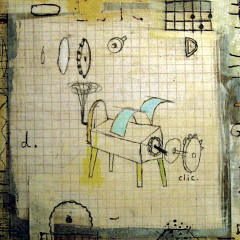
  • Clic dans Signal to Noise

    «CD / DVD / LP / MP3», James Hale, Signal to Noise, no 51, 1 septembre 2008
    lundi 1 septembre 2008 Presse

    The most exciting guitarist to emerge from Quebec since René Lussier, Montréal’s Bernard Falaise moves easily between rock-influenced wailing with such bands as Les Projectionnistes, writing for film and dance, and impressionistic electro-acoustic ensemble work. Clic finds him squarely in the latter category, in the company of some of Canada’s best improvisers, including multi-reedist Jean Derome, clarinetist Lori Freedman, trombonist Tom Walsh, marimba-player Julien Grégoire and drummer Jean Martin. Like Martin, whom Falaise has joined recently in the Barnyard Drama quartet, the guitarist has a love of sound montages and headlong rhythms and a knack for moving adroitly between disparate source materials. Following hard on the digital cut-and-paste of Allô, the hard-driving Tricheur throws the listener into a spiral of fuzzed-out guitar, thorny trombone, irrepressible percussion and electronic effects. While there is no shortage of attention-snapping jump-cuts in Falaise’s music, he manages to make them appear organic, even when (as on Tour) moving between sweetly voiced acoustic material and hardedged electronics. Falaise’s manipulation of found sounds and samples grab the ear, as well as his rhythmic sense and humor, but it is the real-time contributions by the whole ensemble that give Clic its warmth. Together they make this sophomore effort a compelling listening experience.

    The most exciting guitarist to emerge from Quebec since René Lussier

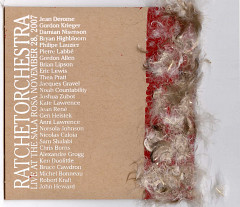
    Live at La Sala Rossa — November 28, 2007 dans Exclaim!

    «Destination Out», David Dacks, Exclaim!, 1 septembre 2008
    lundi 1 septembre 2008 Presse

    This is a lovely recording of a band that have gradually expanded from a quartet to a truly orchestral sound. Several generations of Montréal musicians participate in this project, which displays a wonderful variety of approaches to improvisation, from myriad takes on noise to European classical derivations or the bluesiest of wails. These noir-ish, expansive compositions are obviously influenced by Sun Ra, but in the right ways. Ratchet master Nicolas Caloia never indulges in lame, quasi-mystic space motifs; rather he finds inspiration in the orchestral sounds of Ellington, Ra’s former boss Fletcher Henderson and occasionally, Egyptian icon Om Khalsoum. With over 27 players in the orchestra, seemingly every instrument is doubled, if not tripled up. A large contingent of strings makes for some arresting ensemble sounds, as in the beguiling Carmine and the initial part of T(h)rust. The large scale improvs (Alan Silva, etc.) of the ’60s also come to mind but this disc’s stylistic range, contemporary electric sounds and overall gusto never sound like revisionism. My big gripe is the cover art, which has feathers glued all over the spine. My allergies and my computer’s CD drive curse you for this poor design choice.

    This is a lovely recording of a band that have gradually expanded from a quartet to a truly orchestral sound.

    Plumb dans The Live Music Report

    «Review», David Fujino, The Live Music Report, 1 septembre 2008
    lundi 1 septembre 2008 Presse

    Avant players Lori Freedman and Scott Thomson converse easily throughout these nine recorded tracks of engaging free improvisation.

    Each has a solo track, but otherwise they’re playing spacious, structurally aware, highly sensitive duets. Trombonist Thomson frequently senses mood changes and adjusts (Leak), while clarinetist Lori Freedman expresses her ideas in well-structured outflows (The Plummet).

    Also, they employ extended (and invented) techniques to project their imaginations through sound — or through mixtures of sound and silence, to be more exact.

    While I know it’s a cliché, I have to say that Freedman and Thomson ‘play so human’ in this recording, and their axis of mind, body, and breath, literally breathes in these sonically free and surprising, well-shaped improvisations.

    These players freely ‘play the music’ — and therefore gift us with their sonic imagination, individual experience, and far-reaching intuition.

    These players freely ’play the music’ — and therefore gift us with their sonic imagination, individual experience, and far-reaching intuition.

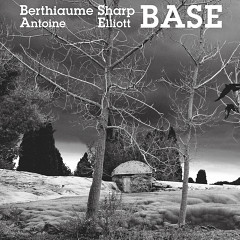
    BASE dans Downtown Music Gallery

    «Review», Bruce Lee Gallanter, Downtown Music Gallery, 29 août 2008
    vendredi 29 août 2008 Presse

    Quebec-based guitarist, Antoine Berthiaume, excels in duo situations, having recorded with master guitarists Derek Bailey and Fred Frith as well as with another guitarist, Takumi Seino and MaryClare Brzytwa on flute and electronics. NY guitar hero, composer, producer and multi-bandleader, Elliott Sharp, also thrives in duo settings with guitar greats like Nels Cline and Scott Fields, as well as with Bobby Previte, Zeena Parkins and Franck Vigroux. Both of these guitarists have their own, distinctive and diverse approaches to playing their guitars, so some of their sounds are not always that guitar-like. Layers of strange electronic sounds, manipulated feedback, bent-note e-bow drones, shimmering static, difficult-to-describe noise, howling ghost-like voices, weird sonic mutations, warped string fluctuations and ancient sounding electro-acoustic music is how I would explain some of these fascinating sounds. It does sound as if Elliott is using his laptop and Antoine, his devices to alter many of these sounds beyond their recognizable string-induced sounds. Each of the eleven pieces evokes a different mood and sets up different scenery. I was consistently blown away by the diverse results and sonic textures that both of these magicians/musicians have given to us worthy and demanding listeners.

    I was consistently blown away by the diverse results and sonic textures that both of these magicians/musicians have given to us worthy and demanding listeners.

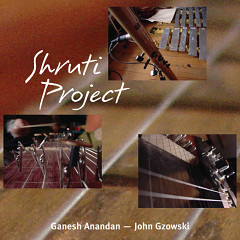
    Shruti Project dans Vital

    «Review», Dolf Mulder, Vital, no 641, 25 août 2008
    lundi 25 août 2008 Presse

    A fascinating work that leads us into the world of microtonality. “Shruti is a Sanskrit word to denote pitch and interval. A word that also means ‘that which is heard, and the smallest intervals of pitch or the spaces between notes’. Ganesh Anandan was born in Bangalore City (south India). He studied Karnatic music before moving to Canada in 1976. Sound designer, composer, musician and instrument maker John Gzowski also studied karnatic music, played oud and guitar in jazz and folk festivals. With his own ensemble he toured Canada with a repertoire of Harry Partch compositions. Gzowski makes his first appearance in the catalogue of Ambiances Magnétiques, but he has many albums out. With very different musical and cultural backgrounds Anandan and Gzowski share their interest for microtonality. They met in 1996 when Gzowski invited Anandan for his micro-tonal Critical Band at The Music Gallery in Toronto, Canada. Gzowski works with a set of self designed micro-tonal guitars and stringed instruments. Anandan works with self built melodic percussion and string instruments based on the Indian Shruti system. To be more precise, on this new cd we hear Anandan playing a self-built electric 12-string shruti stick, plus metallophones, knajira, moorching, tincan and voice. Gzowski uses the Harry Partch guitar, 19_tone guitar, electric Dowel, ukelin and bells. For their Shruti Project they improvise and mix Indian, Indonesian and western musical styles very fluently and intelligently. Each piece opens a new world. Because they play on unknown and self-built instruments we hear new sounds, news colors. Also the music impresses as we hear very unusual tunings, strange textures and rhythms. It is difficult not to become fascinated by these enchanting interventions. Nonetheless not all improvisations worked for me, and left me with something missing. But all in all this is a very interesting meeting of east and west under the parameters of microtonality.
    A fascinating work that leads us into the world of microtonality.

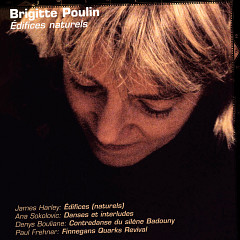
    Édifices naturels dans Vital

    «Review», Dolf Mulder, Vital, no 641, 25 août 2008
    lundi 25 août 2008 Presse

    Poulin is a classically trained pianist. Her repertoire covers all relevant periods, but she feels strongly attracted to modern classical music. Because of this she founded Trio Phoenix (flutes, cello and piano), an ensemble entirely dedicated to new music. Besides she worked with a great diversity of musicians and ensembles. “For a decade, Brigitte Poulin has been commissioning and premiering works by composers who, she thought, could help better define our own piano culture.” From this experience she choose four recent works that found their way to this CD: James Harley’s Édifices Naturels (2000), Ana Sokolović’s Danses et Interludes (2003), Denys Bouliane’s Contredanse du silène Badouny (1998) and Paul Frehner’s Finnegans Quarks Revival (2005-07). At the same she introduces four composers that were unknown to me… The composition by Harley consists of two parts. The first one bursts of energy. The second one is quiet and calm. The composition of Ana Sokolović is inspired on Balkan dance music. It consists of six dances and three interludes. As you can imagine rhythm is a dominant aspect here. The short work by Bouliane is a very ingenious and subtle composition. Finnegans Quarks Revival by Frehner is the longest work of the four. In eight parts this work evokes very different moods during its 35 minutes. Poulin’s choice offers a good insight into the richness of modern composed piano-music, and in Poulin we meet an accomplished and warm-hearted musician.

    Poulin’s choice offers a good insight into the richness of modern composed piano-music, and in Poulin we meet an accomplished and warm-hearted musician.
  • 259
  • 260
  • 261
  • 262
  • 263
  • 264
  • 265
  • 266
  • 267