Sauter au contenu principal
actuellecd

Blogue

50 résultats
  • 1
  • 2
  • 3
  • 4
  • 5
  • 6
  • 7
  • 8
  • 9
  • Tardif dans The WholeNote

    «Review», Raul da Gama, The WholeNote, no 28:3, 13 décembre 2022
    vendredi 23 décembre 2022 Presse

    Brûlez les meubles (a name that translates to Burn the Furniture) suggests a doffing of the proverbial hat more towards the kind of existentialism and Jean-Paul Sartre’s primary idea that people, as humans, are “condemned to be free.” This may seem to be at cross purposes with the kind of Impressionism that has come to be associated with — perhaps even the clarion call of — many contemporary musicians.

    The consistent use of distortion — not simply harmonic dissonance — suggests that these two musicians are flying more than the flag of Impressionism that became associated with many who are influenced by Debussy.

    The duo Brûlez les meubles — guitarist Louis Beaudoin-de la Sablonnière and bassist Éric Normand — claim that they owe as much to Jim Hall as they do Bill Frisell. But that tells only part of their story. The real proof of their musicianship lies in the effect that the repertoire […] under review has on the senses.

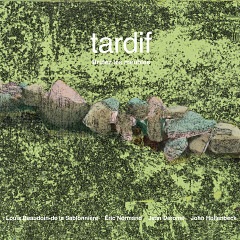
    Listening to Tardif (which means Late) it would seem that songs such as Balade stoïque and Journée pédagogique are indicative that the musicians want us to listen for a deeper meaning in their music. The aforementioned distortion is not simply a musical gesture that frequently runs through this music, but a device to provoke putting a keener ear to work, to listening more deeply to this music.

    The duo’s free association with noise together with saxophonist Jean Derome and the arrhythmia of principal guest John Hollenbeck’s drumming sends a powerful musical message. When we get through the repertoire of Tardif and come to the recording’s climactic conclusion J’en ai connu d’autres we find ourselves wondering if the sense of alienation — or otherness — is not what really propels the musical intention of Brûlez les meubles.

    The duo’s free association with noise together with saxophonist Jean Derome and the arrhythmia of principal guest John Hollenbeck’s drumming sends a powerful musical message.

    Tardif dans La Scena Musicale

    «La ronde des disques 2022», Marc Chénard, La Scena Musicale, 31 octobre 2022
    mercredi 14 décembre 2022 Presse

    Entrepreneur musical polyvalent, Éric Normand joue de la basse électrique et dirige le GGRILL, formation de musique improvisée de Rimouski. Identifié principalement aux courants expérimentaux, ce touche-à-tout s’adonne aussi au jazz. Son groupe au nom singulier réunit pour une première fois l’inénarrable Jean Derome et le batteur américain John Hollenbeck. Le guitariste Louis Beaudoin de la Sablonnière complète la formation. Tous sauf le batteur ont contribué au répertoire de neuf pièces, dont une (A Jazz Tune I Hope) provient du tromboniste Albert Mangelsdorff. Cet album de 47 minutes démontre l’une des multiples façons de faire du jazz à notre époque sans avoir à reprendre les formules convenues. On ne parlera pas d’un langage novateur, mais la signature lui est propre. Et c’est déjà ça.

    Cet album de 47 minutes démontre l’une des multiples façons de faire du jazz à notre époque sans avoir à reprendre les formules convenues.

    BeingFive dans Downtown Music Gallery

    «Review», Bruce Lee Gallanter, Downtown Music Gallery, 1 novembre 2022
    dimanche 20 novembre 2022 Presse

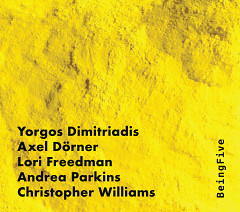
    This quintet of international improvisers was organized by Montréal-based clarinetist Lori Freedman and goes under the name of BeingFive. No doubt you know about trumpeter Axel Dorner (who has worked with Alex Von Schlippenbloch in Monk’s Casino, from lower case to the Globe Unity Orchestra) and accordionist Andrea Parkins (who played in a longtime trio with Ellery Eskelin & Jim Black and another trio with Nels Cline & Tom Rainey). I know very little about bassist Christopher Williams (aside from a duo disc with Derek Bailey) and not much more about percussionist Yorgos Dimitriadas, who has worked with Paul Dunmall & Frank Paul Schubert. This disc was recorded in a studio in Berlin in June of 2022. A more varied set of backgrounds would be difficult to find. The music/sounds here move quiet sound to more abrasive free wheeling intensity. What I like about this is that everything sounds focused and directed somehow. For a long piece called “Miniatures”, the quintet plays a number of short pieces, all are either less than 30 seconds or from 1 to 3 minutes. The brevity forces the group to play together without giving things a chance to evolve very much. The electronics, used by three of the members, are also used selectively like punctuation. Both Lori Freedman and Axel Dorner are diverse improvisers who have worked in a wide variety of situations, hence it is often concentrated on subtle textures or gestures. Due to some extended technique playing, it is often hard to tell who is doing which sound. On the final and longest piece, “Freeze”, the group stretch their sounds into long, humming drones and eerie textures. The production, the music and the way things evolve are top notch here, a new high for the ever-challenging Relative Pitch label.

    … everything sounds focused and directed…

    Cage dans Jazz Word

    «Review», Ken Waxman, Jazz Word, 1 novembre 2022
    mardi 1 novembre 2022 Presse

    Adaptation of two of John Cage’s later aleatoric compositions in their own fashion, members of Montréal’s Quartetski stay true to the composer’s instructions while creating completely original works. With Four6 designed for any way of producing sounds and One7 created for pitched instruments playing sustained notes, Pierre-Yves Martel on electric bass and sine waves and Bernard Falaise on electric guitar plus bass clarinetist Philippe Lauzier and percussionist Isaiah Ceccarelli, both of whom also play synthesizers, construct electro-acoustic tracks of kaleidoscopic textures.

    Since One7 wants instruments acting as one, Quartetski’s layered interactions concentrate into a pointillist vibrating mass by mid-point and propelled by altissimo reed whistles and voltage drones, stay that way until the end. Before that, organ-like synthesizer swells, guitar string plinks, unvarying chalumeau-register clarinet buzzes and percussion rolls corkscrew multiple pitches into the exposition before coalescing.

    More individualism characterizes Four6 since multiple sounds are expressed and emphasized. Lauzier at points projects both subterranean body tube growls and repeated staccato shrieks; Ceccarelli sounds doorbell-like peals or cymbal scratches as often as bass drums thumps; Falaise’s effects pedal moves intermittent guitar twangs upwards; and Martel’s thick bass strums propel regularized rhythmic vibrations as well as focusing timbral evolution. Crucially, however, at certain moments, reoccurring harsh reed flattement confirm linear evolution.

    Transforming interpretation into originality, Quartetski realizes the essence of Cage’s conception in a novel and unique form.

    Transforming interpretation into originality, Quartetski realizes the essence of Cage’s conception in a novel and unique form.
    Cage dans Musicworks

    «Review», Ken Waxman, Musicworks, no 143, 1 septembre 2022
    mercredi 26 octobre 2022 Presse

    Adaptation of two of John Cage’s later aleatoric compositions in their own fashion, members of Montréal’s Quartetski stay true to the composer’s instructions while creating completely original works. With Four6 designed for any way of producing sounds and One7 created for pitched instruments playing sustained notes, Pierre-Yves Martel on electric bass and sine waves and Bernard Falaise on electric guitar plus bass clarinetist Philippe Lauzier and percussionist Isaiah Ceccarelli, both of whom also play synthesizers, construct electro-acoustic tracks of kaleidoscopic textures.

    Since One7 wants instruments acting as one, Quartetski’s layered interactions concentrate into a pointillist vibrating mass by mid-point and propelled by altissimo reed whistles and voltage drones, stay that way until the end. Before that, organ-like synthesizer swells, guitar string plinks, unvarying chalumeau-register clarinet buzzes and percussion rolls corkscrew multiple pitches into the exposition before coalescing.

    More individualism characterizes Four6 since multiple sounds are expressed and emphasized. Lauzier at points projects both subterranean body tube growls and repeated staccato shrieks; Ceccarelli sounds doorbell-like peals or cymbal scratches as often as bass drums thumps; Falaise’s effects pedal moves intermittent guitar twangs upwards; and Martel’s thick bass strums propel regularized rhythmic vibrations as well as focusing timbral evolution. Crucially, however, at certain moments, reoccurring harsh reed flattement confirm linear evolution.

    Transforming interpretation into originality, Quartetski realizes the essence of Cage’s conception in a novel and unique form.
    Transforming interpretation into originality, Quartetski realizes the essence of Cage’s conception in a novel and unique form.
  • 1
  • 2
  • 3
  • 4
  • 5
  • 6
  • 7
  • 8
  • 9