Sauter au contenu principal
actuellecd

Blogue

69 résultats
  • 4
  • 5
  • 6
  • 7
  • 8
  • 9
  • 10
  • 11
  • 12
  • Gyula Csapó: Déjà? Kojâ? dans The WholeNote

    «Modern and Contemporary», Stuart Broomer, The WholeNote, no 23:8, 1 mai 2018
    mardi 1 mai 2018 Presse

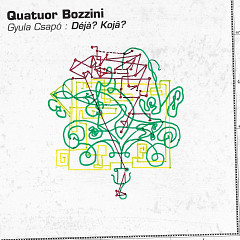
    Founded in 1999, Quatuor Bozzini are distinguished interpreters of contemporary repertoire, including fine recordings of John Cage, James Tenney and Steve Reich. Here they present a particularly challenging work, a three-part, 73-minute piece composed between 2011 and 2016 by Gyula Csapó, a Hungarian composer currently teaching at the University of Saskatchewan. His music suggests the influences (including scale and depth) of Morton Feldman and Arvo Pärt. Csapó’s brief note about this work is dauntingly abstract (“event-fossils,” “fractals”), but the core is in the title, Déjà? Kojâ? part French, part Persian: “Already?” is easy. “Kojâ?” comes with a poem that suggests “Threshold” as the crucial sense, and that this world is a threshold, the beginning of another experience or existence, a step both inevitable yet deferred. The work is monumental, developing thick, often dissonant textures. Its long first section is anchored to a repeating oscillation, brief but slow, between low-register cello and viola and high, reedy violins. Seconda Parte is more varied, adding other sonic devices, including moving the contrast of registers to pizzicato lows and whistling harmonic glissandi from the violins. Terza Parte eventually expands the oscillating figures into a still minimalist, but gradually evolving melodic shape. It’s a demanding work, a dark reverie that suggests anticipation while dramatizing its delay, a sombre meditation shot through with bright highs that are themselves dissonant. At once static and tumultuous, this is depth experience, rewarding all the attention one can give it.

    At once static and tumultuous, this is depth experience, rewarding all the attention one can give it.

    Boule-spiel dans Free Jazz Blog

    «Review», Stef, Free Jazz Blog, 23 avril 2018
    lundi 23 avril 2018 Presse

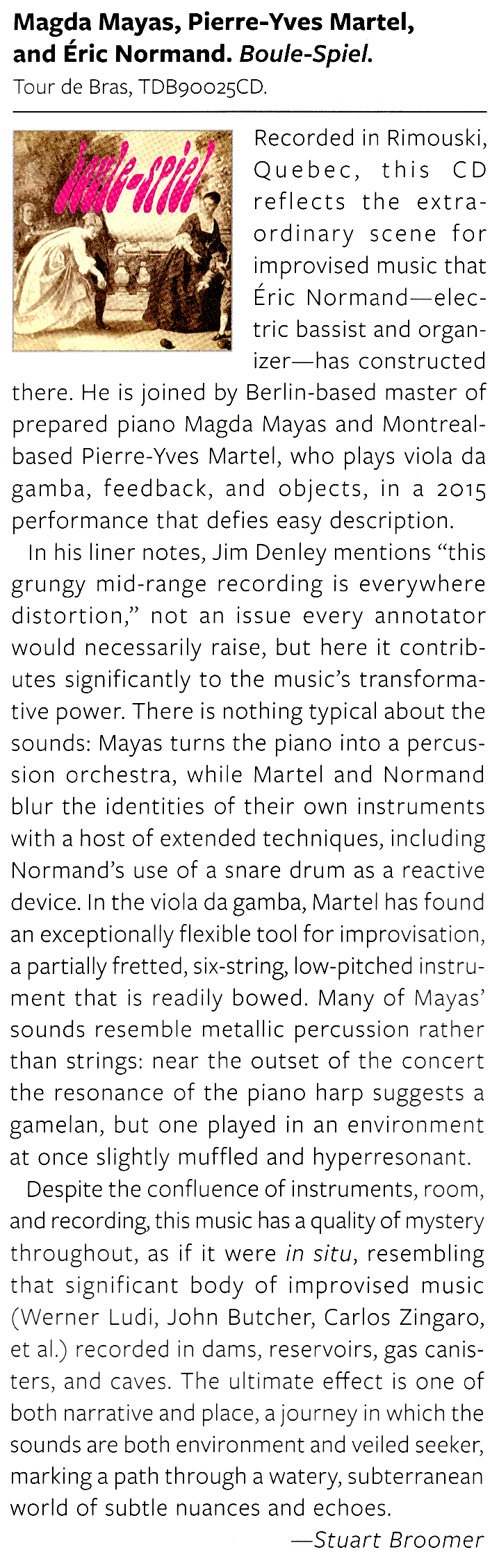
    Even if the trio is Magda Mayas on prepared piano, Pierre-Yves Martel on viola da gamba, feedback, objects, and Éric Normand on electric bass, speakers and snare drum, the instruments don’t really matter. The trio’s focus is on improvised sounds, little sounds, little noises, creating sonic universes that shift between the calm and the eery, the contemplative and the outright frightening. It is sound lifted beyond music, as a wonderful texture of things falling, scraping, hitting and plucking or just resonating, marbles rolling over strings? an endless bow on one string? metal gliding over all piano strings? piercing feedback through the speakers? raindrops hitting wood? wind rushing through leaves? animals crying in the distance? rhythmic industrial activity? a far unoiled metal door opening?

    The sonic universe evolves at its own pace, slowly, slowly building, and growing within its own logic, or even lack thereof, within its own organic nature. Every sound has its own space, carefully positioned, cautiously placed, audaciously created, resulting in a exquisite and intense listening experience. There is an incredible beauty in it, defined by its own aesthetic. There are emotions too: shifting, and sometimes superimposed, like sadness and fear and resignation all at the same time, like joy and distress and surprise as one feeling. You can’t put your finger on it. And that makes it so wonderfully enjoyable.

    There is an incredible beauty in it, defined by its own aesthetic.

    Lézardes et zébrures dans Voir

    «Critique», Réjean Beaucage, Voir, 18 avril 2018
    mercredi 18 avril 2018 Presse

    Le musicien Bernard Falaise a joué depuis un quart de siècle avec tout ce que notre scène de musiques nouvelles compte de mieux et c’est un collaborateur tellement recherché que l’on se demande un peu comment il fait pour s’y retrouver. Le voici fin seul, une nouvelle (rare) fois, avec l’envie de faire des musiques vaguement méditatives et la possibilité, grâce à la magie du studio, de se multiplier pour colorer le son de ses guitares d’un brin de mélodica, d’un chouïa de glockenspiel et d’une touche d’électronique. L’homme est un grand guitariste (il ne joue pas avec tout le monde pour rien), mais ici, pas d’explosions de virtuosité, on est plutôt dans l’atmosphérique et le plaisir du son. Et de ce côté-là, c’est une grande réussite.

    … c’est une grande réussite.

    Torche! dans Revue & Corrigée

    «Chronique», Claude Colpaert, Revue & Corrigée, 1 avril 2018
    dimanche 1 avril 2018 Presse

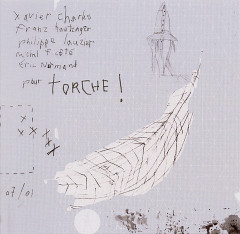
    Stridences enfin (mais pas que) chez les partenaires d’une belle rencontre entre le Français Xavier Charles (clarinette), l’Autrichien Franz Hautzinger (trompette) et les Canadiens Philippe Lauzier (clarinette basse), Michel F Côté (batterie) et Éric Normand (basse électrique et caisse claire). Enregistré en concert dans le cadre du Festival des musiques de création de Jonquière (Canada), les huit plages de Torche! portent bien leur nom: captivants départs de feu, craquements toniques et belles incandescences, voilà de quoi devenir pyromane!

    … captivants départs de feu, craquements toniques et belles incandescences, voilà de quoi devenir pyromane!

    The Space Between Us dans Free Jazz Blog

    «Review», Stef, Free Jazz Blog, 1 avril 2018
    dimanche 1 avril 2018 Presse

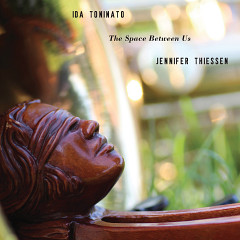
    Sometimes we may move towards the fringes of jazz or free improv. This beautiful album is more avant-garde classical, yet nevertheless of posssible interest to the readers of this blog. The musicians are Ida Toninato on baritone sax, hailing from Strasbourg in France, and Jennifer Thiessen, playing viola d’amore, and hailing from Manitoba in Canada.

    Thiessen is very active in modern classical music and in baroque music with the ensemble Cénacle, she even if she took some steps into pop music with her band Daily Alice.

    Toninato comes from a more experimental background, exploring reverberant spaces with uncommon acoustics, with her solo debut album Strangeness Is Gratitude as a wonderful example of that approach. She also works with Ana Dall’Ara-Majek as Jane/KIN, creating performances that mix spatialisation and improvisation.

    Their music is spacious, calm, intense, slowly and cautiously progressing, creating timbres and resonance and pursuing them further as they grow and change. In contrast to even modern classical music, there are no obvious patterns or melodies to discern, but a drone-like shimmering of solemn sounds that explore each other around a space of silence. Despite their differences in background and perspective, both musicians find each other perfectly in the deep and central register of their instruments, which are almost always played with a gentle traditional approach.

    On the last track Toninato adds some wordless singing and even if I usually hate this, somehow it works here.

    It’s great to hear two young musicians perform in a duo with unusual instruments and coming from different perspectives and continents, and find such a strong common ground and sound. The whole album is solid and with a clear central vision on their music: coherent, beautifully performed and with a unique sound. They find each other in the space between them, and they delight us. What more do you want? ★★★★

    The whole album is solid and with a clear central vision on their music: coherent, beautifully performed and with a unique sound.
    ★★★★
  • 4
  • 5
  • 6
  • 7
  • 8
  • 9
  • 10
  • 11
  • 12