Sauter au contenu principal
actuellecd

Blogue

59 résultats
  • 2
  • 3
  • 4
  • 5
  • 6
  • 7
  • 8
  • 9
  • 10
  • Quartetski dans La Scena Musicale

    «Pierre-Yves Martel – Quartetski et le loup (Bartók et Prokofiev dans le collimateur)», Marc Chénard, La Scena Musicale, 1 avril 2017
    samedi 1 avril 2017 Presse

    Depuis son arrivée à Montréal en 2004, Pierre-Yves Martel a fait un son chemin. Armé d’une contrebasse et d’une viole de gambe, ce fils de la capitale nationale s’est pleinement intégré dans notre scène, son succès reposant sur sa polyvalence. D’une part, il s’est donné de la visibilité comme membre permanent de la formation Constantinople des frères Tabassian, groupe tous azimuts à la confluence de la musique persane et celles d’autres traditions. D’autre part, Martel s’est inséré dans le monde des musiques créatives, autant chez nous – par sa présence au sein du collectif Ambiances Magnétiques – que par ses associations avec des partenaires étrangers (v. référence discographique ci-dessous).

    Autre corde à son arc, il dirige une formation au nom singulier, Quartetski, spécialisée en relectures audacieuses d’œuvres de ­compositeurs classiques. Au fil des ans, lui et ses complices se sont attaqués à des musiques de toutes les époques, commençant en 2006 par Prokofiev (le nom du groupe étant donc un clin d’œil à ce compositeur), puis suivis par Éric Satie, Henry Purcell, Tobias Hume, Igor Stravinski et, le dernier en date, Bela Bartók.

    Début avril, il propose de présenter des extraits de Mikrokosmos, grand opus pour piano solo du célèbre Hongrois. Le concert reprendra les 29 miniatures figurant sur le disque le plus récent, retravaillées considérablement par l’ensemble. Mais Martel nous réserve deux surprises pour cette occasion.

    «J’avais eu l’idée du concert pour marquer les dix ans de Quartetski, explique Martel, avant de faire une mise en garde: j’aurais bien pu reprendre mon premier projet, les Visions fugitives de Prokofiev, pour faire la boucle avec le Bartók, mais cela me semblait trop évident. Je me suis fixé sur une autre œuvre du compositeur russe, Pierre et le loup. Cependant, je vais utiliser le texte littéraire plutôt que la partition comme matière à créer une musique originale, démarche inédite pour mon groupe.»

    Réservée pour la seconde partie de la soirée, cette pièce suivra une autre première avant l’entracte, celle-là intitulée Makrokosmos. Toujours selon Martel: «Après avoir repris Le sacre de Stravinski en 2013 à l’occasion du centenaire de sa création, je voulais me tourner vers quelque chose de moins massif, d’où mon choix des miniatures de Bartók. À celles-ci, je vais ajouter cette autre première, une pièce de plus longue durée et assez minimaliste dans ses matériaux, question d’explorer une autre avenue.»

    Pour l’automne, Martel et ses acolytes reviendront à la charge avec leur projet le plus jazzistique: la musique de Duke Ellington, étirée dans tous les sens avec le concours de Martin Tétreault aux tables tournantes et vinyles assortis. On en reparlera sûr et certain.

    Dernière heure: Josh Zubot, résidant désormais à Vancouver, sera remplacé par un autre violoniste, Guido del Fabro.

    Armé d’une contrebasse et d’une viole de gambe, [Pierre-Yves Martel] s’est pleinement intégré dans notre scène, son succès reposant sur sa polyvalence.

    Chants et danses… with Strings! dans Can this even be called music?

    «Mini-Reviews», Dæv Tremblay, Can this even be called music?, 28 mars 2017
    mardi 28 mars 2017 Presse

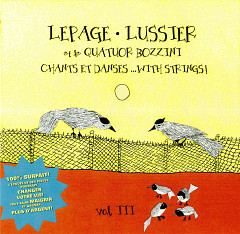
    Chants et danses… with Strings! (Vol. III) is a rather mind-blowing album by Robert Marcel Lepage, René Lussier, and the Bozzini Quartet. This album is a masterpiece of experimental music, joining together chamber music, noise music, and improvisation. The guitarist and clarinetist are joined here by an experimental and classical string quartet, which serves as support and filler more than anything else. Their role isn’t prominent but certainly gives more body to the record. It’s a really unique album I’d recommend to anyone!

    mind-blowing album […] masterpiece of experimental music

    Miella Totomi dans Musicworks

    «Review», Ken Waxman, Musicworks, no 127, 21 mars 2017
    mardi 21 mars 2017 Presse

    A Power Trio gone rogue, Montréal-based Just Got Death (JGD) matches the ingot-hard guitar flanges of Sam Shalabi with the surging bass thumps of Jonah Fortune and the nimble percussion accents of Michel F Côté in a program of seven originals that ricochet between punk-metal energy and sophisticated improvisation. Like a lapel flag pin which subtly declares the wearer’s convictions, proof of the band’s unique orientation is Côté’s understated drumming. Veteran of ensembles like Klaxon Gueule, his in-the-pocket or chronometer-like percussion pacing is smooth and non-disruptive. On tunes such as Vagrazo Hallottkemek and Early parasitic being for instance, his relaxed, steadfast rhythms create a solid tapestry upon which adornments, in the form of Shalabi’s finger-picking that sharpen notes with mandolin or banjo-like twangs, plus Fortune’s busy string slides and aggressive beat rolling, create appropriate adornments.

    Like a thriller’s surprise ending however, this exposition only tells one part of Miella Totomi’s story. JGD’s other interest appears to be in updating to the 21st Century, the variant of jazz-rock-psychedelic fusion that permeated 1970s music. On several tracks gurgles and guffaws from Craig Pedersen’s muted trumpet and sputtering echoes from Guillaume Dostaller’s JX3P and Wurlitzer add vaporous embellishments to the redwood tough bottom created by the rhythm section. Especially notable is Non monotono where the electric keyboardist’s slide-whistle-like peeps bond with the guitarist’s buzzing top-of-neck frails to create a solid mass of pulsating timbres. This too-bulky mixture is only deflated by the trumpeter, whose grace notes provide needed lightness. Elsewhere, before disconnected Wurlitzer wiggles and snapping guitar spirals prevent interludes from breaking their moorings and fly away, Fortune’s consistent ostinato firmly ground them. This type of skillful in-the-moment expansion and recovery underlines the strength JGD displays throughout the disc. The remaining question is why a band that plays such intricate, life-affirming music chose a downer designation as its name?

    JGD’s other interest appears to be in updating to the twenty-first century the variant of jazz-rock-psychedelic fusion that permeated 1970s music.

    Drifter dans The Guardian

    «Review», Kate Molleson, The Guardian, 16 mars 2017
    jeudi 16 mars 2017 Presse

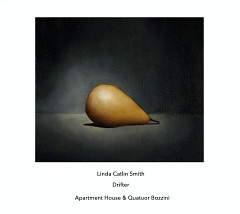
    “The experiment is always about whether something will hold,” says Toronto-based US composer Linda Catlin Smith, whose music tests how sounds can be longer or shorter, thicker or thinner, higher or lower, more distant or more intimate. The results are beautiful: poised and thoughtful, never forced. Often the music is soft but tactile — Catlin Smith lets us sit with the texture of the sounds, like feeling fabric between the fingers. This album of chamber music from the past two decades follows last year’s Dirt Road, also on Another Timbre. Drifter features Montréal’s Quatuor Bozzini playing the lilting Gondola, the Turner-inspired Folkestone and the Piano Quintet with Philip Thomas in graceful form; members of the ensemble Apartment House bring lonely elegance to Cantilena for viola and vibraphone and to the lissom title track for piano and guitar.

    The results are beautiful: poised and thoughtful, never forced.

    Les musiques d’Urnos dans SilenceAndSound

    «Critique», Roland Torres, SilenceAndSound, 15 mars 2017
    mercredi 15 mars 2017 Presse

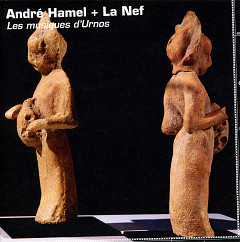
    C’est à un voyage dans le temps auquel nous invite le compositeur québécois André Hamel via Les musiques d’Urnos, imaginant une époque lointaine, 5000 ans avant JC, où résonnaient les mélodies d’une civilisation disparue originaire des plaines de l’Indus et qui aurait laissé les bribes des premières annotations musicales et dont les instruments ont été reconstruits pour mener à bien cette création.

    Si les 9 titres sont le fruit de l’imagination d’André Hamel, ils ont ce pouvoir évocateur qui transperce l’auditeur de par ses sonorités envoutantes, la cornemuse prenant des airs de passeur temporel portant entre ses notes le souffle de temps anciens.

    Il n’y a qu’à fermer les yeux pour se voir projeter en arrière, dans une cour pleine de musiciens virevoltants s’affairant à donner vie à des mélodies, conçues pour plonger les sens dans un tourbillon de pulsations antiques ayant traversé les siècles pour s’échouer sur nos rivages à la modernité éculée.

    Les musiques d’Urnos sont la réponse de temps ancrés dans le présent d’un passé fantasmé à la beauté tumultueuse et captivante. Un opus d’ethno-musique poétique aux courbes utopiques hanté par l’imagination et le désir de faire rêver. Intriguant.

    Les musiques d’Urnos sont la réponse de temps ancrés dans le présent d’un passé fantasmé à la beauté tumultueuse et captivante. Un opus d’ethno-musique poétique aux courbes utopiques hanté par l’imagination et le désir de faire rêver. Intriguant.

    Christopher Butterfield: Trip dans Bandcamp Daily

    «Best of Bandcamp Contemporary Classical: March 2017», Peter Margasak, Bandcamp Daily, 1 mars 2017
    mercredi 1 mars 2017 Presse

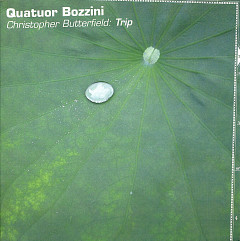
    Since forming in 1999, Montréal’s Quatuor Bozzini have steadily ascended to become not only one of the most daring string quartets in Canada, but in the entire world. The consistently bring both an exquisite touch and a refined sensibility to music that demands invisible rigor. In recent years, they’ve earned acclaim for their peerless readings of music by Swiss Wandelweiser Collective composer Jürg Frey, but they’ve also been key proponents of lesser-known composers from their homeland, including Martin Arnold and Simon Martin.

    This new offering focuses on the music of Christopher Butterfield, an influential Canadian figure whose position at the University of Victoria has impacted scores of young composers over the last few decades. His own work isn’t as well known as it should be, but Trip certainly provides a good opportunity to catch up. The five pieces here span over two decades — the two most recent compositions, Trip (2008) and fall, (2013) were written specifically for Quatuor Bozzini. The earliest piece here, Lullaby, is a piece for string sextet; its tightly-controlled moods are conveyed at a hush except for some bracing, hair-raising interruptions that subside as suddenly as they appear. Over time, Butterfield has embraced chance in his process: the solo violin piece Clinamen, for example, is shaped largely by short phrases printed on eighty cards to be mixed at will by the performer, while the aleatoric nature of the four-movement title piece produces unpredictable harmonies within a relatively fixed structure, changing the nature of the work with every new performance.

    Since forming in 1999, Montréal’s Quatuor Bozzini have steadily ascended to become not only one of the most daring string quartets in Canada, but in the entire world.
  • 2
  • 3
  • 4
  • 5
  • 6
  • 7
  • 8
  • 9
  • 10