Sauter au contenu principal
actuellecd

Blogue

59 résultats
  • 1
  • 2
  • 3
  • 4
  • 5
  • 6
  • 7
  • 8
  • 9
  • Christopher Butterfield: Trip dans The WholeNote

    «Review», Paul Steenhuisen, The WholeNote, 29 août 2017
    mardi 29 août 2017 Presse

    For its 23rd CD, Quatuor Bozzini has produced a monograph recording with an almost-chronological retrospective of music by Christopher Butterfield. Spanning more than 20 years, it contains three pieces for solo strings and two string quartets. Clinamen (the Latin name Lucretius gave to the unpredictable swerve of atoms), for solo violin (1999), is made up of 80 cards, each containing a short musical phrase, combined according to the free will of the performer. Intentionally inchoate, the piece is bound together most prominently by the honey tone of Clemens Merkel’s playing, and yet, there are whispers of its compositional technique, as though related materials were sketched, bent through historical filters from classical music to modern, and then splayed by means of William S Burroughs’ cut-up technique.

    fallùù (2013), written for the full quartet, is the perfect vehicle for the Bozzinis’ signature non-vibrato playing. At times haunting and tense, their sound is also unadorned, unaffected and exquisite. Engaged in material processes of rotation and accumulation, the ensuing tone of the piece is plaintive and distantly evocative of Cage’s String Quartet in Four Parts. The eponymous Trip (meaning possibly all of: excursion, to dance or run lightly, to stumble or fall, to release and raise an anchor, and to hallucinate) is an outlandish journey from a short Scorrevole movement augmented by a random talk radio broadcast, through a moto perpetuo, to a swaying, recapitulatory Scherzo. The last movement, marked Adagio molto, is longer than the preceding movements combined, and sounds not simply slow but like a time-stretched recording, where the smallest, usually ordinary timbral deviation is magnified and burnished, while notes, lines and harmonies are expanded into tranquillizing beauty.

    At times haunting and tense, their sound is also unadorned, unaffected and exquisite.

    D’éclisses dans Mouton Noir

    «Critique», Geoffrey Lain, Mouton Noir, no 22:06, 1 juillet 2017
    samedi 1 juillet 2017 Presse
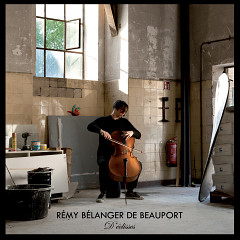
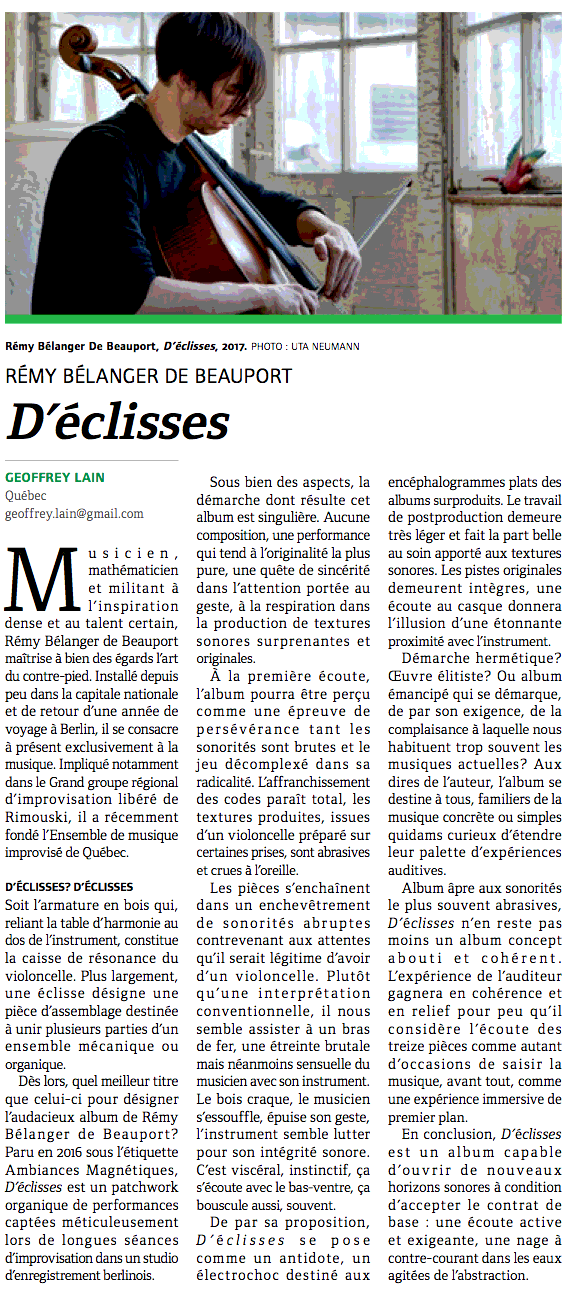
    D’éclisses est un album capable d’ouvrir de nouveaux horizons sonores à condition d’accepter le contrat de base: une écoute active et exigeante, une nage à contre-courant dans les eaux agitées de l’abstraction.

    Christopher Butterfield: Trip dans The Squid’s Ear

    «Review», Brian Olewnick, The Squid’s Ear, 28 juin 2017
    mercredi 28 juin 2017 Presse

    Butterfield (b. 1952) is a long-time teacher and composer, operating largely in Toronto and Montréal. As a teacher, he has a number of students working in various contemporary areas, including Wandelweiser-influenced, who assign him a great deal of credit for their development.

    The Quatuor Bozzini, which also works out of Montréal, presents five of his works ranging in origin from 1991 to 2013: two quartets, a sextet and two solo pieces, all of them bracing and enjoyable. Lullaby (1991) adds an additional viola and cello. It’s a somewhat disorienting lullaby, broken up at times by nightmarish shrieks, but by and large it wafts along with luscious, quavering harmonics, sometimes entering surprising, perhaps dreamlike song formations, reminding this listener of Ben Johnston’s work. Maybe some Tenney as well. Generally, Butterfield’s music, as represented here, often goes off in unexpected, delightful directions where one can hear (or think to hear) this or that reference but still comes away with more of a Butterfield-ness than anything else. Lullaby is an excellent example of this. beach whistle (1993) and Clinamen (1999) are solo works for cello and violin, respectively, the former a sober conversation of sorts between high and low, plucked and bowed, the later portions strangely melancholy and evocative while Clinamen is something of a dance, flitting from one light form to another (it’s constructed from 80 short phrases which the violinist can combine in any sequence he/she chooses).

    The final two pieces are for string quartet proper. As per the composer’s notes, fall (2013) is “(b)ased on the chromatic rotation of a four-note row” with a randomized dynamic range. The result is a hymn like structure but, as Butterfield says, “unpredictable ‘voice leading’ and a sense of undependable harmony.” One experiences a vivid spatial effect, the louder chards seemingly “nearer” than others, an otherwise self-similar landscape where perceived distance is the sonic qualifier. Additionally, the overall meditative aspect of the music itself permeates this landscape, somber and disquietingly beautiful. Trip (2008) is in four sections, the first three short (each less than 2:30) while the final lasts some 13 1/2 minutes. The three brief movements are brisk and rich (the first incorporating a talk radio capture), rather Neo-Romantic in flavor while the final (marked Adagio molto) is dark, scratchy, agitated and brooding, though not discarding an underlying tonality; I found myself thinking of Arnold Böcklin’s paintings.

    Overall an extremely satisfying release — absorbing music incisively performed by Quatuor Bozzini.

    Overall an extremely satisfying release — absorbing music incisively performed by Quatuor Bozzini.
    Trio dans Le son du grisli

    «Critique», Guillaume Belhomme, Le son du grisli, no 116-117, 17 juin 2017
    samedi 17 juin 2017 Presse

    C’est dans un autre trio guitare / basse / batterie que celui qu’il forme avec Chris Burns et Nicolas Caloia — récemment entendu sur Live: Taking a Shot, cassette Small Scale Music — que l’on trouve ici John Heward. Le temps de quatre improvisations enregistrées en Nouvelle-Écosse en juillet 2013 avec Arthur Bull (la guitare) et Adam Linson (la basse).

    Et ce trio diffère de l’autre, au gré d’intentions délicates qui n’imposent pas à l’improvisation l’allure forcée d’un jazz qu’on aimerait libre. C’est sans doute là l’expérience des intervenants, qui s’est forgée auprès de partenaires de taille: Steve Lacy, Lori Freedman, Malcolm Goldstein ou Joe McPhee pour Heward, Derek Bailey, Roscoe Mitchell ou Roger Turner pour Bull, John Butcher ou l’association Axel Dörner / Rudi Mahall / Paul Lytton pour Linson.

    La frappe mesurée — retenue, même, parfois — du batteur invite ainsi à un jeu courtois que respectent les feedbacks maîtrisés du guitariste comme les allers et retours turbulents de son médiator, les grands mouvements d’archet du contrebassiste comme ses fabuleux accrocs. Sur la deuxième improvisation, la plus longue (une douzaine de minutes), le ton montera quand même, pour permettre peut-être au contraste de parachever le tableau.

    La frappe mesurée du batteur invite ainsi à un jeu courtois que respectent les feedbacks maîtrisés du guitariste comme les allers et retours turbulents de son médiator, les grands mouvements d’archet du contrebassiste comme ses fabuleux accrocs.

    Avant dans Voir

    «Chronique disques», Réjean Beaucage, Voir, 15 juin 2017
    jeudi 15 juin 2017 Presse

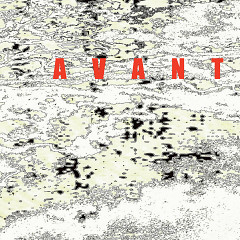
    Poursuivant leur projet amorcé l’année dernière avec le disque 1948 (Kohlenstoff Records), qui saluait le travail des pionniers de l’époque de l’invention de la musique concrète par Pierre Schaeffer, les deux bad boys de la musique actuelle nous arrivent avec un enregistrement en concert à Québec dans le même esprit, c’est-à-dire très noise. On est au cœur du glitch; l’aiguille du tourne-disque de Tétreault est au beau milieu de l’égratignure et le laptop de d’Orion, saturé à souhait, mord la poussière. Ces deux-là ont raffiné le produit depuis un bout de temps et leur noise est épuré; raison de plus pour regretter que le tout ne fasse guère plus de 25 minutes.

    On est au cœur du glitch; l’aiguille du tourne-disque de Tétreault est au beau milieu de l’égratignure et le laptop de d’Orion, saturé à souhait, mord la poussière.

    Parlures et parjures dans Voir

    «Chronique», Réjean Beaucage, Voir, 5 juin 2017
    lundi 5 juin 2017 Presse

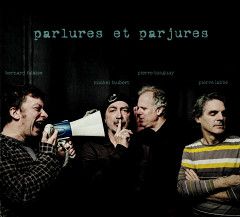
    Déjà trois ans que le saxophoniste Pierre Labbé donnait au Festival international de musique actuelle de Victoriaville (FIMAV) la création de son projet mêlant trad et musique actuelle avec le concours de Michel Faubert dans le rôle du «conteur électrique». La poésie de ses propos est magnifiée par les mélodies recherchées que tissent autour d’elles les musiciens (le guitariste Bernard Falaise et le batteur Pierre Tanguay appuient le souffleur). Comme en concert, on se laisse prendre tout de suite par l’énergie de l’ensemble, semblable à celle du groupe Papa Boa, auquel Falaise, Faubert et Labbé ont participé et dont Jean Baribeau revient faire un tour de piste ici. Un projet à surveiller s’il passe dans votre coin, et dont on espère des suites.

    Un projet à surveiller s’il passe dans votre coin, et dont on espère des suites.
  • 1
  • 2
  • 3
  • 4
  • 5
  • 6
  • 7
  • 8
  • 9