Sauter au contenu principal
actuellecd

Blogue

59 résultats
  • 1
  • 2
  • 3
  • 4
  • 5
  • 6
  • 7
  • 8
  • 9
  • Résistances dans La Scena Musicale

    «La ronde des disques Millésime 2017», Marc Chénard, La Scena Musicale, no 23:4, 1 décembre 2017
    vendredi 1 décembre 2017 Presse

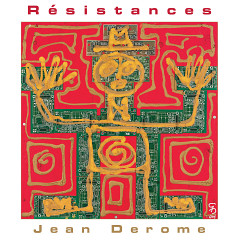
    Récipiendaire d’une bourse de carrière en 2013, Jean Derome a investi son pécule dans une série de projets spéciaux. Le premier, créé en mai 2015, fait l’objet de ce tout nouveau disque lancé le 14 décembre. Pour saisir la pleine portée de cette entreprise, de loin la plus ambitieuse de Derome, une lecture des notes de l’artiste s’impose. En bref, l’œuvre entière repose sur la fréquence de 60 Hz, norme utilisée dans le réseau hydro-électrique nord-américain. En musique, cela se traduit par une note située entre le si bémol et le si naturel, celle-ci servant de tonalité de base. Derome explore donc la microtonalité, ce qui nécessite une certaine adaptation de l’oreille au début. Pour réaliser sa vision, le compositeur a recruté 19 collègues jouant toute une gamme d’instruments, incluant des synthés et tourne-disques. À une seconde près des 60 minutes et divisé en 16 plages, le disque se déploie assez lentement dans la première moitié. Outre un ostinato de basse quasi ellingtonien dans la sixième plage, il y a peu de matière compositionnelle dans cette tranche; il faudra donc attendre la dixième plage et les suivantes pour que l’ensemble ressorte davantage, dans un premier temps par des jeux d’improvisation collective dirigée et, dans un second, par une ligne thématique en fin de parcours. En tant que disque, cette œuvre conceptuelle pèche par des longueurs, mais ceux qui ont pu assister à la captation en concert de cet enregistrement le printemps dernier au Gesù pourront sans doute avoir un autre… buzz.

    … l’ensemble ressort davantage, dans un premier temps par des jeux d’improvisation collective dirigée et, dans un second, par une ligne thématique en fin de parcours.

    Eliot Britton: Metatron dans The Squid’s Ear

    «Review», Marc Medwin, The Squid’s Ear, 25 octobre 2017
    mercredi 25 octobre 2017 Presse

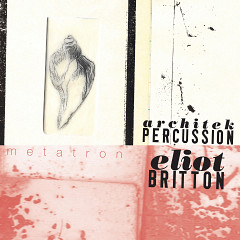
    How deep is the ocean, asks the now-standard tune’s lyrics throughout this half-hour sonic extravaganza. The answer: As deep as the titlewave of sonic signifiers bouncing off the walls of composer Eliot Britton’s diverse, inclusive and warped imagination.

    To suggest that Metatron is plunderphonic at its heart is to suggest that Bach and Webern both employed counterpoint, which is to miss the point almost entirely. Reflecting on the piece as a time warp akin to the end of Stanley Kubrick’s 2001 is also something approaching an injustice. Both are true and false, as music can present the simultaneities toward which speech struggles. Aided by the empathetically excellent work of Architek Percussion, Britton offers a series of quantum leaps through the development of technology, its attendant audio history and many of the signifiers therein as viewed through a 21st century lens.

    The results are miraculous. The deeper you dive, the more you find, and the more you’ve been listening, the greater the rewards. From the radical percussion works of Varese to the bleeps, brips and braps of early 1980s video games, from Whispering Jack Smith to those ambient tintinnabulations of middle 1970s ECM discs, from swinging Ella Fitzgerald to Blue Skies as it might be heard on the Minus label, all is referenced for listener gratification. If it were that simple, the piece might fail; there is a narrative, a beautifully touching and often laugh-out-loud meta-story of how development and recurrence partner on some vast cosmic dancefloor, converging and diverging in spirals of heartfelt reminiscence. If that weren’t enough, the piece begins and ends in C, more or less. How’s that for convention?

    Again, were the recording not absolutely spectacular, those retro-washes of synth magic, the sudden gear-shifts and the constant illusions to old and beloved pop tunes would be lost in the fray. They aren’t, and it is to the credit of all involved that this is one of the most extraordinary, confrontational and often gorgeous trips through timbral history that I’ve encountered.

    The results are miraculous. The deeper you dive, the more you find, and the more you’ve been listening, the greater the rewards.

    Jeux de pistes dans The Squid’s Ear

    «Review», Marc Medwin, The Squid’s Ear, 4 octobre 2017
    mercredi 4 octobre 2017 Presse

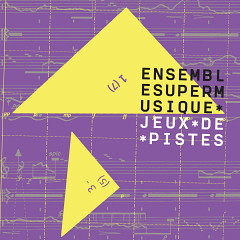
    At this point, there is nothing innovative or even novel about the combination of improvisation and composition save the way the symbiotic relationship is achieved. On this score, Ensemble SuperMusique succeeds on all counts. This disc offers up four of what might be described, loosely and inadequately, as graphic scores, though whatever images are involved are not nearly as graphic in detail as the excellent playing and recording.

    The oldest entry is John Rea’s Tempest, composed in 1969 and here adapted for a much larger temporal canvas than its original two minutes. Sussurations and long-form semidrone encompass voices and instruments of deliciously indeterminate character, leaving aside the point or two at which identification is readily and vividly apparent. Entering and exiting as the proverbial lamb, everything bubbles and seethes with an energetic undercurrent, planes of sound nearly intersecting as unisons ebb and flow into each other, forming complex but clear sonorities that shake hands before exiting.

    The other three scores were composed in the past few years, and easily the most whimsical among them is Malcolm Goldstein. Any fan of Ligeti’s Aventures pieces will absolutely love this realization, such is its cheek and daring. Swoops and glides abound, punctuated by vocal outbursts reminiscent of Phil Minton at his seriocomic best. The occasional unison is fodder both for pause and momentary reflection before the zaniness recurs, turntable often at the ready and a wonderful upward and rapid flick out of focus concluding the proceedings. Danielle Palardy Roger’s TanGRAM is a study in what Jack Kerouac, describing Proust’s Cambre Cathedral, called slow concentric waves. According to shapes based on the ancient Chinese puzzle, we ascend and descend in arcs and lines that creep glacially in and out of cognition as timbres converge and diverge. There are a few similar passages in Tempest, but TanGRAM is pure slow-motion bliss and horror as some percussion rolls a foundation of dread and dynamics slowly increase, eventually leading to fragmentation in the final minutes.

    By way of total contrast, Jean Derome’s L’argent roils, beats and explodes with the unbridled passion only an energetic ensemble of improvisers and composers can bring to the table. Huge fits and starts pervade this sectionalized assault on the senses, and, were it not for a first-rate recording, much of its nuance would be lost in the noise. Fortunately, interstitial and timbral delineation is possible, and a few of the episodes are greeted by the whoops and hollers of a particularly appreciative audience. No sound is left unused, from looped electronics to all combinations of acoustic sonic layering; as with the rest of the discs, the results excite and mesmerize by turn, capturing what was undoubtedly a fiery and introspective performance.

    No sound is left unused, from looped electronics to all combinations of acoustic sonic layering; as with the rest of the discs, the results excite and mesmerize by turn, capturing what was undoubtedly a fiery and introspective performance.

    Mikrokosmos Sz 107 dans The Squid’s Ear

    «Review», Dave Madden, The Squid’s Ear, 18 septembre 2017
    lundi 18 septembre 2017 Presse

    Quartetski’s interpretation of classic works has been a mixed approach in the best possible way. Their version of Stravinski’s Le Sacre du printemps adhered near 50% of the time to the mystical original, the other portion being a different type of genius musical accoutrement.* The group’s Prokofiev covers turned the Russian composer into a hard-bopping jazz man. Now the quintet (oh the irony) sifts through 96 acts that make up the first three books of “progressive piano pieces” by Béla Bartók’s Mikrokosmos and offers 25 greatest hits.

    The results here are… fun. They range from playful, naïve (per the simpler works intended as etudes for Bartók’s young son Péter) to mischievous to bold to sweet and stark. Livre I: I. Six mélodies à l’unisson wiggles out of the corner with Bernard Falaise’s gentle guitar melody. He hangs on a last note as Phillippe Lauzier’s bass clarinet and Isaiah Ceccarelli on xylophone meander in the delicate simplicity. Violinist Joshua Zubot offers a syrupy line and pause before the group — with Pierre-Yves Martel rounding out the mix on electric bass guitar — slams into a stint of rocking out. Turning on a dime, Lauzier is joined by a drifting melodica until a micro-burst of slinky jazz slips in. Livre III: XIII. Gamme pentatonique shimmers with a bloated pitch-shifting guitar (as in it sounds like someone skronking on a harmonizer pedal), slightly-out-of-tune synth and lively pizzicato from Zubot. An icy, wandering duet of wind instruments (soprano sax riffing that would make sense coming out of Evan Parker) meets lithe, mandolin-like strums, and the band slams back into the relatively pummeling, lugubrious rock; the mania of the sax persists as the rest of the crew hunker into a big ol’ groove.

    Livre II: VI. Accompagnement en accords brisés comes with slide whistle sounds, pick slides, sexy rhythmic patterns, fun accordion-like chords (more melodica), the work coming off as Tom Waits scoring a Jim Jarmusch flick; Livre II: X. Méditation adopts the same aesthetic, but adds sultry tremolo guitar to the fold. Livre II: Dialogue is 43 seconds of punctuating distorted crunch whose last pluck probably ended with tongue out and a devil horns hand pose.

    Makrokosmos, the final and longest piece at over nine minutes, is the quintet sinking into a wave of droning material with wispy gestures of bowed cymbals, squeaking harmonics and deep rumbles percolating to the surface. The juxtaposition of style here furthers the mystique of the album in that, sonically, it eulogizes the previous tracks. “Bartók, you are why we are gathered today, and this record is an artifact to the influence you had on us. Look at what your legacy produced!

    Technical virtuosity meets a virtuosity in cleverness is the best way to describe this music. Homage, respect, innovation: paint that on a banner and hang it at the next Quartetski show.

    *This is an album that will be included in my desert island bunker.

    Technical virtuosity meets a virtuosity in cleverness is the best way to describe this music. Homage, respect, innovation: paint that on a banner and hang it at the next Quartetski show.

    Chants et danses… with Strings! dans Touching Extremes

    «Review», Massimo Ricci, Touching Extremes, 6 septembre 2017
    mercredi 6 septembre 2017 Presse

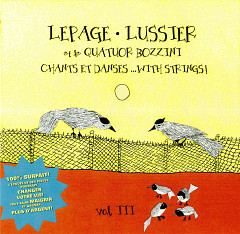
    We’re here reporting about the most recent effort by a pair of pillars of Québec’s scene, of whom this reviewer bought the vinyl version of their first collaboration — Chants Et Danses Du Monde Inanimé — shortly after it came out in 1984 (gasp). We never looked back, in case you’re asking.

    Conventum, ever heard of them? Le Trésor De La Langue, anyone? Does the title La Traversée De La Mémoire Morte ring any bell? There is time to do some homework, no problem. But please do it if you’re not acquainted with these perennially acute artists yet.

    The activities of Lepage and Lussier — quirkily proficient in clarinet and guitar respectively — are exquisitely complemented by Bozzini’s strings across a cycle of pieces long enough to give the idea of a fully formed concept and short enough to make sure that, once the picture has been drawn, there is no need to dwell on it more than necessary.

    It’s a clever choice, because this is unpredictable music who literally defies categories. Furiously arrhythmic and incredibly poised; strengthened by commitment and ironically derisive; replete with melodic sketches which, in a matter of seconds, melt individual meanings in a contrapuntal cauldron of distortion, dissonance and — for lack of a better description — unobtrusive clangor.

    Sometimes the mind’s gates get opened to sudden contemplative flashes. Those don’t last too much, either. Basically it’s all a “catch-a-glimpse” game: one may succeed or simply not realize what’s going on. When the ears manage to convey a precisely articulated message to the brain, chances are that Lussier, Lepage and the good people at Bozzini’s will find a way to disrupt whatever was learnt a moment before.

    And they always do that armed with a wry smile emerging from nowhere, perhaps in the middle of a semi-organized chunk that doesn’t fit in any mental archive.

    In another age, we could have stamped this album with a “sonic art for the modern times” definition. However, faint lights of yesteryear occasionally guided us along a path that exploits the memory as a catalyzer of transmissions related to some kind of “future”. A place where language is truly just the virus hypothesized by Bill Burroughs, exclusively curable through the use of instantaneous decisions dictated by instrumental adroitness.

    Let’s sing and dance ourselves, then — and raise our aerials up. Maybe we’re set to untie the knots of incommunicability, and we don’t even know it.
    The activities of Lepage and Lussier — quirkily proficient in clarinet and guitar respectively — are exquisitely complemented by Bozzini’s strings…
  • 1
  • 2
  • 3
  • 4
  • 5
  • 6
  • 7
  • 8
  • 9