Sauter au contenu principal
actuellecd

Blogue

198 résultats
  • 3
  • 4
  • 5
  • 6
  • 7
  • 8
  • 9
  • 10
  • 11
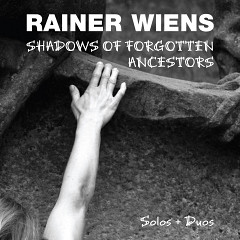
  • Shadows of Forgotten Ancestors dans Downtown Music Gallery

    «Review», Bruce Lee Gallanter, Downtown Music Gallery, 30 octobre 2009
    vendredi 30 octobre 2009 Presse

    This is Rainer Wiens third appearance on the AM label, both previous ones have involved new music violinist Malcolm Goldstein. I can’t think of many other discs which have featured the kalimba or thumb piano in a new music setting except for Richard Crandell who has two discs on Tzadik. The Valley of Green Ghosts opens with a sublime, earthy kalimba solo, delicate and enchanting. If a Bird Sings in the Forest is a fine solo for soprano sax, rich and slightly twisted. Blood Fever is violin solo by Mr. Goldstein and it is stark and a bit eerie. The title track features violin (Joshua Zubot) and flute shadowing each other in a most mysterious way playing some bent (written) harmonies. Since Mr. Wiens only plays on a few of these pieces, it sounds as if he has written or at least directed the other solo & duo pieces. All of these pieces do fit together and seem to evoke an ancient ritualistic vibe, hence the CD’s title. Jean Derome plays some superb flute on Bird of Jade, an instrument which he doesn’t get to play often enough. Shh… Whisper to the Wind features some more strange, bent violin and breath-like vocal sounds or whispers. If I didn’t know better, I would’ve thought that this disc was a soundtrack to a native American psychedelic ceremony. Does anyone still do peyote or magic mushrooms? I wouldn’t know.

    If I didn’t know better, I would’ve thought that this disc was a soundtrack to a native American psychedelic ceremony.

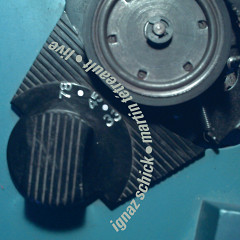
    Live • 33 • 45 • 78 dans Downtown Music Gallery

    «Review», Bruce Lee Gallanter, Downtown Music Gallery, 30 octobre 2009
    vendredi 30 octobre 2009 Presse

    Ignaz Schick is a Berlin-based musician who runs the Zangi label and is a member of the International Turntable Orchestra, along with Martin Tétreault, Philip Jeck & Dieb 13. Mr. Tétreault has been playing turntables with & without records for many years and can be heard on more than 25 discs. Tétreault was one of the first turntablists to abandon records and just play & manipulate the turntable itself. Besides being a strong improviser, Mr. Tétreault is a concept man as many of his discs can attest to. Sometimes his concepts are successful and sometimes not so. This disc appears to be a live duo with two master turntable manipulators. It often sounds as if there are few if any records involved. What we hear are clicks, static, rubbed styles and assorted turntable and tone-arm manipulations. Ping pong balls? balloons? What exactly is going on? Only these turntablists know for sure. The results are more diverse and often fascinating than one might imagine. Much of this is similar to electronic music but more stark. Each sound seems to works and fits well into in its own place. Like listening to a bunch of machines whizzing and whirring by the themselves, yet there is a concept or direction. Pretty engaging, nonetheless.

    Pretty engaging

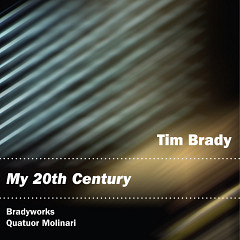
    My 20th Century dans Downtown Music Gallery

    «Review», Bruce Lee Gallanter, Downtown Music Gallery, 30 octobre 2009
    vendredi 30 octobre 2009 Presse

    Tim Brady is perhaps the most ambitious guitarist and composer to emerge from Canada over the past couple of decades. He rarely seems to be tied to any one category like jazz, classical or progressive rock, although his music involves all of those and more. This double disc (CD+DVD) set is Tim’s most ambitious work yet. My 20th Century features two ensembles: Bradyworks (el. guitar, piano, saxes, sampler & percussion) and the Quatuor Molinari (string quartet) plus video. This work is broken into four parts, each one an homage to an certain artist. Strumming (for John Lennon)> is first and it was inspired by the John Kennedy assassination, the arrival of the Beatles and the way TV brought the world together for these monumental events. The piece features multiple electric guitars and a looped video image. I dig the way a melody and then some guitar noise is trying to break through the multiple layers of strumming. Each of the various layers of guitar parts evokes different ways the electric guitar effects our lives. Traces (for Charlie Christian) was inspired by a famous early jazz guitar solo (Solo Flight from 1941), in which Mr. Christian joined Benny Goodman on stage at Carnegie Hall, thus breaking down racial barriers. This piece features Bradyworks, Tim’s working quintet, and it is a deconstruction of Mr. Christian’s solo. I like the way that this work turns the original melody inside out, so we hear it in different ways, speeding it up and slowing it down in places. Hommage à Rosa Luxemburg was inspired by a painting by Jean-Paul Riopelle, “a work obsessed with ghostly images of birds and nature”. This piece features the Quatuor Molinari string quartet and samples of the casino where the painting was hung. It is long and consistently fascinating with slowly swirling layers of strings punctuated by selective samples. The final piece is called Double Quartet and it does indeed feature both groups. It is dedicated to the composer Dmitri Shostakovich and was inspired by the composers’s long life in Russia under various regimes and the great music that he composed. This piece is the most ambitious yet and is about 30 minutes long, broken into three sections. As I listen to this piece for the third time in 2 days, I am still amazed by the many things involved: Zappa-like quirky writing, tight inter-connected lines moving together and around one another like with the precision of a successful train schedule (not NJ Transit). The video DVD provides another source of stimulation to be dealt with and again it takes time to absorb the many different ideas involved. A great deal of preparation and work obviously went into wonderful double disc set, so please take the time seriously study this grand work. It will be well worth it, I can assure you.

    Tim Brady is perhaps the most ambitious guitarist and composer to emerge from Canada over the past couple of decades.

    Scat dans Downtown Music Gallery

    «Review», Bruce Lee Gallanter, Downtown Music Gallery, 30 octobre 2009
    vendredi 30 octobre 2009 Presse

    This is an extraordinary collaboration between artists from across the world. Brady’s rhythmic jazz-influenced North American chamber music is paired with the dynamic, take-no prisoners virtuosity of Australia’s Topology ensemble, based in Brisbane. Brady and Topology began collaborating in 1997, and toured Australia together in 1999, when the idea for this project was born. The CD presents some of Brady’s most exciting and passionate chamber works, in unrivaled performances by one of the finest new music ensemble of our time. SCAT (because we all have voices and stories to tell) takes its title from the strongly jazz-influenced first and third movements, and also from the unusual use of the musicians speaking voices as part of the music in the second and third movements. In the final movement, the musicians have to tell their life-story in 30 seconds, while playing their instrument as an accompaniment, ‘scating’ their personal histories. Lighting Field was composed for the 1999 Brady/Topology Australian tour, and consists of two movements. Darkness pairs the musicians against an electro-acoustic sampler part (playing processed electric guitar samples) to create a quietly foreboding atmosphere. Illumination brings the ensemble together for one of the most exciting rhythmic and dramatic movements that Brady has penned in recent years. Dark Matter (Primal Pulse) was originally composed for the Philadelphia ensemble Relâche, and is a small-scale concerto for viola, accompanied by 8 musicians. The work is quiet and introspective in character, and is given a beautiful and detailed performance by Topology’s violist, Bernard Hoey. Struck Twice By Lightning uses some of the same set of electric guitar samples as Lightning Field, but creates a totally different musical universe with them. Struck Twice By Lighting is about rhythm and articulation, about connecting the dark, visceral sound of the viola to the chiming, clangorous, pulsing sound of sampled electric guitars.

    This is an extraordinary collaboration between artists from across the world. Brady’s rhythmic jazz-influenced North American chamber music is paired with the dynamic, take-no prisoners virtuosity of Australia’s Topology ensemble, based in Brisbane.

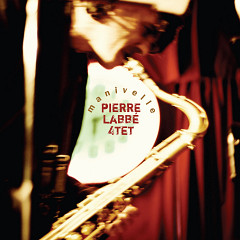
    Manivelle dans Montreal Mirror

    «Review», Gordon M Allen, Montreal Mirror, 29 octobre 2009
    jeudi 29 octobre 2009 Presse

    Following the success of his 50-piece orchestra at this summer’s Off Jazz Fest, Labbé gives us Manivelle, his best record to date. His quartet brings subtlety and muscle where they are due, flying high on nine great compositions ranging from snaky rhythmic workouts to airy ballads. It’s a treat to hear such a fully realized work from one of the city’s underappreciated creative forces.

    8/10

    It’s a treat to hear such a fully realized work from one of the city’s underappreciated creative forces.

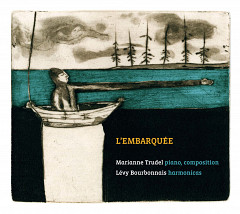
    L’embarquée dans Hour

    «Review», Mike Chamberlain, Hour, 22 octobre 2009
    jeudi 22 octobre 2009 Presse

    One can look forward to a voyage, or one can think about what one is leaving. The cycle of songs on L’embarquée, the self-released album by duo Marianne Trudel (piano) and Lévy Bourbonnais (harmonicas) appears to view the journey from the latter perspective, for the mood is more melancholy than hopeful in its lyricism. As for the playing, a piano and harmonica could easily get in one another’s way, but Trudel avoids this by focusing on melody and intelligent use of musical space, leaving room for Bourbonnais’ musings, with an interesting balance between the sonorities of the harmonica and the sharper pointillism of Trudel.

    ★★★

    En ce qui a trait à l’interprétation, le piano et l’harmonica pourraient facilement se nuire l’un à l’autre, mais Trudel évite cela en se concentrant sur la mélodie et en utilisant l’espace musical avec intelligence, laissant la place nécessaire aux rêveries de Bourbonnais
    ★★★
  • 3
  • 4
  • 5
  • 6
  • 7
  • 8
  • 9
  • 10
  • 11