Sauter au contenu principal
actuellecd

Blogue

215 résultats
  • 1
  • 2
  • 3
  • 4
  • 5
  • 6
  • 7
  • 8
  • 9
  • La notte fa dans Altremusiche

    «Recensione», Michele Coralli, Altremusiche, 15 décembre 2008
    lundi 15 décembre 2008 Presse

    Se lo spazio sonoro vuoto o l’idea di una prospettiva quasi geometrica, seppur costruita attorno a un affastellamento di suoni/rumori montati e rimontati, costituiva uno dei fulcri estetici di gruppi ormai totalmente votati alla costruzione digitale come i Klaxon Gueule, di cui Côté è membro, in questo La notte fa il batterista e manipolatore canadese assieme al suo partner Aimé Dontigny, altro manipolatore e turntablist, toglie ogni senso prospettico ai disegni sonori con una copertura di spazi realizzata attraverso ostinati e ripetitivi pattern ritmici, a volte montati in cut-up, a volte perfino programmati con un oggetto semi-vintage come una drum machine. Il risultato è un insieme di dieci brani molto processati e sintetici, nei quali può diventare anche stimolante ricercare i campioni (utilizzati previa autorizzazione) di Don Cherry, David Cronenberg, Mahavishnu Orchestra, Maurice Ravel e diversi altri. La grana complessiva comunque è molto ruvida, adatta cioè a un ascolto più emotivo, che razionale, in uno zibaldone di grooves sporcati qua e là da rumorismi attraverso cui tutto quanto può rientrare e che possono esplodere, comprimersi o interrompersi in qualsiasi momento senza che si perda la direzionalità complessiva.

    Uno zibaldone di grooves sporcati qua e là da rumorismi attraverso cui tutto quanto può rientrare e che possono esplodere, comprimersi o interrompersi in qualsiasi momento senza che si perda la direzionalità complessiva.

    Isaiah Ceccarelli, Michel F Côté, Fred Frith, Danielle Palardy Roger dans Left Hip Magazine

    «Concert Review», Isnor B Gordon, Left Hip Magazine, 12 décembre 2008
    vendredi 12 décembre 2008 Presse

    Fred Frith played in Montréal recently along with some very talented local free improv players. I was fortunate enough to catch the show…

    Legendary avant-garde guitarist Fred Frith dropped by Montréal’s Cabaret Juste Pour Rire the other night for a duo show with drummer Danielle Palardy Roger, and an opening set by two incredible percussionists — Michel F Côté and Isaiah Ceccarelli.

    Côté and Ceccarelli started things off with nothing but drums. Côté was behind a standard kit extended with lots of toys and two mics rigged up two a pair of Pignose amps. Ceccarelli just had a bass drum lying on a chair along with, again, lots of toys. The pieces were all very brief which was really nice, and despite the fact that drums alone might seem limited, each piece was very different from those that came before – sound loud and frenetic, others quiet, one actually managed to elicit quite a bit of laughter from the audience, which I’m hoping was a good thing. Côté used the mics as drum sticks to great effect — creating all kinds of unusual sounds of tension and release, friction, surprisingly dynamic feedback that almost made one think of the expressiveness of the Theremin, and there were moments of all out, distorted, banging-on-a-drum fun. The feedbacking drums were paired up really well with Ceccarelli’s bowed playing. A great set.

    Fred Frith and Danielle Palardy Roger were up second and once they began playing, they did not stop until their set was finished — a really long and well laid-out musical journey with lots of highlights and unexpected twists and turns. Fred pulled out every trick in the prepared guitar book — from the old twanging drum stick between the strings to an array of effects and looping pedals and beyond. But with his mastery of music and his instrument it never felt like he was depending on the gimmicks, more using them to great effect to build up a complex, multilayered soundscape and every-evolving composition. He was well matched up with Danielle Palardy Roger, who also had all of the extended techniques and managed to make great music with them. They both seemed to be following their own paths the whole way not interacting too much like some free improv players do, creating a sort of back and forth conversation type of sound, but their individual paths meshed perfectly well together, so maybe they were both just following the music more than their own instrumental egos. Adding an extra oomph to the coolness of the show was when first Fred Frith let loose a barrage of percussive and wailing tribal vocals, followed a little later on by vocal sounds along similar lines from Danielle Palardy Roger. Took it to another level beyond the often staid confines of stylized free improv into something more about music in a broader and more sophisticated sense.

    An awesome concert, and I think it was part of a recording project so it may see the light of day on CD in the not too distant future…

    An awesome concert…

    Toronto (Duets) 2007 dans Paris Transatlantic

    «On Barnyard», Nate Dorward, Paris Transatlantic, 12 décembre 2008
    vendredi 12 décembre 2008 Presse

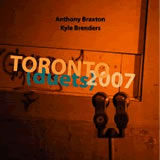
    Anthony Braxton has been up north of the border a fair bit lately: he’s been a guest at both the Victoriaville and Guelph festivals, and has forged an alliance in this city with the AIMToronto collective. The live double-CD Toronto (Duets) 2007 contains two 45-minute performances of his Ghost Trance compositions in the company of saxophonist Kyle Brenders. Composition 199 is a jogtrot quarter-note spiel that’s very much in the mode of Braxton’s early GTM; indeed, a glance at Jason Guthartz’s discography suggests that, though it seems to be previously unrecorded, it must date from the mid-1990s. The other piece (Composition 356) is an “Accelerator Whip” GTM piece that already received an airing on the mammoth Iridium set from Firehouse 12, its constantly shifting proportional rhythms sending the players on a bumpy rollercoaster ride. Both performances leave the GTM tramlines fairly quickly, leaping off into a forest of contrasting episodes; the players are particularly good at playing foreground/background games, so that you’re constantly shifting from hearing their interaction as mutual dialogue or as solo-with-accompaniment. When he’s on soprano, Brenders sometimes mimics Braxton’s skittery loopdeloops but more often tends towards a melodic forthrightness out of Steve Lacy (in town, he frequently plays with The Rent, a Lacy covers band); on tenor he’s more of an Evan Parker man, his tone gruff and grainy. A few of his licks are distractingly derivative (especially his recourse to Parkerish burblings), but what matters is his great ears and his wholehearted response to the very plastic character of Braxton’s music, the way it seems to be buffeted by strange gusts of anger and hesitancy and delight or to suddenly become soft and languid. Given that this year has been even by Braxton’s standards a prolific one for releases — an amazing nineteen Braxton CDs and one DVD were reviewed in the Fall 2008 issue of Signal to Noise alone — there’s some danger of this one falling through the cracks, which would be a shame: there are passages here that are among the most enjoyable I’ve encountered in latterday Braxton, like the deluge of slithering arabesques that occurs near the end of Composition 199.

    … there are passages here that are among the most enjoyable I’ve encountered in latterday Braxton

    It’s Only Life! dans Paris Transatlantic

    «On Barnyard», Nate Dorward, Paris Transatlantic, 12 décembre 2008
    vendredi 12 décembre 2008 Presse

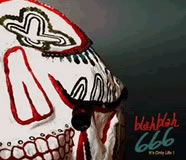
    It’s Only Life! is by the determinedly offbeat quintet Blah Blah 666. It’s best described as postmodern, DIY vaudeville (banjo, ukulele, ricky-tick percussion, tootling melodicas, glockenspiels) with south-of-the-(American)-border touches, including covers of La Cucaracha and Mexican Hat Dance. They’re probably a band to see live, given the bizarre visual component of the music — Ryan Driver (of the Reveries, another of Toronto’s more self-consciously bizarre ensembles) plays a bass made out of a broom, and Martin and Nick Fraser play a single drumkit simultaneously, at least when one of them’s not playing “plastic blow thing” or trumpet — and perhaps it’s better to think of this as a kind of celebration of the collaborative, communal nature of this city’s music scene. The sense of fun comes through even just on disc, but unlike other offerings on the label, this one relies too much on charm and stylized tattiness.

    The sense of fun comes through…

    Plumb dans Paris Transatlantic

    «On Barnyard», Nate Dorward, Paris Transatlantic, 12 décembre 2008
    vendredi 12 décembre 2008 Presse

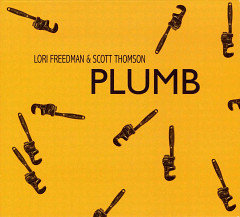
    Plumb is the only “traditional” free improv disc in this batch of releases, an encounter between clarinetist Lori Freedman (best known as half of the duo Queen Mab with Marilyn Lerner) and trombonist Scott Thomson. It’s recorded in extreme close-up in a dry acoustic, which actually suits the music very well: the playing is plenty vivid on its own, a lot of the action taking place “inside” the sounds. The CD is, fortunately, not an extended-technique showcase, though there are plenty of odd, ear-tickling sounds to be found here. What the duo is up to is subtler than hiss-blap-brrp sonic extremism: often it’s as if they are unpacking the extraordinary sonic oddities and treasures discoverable even in fairly standard sounds on their instruments, the rasps and flutters and expressive jolts that lurk within a note. Thomson keeps to small, tactile gestures but somehow contrives to give bebop momentum even to moments of drifting near-stasis, his playing’s calm surface ruffled by countless small shivers of delight and contrariness; while the solo piece Lead shows how much mileage he can get out of quivery pirouettes and split tones — he even throws in some curt bouncing-ball melodies right out of J J Johnson. Freedman is more inclined to moments of catharsis, exploiting the bass clarinet’s sheer animal warmth or (contrarily) emitting abrupt, computery bleeps, and letting loose a huge outcry in the middle of The Plummet; but she’s also got a knack for using hisses, sighs and whispers with needle-like precision. (Nice to hear a free improv disc where the quietest moments are so intense, even passionate, never threatening to dissolve into vagueness or low-energy drift: there’s a quiet, bubbling episode at the end of Leak that will make your scalp prickle.) This is first-rate music that hardly deserves the tag “abstract”: it contains more melodic invention than a score of mainstream jazz records.

    This is first-rate music that hardly deserves the tag “abstract”: it contains more melodic invention than a score of mainstream jazz records.

    Freedman dans Paris Transatlantic

    «On Barnyard», Nate Dorward, Paris Transatlantic, 12 décembre 2008
    vendredi 12 décembre 2008 Presse

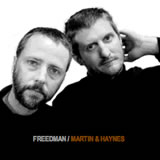
    The Martin-Haynes duet album Freedman is the oddest of the bunch. Haynes is on ukulele throughout, and Martin’s kit is simply a suitcase. (Do musicians still play on suitcases in hotel-room jam sessions these days? It’s a sound familiar to anyone who’s got a copy of the old Bird on Tenor session….) The setlist consists of seventeen tunes by Myk Freedman, the lap-steel player who masterminds the St. Dirt Elementary School (local faves at the Tranzac Club). There are no feats of Jake Shimabukuro-style uke virtuosity here, just a gentle ramble through Freedman’s ought-to-be-standards: lazybones serenades, plingy dance music, miniature Chadbournesque string-violence, shuffle-and-thump grooves, ghostly Oriental ditties and faux-bossa. The players are recorded in tight close-up, which makes the uke sound splendid and gives everything an intimacy that’s as affecting as bittersweet melodies like “Love Boat of Love”. Haynes plays with a laidback charm and grace, occasionally letting things drift whimsically off-course, and (as on all these albums) Martin’s ability to get a huge sonic variety out of next to nothing is uncanny. It’s good-humoured music, but they’re not playing it for laughs or kitsch; it might sound like a gimmicky premise for a CD, but give it a try and it’ll pleasantly surprise you.

    Martin’s ability to get a huge sonic variety out of next to nothing is uncanny
  • 1
  • 2
  • 3
  • 4
  • 5
  • 6
  • 7
  • 8
  • 9