Sauter au contenu principal
actuellecd

Blogue

223 résultats
  • 13
  • 14
  • 15
  • 16
  • 17
  • 18
  • 19
  • 20
  • 21
  • Étymologie dans Le Devoir

    «Jazz: Le DGT, le très grand groupe», Serge Truffaut, Le Devoir, 30 juin 2007
    samedi 30 juin 2007 Presse

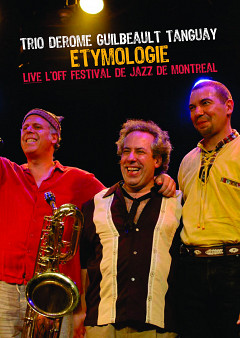
    On ne le dira jamais assez… Non! C’est pas ça. On n’insistera jamais assez: le trio formé de Pierre Tanguay, Normand Guilbeault et Jean Derome est un grand groupe. Pas un grand trio ou quartet moins un, un très grand groupe. Pas un grand groupe montréalais, québécois, canadien ou nord-américain, mais bien un immense groupe du monde mondial. Point barre.

    Cette semaine, dans le cadre du Off Festival de jazz de Montréal, le Trio Derome Guilbeault Tanguay a publié un DVD enregistré lors de l’édition antérieure de cet événement. C’est un bijou, un régal, si on aime le jazz évidemment. Plus précisément si on aime le jazz qui décape au quart de tour parce que décliné sur le mode de la passion. De la passion et de l’intégrité. On s’explique.

    Tout d’abord, il faut évoquer le programme du spectacle. Il faut le souligner parce qu’il met en relief l’extraordinaire habileté du groupe à détailler, et non pas relire, les moindres beautés du jazz. Qu’on y songe: en guise d’introduction ils nous servent Miss Ann d’Eric Dolphy. Puis ils enchaînent avec 245 du même immense Dolphy, le saxophoniste qui adorait les pinsons. Et c’est pas une blague.

    Ensuite? Fleurette africaine de Duke Ellington, Étymologie de Jean Derome, A Bit Nervous de Misha Mengelberg, Jitterbug Waltz de Richard Malby, Baby de Lennie Tristano et Fluide de Derome. Bref, un programme de rêve, sauf qu’on aurait adoré qu’il glisse entre deux morceaux une pièce de Roland Kirk, que les musiciens décomposent à souhait.

    Leur jeu? Ils est à hauteur d’homme. Et comme ils sont longs… Concrètement, empiriquement, comme au ras des pâquerettes, leur jeu a ceci de bien comme de bon que les trois musiciens ne font pas de la gestion de risque mais qu’ils le cultivent, le risque. Résultat: ils ne captent pas, ils kidnappent plutôt notre attention. Et ça, c’est du grand art. Intitulé Étymologie, ce DVD a paru sur étiquette Ambiances Magnétiques.

    … un immense groupe du monde mondial. Point barre.

    63 apparitions dans Meshes of the Afternoon

    «Review», Seth Watter, Meshes of the Afternoon, 17 juin 2007
    dimanche 17 juin 2007 Presse

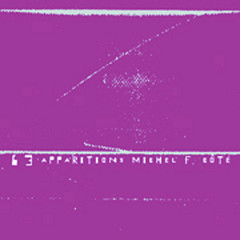
    An obscure and unfortunately neglected record by key Ambiances Magnétiques player Michel F Côté, 63 Apparitions (&records, 2004) was originally written as a choreographical piece performed in Montréal. While I have no idea what the visual counterpart may have been or the significance of its title, I do know that this is stunningly beautiful music that deserves to be reappraised. Composed by Bruire frontman Côté and sounding very much like a continuation of his work in Klaxon Gueule, 63 Apparitions also features the playing of Christof Migone and labelmate Martin Tétreault on various objects, as well as the unrecognizable voice of AM staple Diane Labrosse. The fifteen brief tracks here all begin and end quite awkwardly, as if a continuous recording had been separated into pieces and re-shuffled. Côté’s main axe is the drum, but you’d be hard-pressed to tell from this strange melange of percussion, electronics, piano, vocal manipulations and orchestral samples. Everything sounds remarkably organic, blending the electronic and the acoustic into a fluid whole.

    Tracks 1-8 puff along in a kind of jerky stop-start mode, reaching interesting plateaus but never quite building to a climax. Even with the intrusion of classical music by track 9, there is never the sense of resolution, as what sounds like a melancholy excerpt from one of Gorecki’s string quartets — though I’ve read only Cage and Satie listed as sources — is quickly eclipsed by Côté’s trademark electronic gurgle and twittering sine waves. A sample is never allowed the freedom to play for more than a few phrases at a time, deferring importance to the insect-like buzzings of Côté’s setup. Not a quoter, Côté’s use of prerecorded music turns those fragments into dreamlike snippets from elsewhere, fully absorbing them into his own aural narrative. He gradually effaces the sound of strings and woodwinds beneath oscillating tones and rough scrapes; noises equivelent to fireworks (track 1), accordions (track 8) and airplane motors (track 11) prevent the music from reaching a maudlin conclusion. And it is always the orchestra that sounds bland and repetitive, never the “lesser” instruments of the computer and the mixing board.

    As I walked around Yonkers, NY’s Untermyer Park today, a space I’ve known intimately for the past fifteen years, I listened to the snatches of melody 63 Apparitions offered up through my headphones. Untermyer is filled with ruined and decaying buildings, overgrown vegetation and crumbling faux-Roman architecture. I couldn’t help but thinking that Côté’s music provided my stroll with a perfect soundtrack, appearing before me as the fragments of a damaged landscape whose former splendor was now buried beneath layers of grime. Far from robbing the original of its beauty, the new elements accumulating atop it had turned it into something even more beautiful, with so much texture concentrated in each surface that I broke off a piece of the pool’s flooring with the heel of my shoe to pocket and take home with me. And I again came to the realization that music is that which helps animate the mute ugliness of the world around us: one view, a thousand notes.

    Everything sounds remarkably organic, blending the electronic and the acoustic into a fluid whole.

    Flat fourgonnette (Mescal Free Style) dans emoRAGEi

    «De zéro à disque», Nicolas Pelletier, emoRAGEi, 14 juin 2007
    jeudi 14 juin 2007 Presse

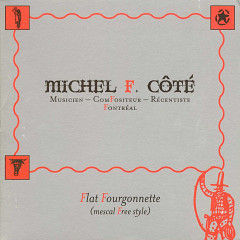
    Michel F Côté est un vétéran de la musique actuelle québécoise. Il a touché à toutes sortes de facettes de la musique: au théâtre, au cinéma, en performance, etc. Cette fois-ci, Côté nous présente un voyage en Amérique profonde. Celle du blues et du jazz des Noirs. Celle de la belle époque de Billie Holliday et de Mississippi John Hurt. Évidemment, du blues à la sauce Côté, ce n’est pas du Clapton! Sur ce Flat fourgonnette, le batteur est accompagné par une bande de copains virtuoses: Bernard Falaise et Claude Fradette aux guitares, Fred Boudreault et Normand Guilbeault à la basse, Frank Martel au theremin. Les Guillaume Dostaler, Tom Walsh, Lou Babin et Jean Derome, pour ne nommer que ceux-là, viennent aussi faire leur tour. On y note deux tendances générales, toutes deux très intéressantes. La bande à Côté offre parfois des blues et des jazz déjantés, comme pris dans la mélasse. Autre curiosité digne de mention, plusieurs morceaux ont été enregistrés en jouant par-dessus la bande originale d’un air des grands du jazz ou du blues. Guitares «slide», basse et batterie se joignent ainsi au vieux 33-tours grincheux qui sert d’inspiration et de chanson de base. On l’a tous fait en essayant de repiquer des solos, mais rarement avec autant de créativité. Immense reste le respect pour l’œuvre originale.

    Ensemble SuperMusique (ESM), Joane Hétu dans Downtown Music Gallery

    «24th Annual Festival International de Musique Actuelle de Victoriaville», Bruce Lee Gallanter, Downtown Music Gallery, 1 juin 2007
    vendredi 1 juin 2007 Presse

    […] The final day began with a wonderful set by Joane Hétu’s Ensemble SuperMusique called Filature. Joane Hétu runs the great label from Montréal, Ambiances Magnétiques. Her longtime partner is Jean Derome and both of them play alto sax, do vocals and compose at length. Both Joane and Jean consistently release excellent, diverse discs on Ambiances Magnétiques and I always look forward to any project that either works on. Just about every year, someone from this label (like Diane Labrosse, Normand Guilbeault, Danielle Palardy Roger or Pierre Tanguay) does something special up at Victo. Filature is Joane Hétus most ambitious project yet and it will take a while to absorb its many layers of ideas. It featured ten musicians, five women and five men with Pierre Hébert doing video projections. Joane refers to it as sound/theatre and that sounds right. Joane was once a weaver before concentrating on becoming a musician and the theme of weaving is the central thread throughout this work. The first part is called The Warp and featured the five men on alto sax or flute, violin, trumpet, contrabass and drums. The music was an exquisite blend of lovely harmonies, short drones, acappella vocal sections and haunting music. The video images were of a single tree branch with some occasional growth. The second part, The Weft featured the five women musicians on violin, cello, flutes, sampler, percussion & alto sax. Most of the women contributed charming vocal sounds along with their contemplative, cinematic music, sometimes sparse but always enchanting. The third and final part was called The Pattern and it featured all ten musicians. It began with just a few repeating notes and evolved through different grooves and sections. I love the way the vocals and instruments shared stunning harmonies with each other. Joane has a gift for breaking up the melody and having different members share their lines so that whole band sounds like one refined tapestry of sound. It reminded of the superb magic-music that Fred Frith’s Keep the Dog used to play and yes, Jean Derome was an integral part of that band many years ago. The images of twine, knots, rope, faces and hands connected with the music just right. It was a marvelous set and I can’t wait for it to be released on disc! […]

    Joane has a gift for breaking up the melody and having different members share their lines so that whole band sounds like one refined tapestry of sound.

    Jean Derome, Fanfare Pourpour, Lars Hollmer dans AllMusic

    «Biography», Dave Lynch, AllMusic, 1 juin 2007
    vendredi 1 juin 2007 Presse

    Quebec’s circusy big band Fanfare Pourpour have their roots in a number of musical and artistic groupings dating back to the mid-’70s through the early ‘80s, including L’Enfant Fort, a Saturday-afternoon Montréal street band; the Pouet Pouet Band, which incorporated theatrical and cabaret elements into their mix; and Montréal Transport Limité, an underground cabaret and progressive pop group. The musicians all went their separate ways until the summer of 1995, when their love of playing and performing brought them together as the Fanfare Pourpour. Their street band attitude gives the Fanfare Pourpour a ramshackle charm, and their open and friendly embrace has seemingly welcomed to the fold any friend or family member who can toot on a horn or whack a caisse claire, as long as the proper spirit is maintained. Since the band’s “formal” founding in 1995, however, the Fanfare have grown into a tight and formidable outfit, with no diminution of the raucous spirit that has always been central to their, well, raison d’être.The band’s first album, released in 1999 on their Monsieur Fauteux m’entendez-vous? label, was entitled Tout le monde — the CD featured an 11-piece core ensemble, notably featuring Montréal singer/accordionist Lou Babin, supplemented by a handful of high-profile guest musicians from Quebec’s jazz and musique actuelle scenes on selected tracks, including saxophonist Jean Derome and guitarist René Lussier. On follow-up CD Le Bal from 2004, the group’s ranks had swelled to 15 with an additional six guest musicians scattered here and there; by now Derome had taken on musical direction responsibilities and penned five of the album’s 16 tracks. On these two releases the ensemble members proved highly capable on practically any and every musical instrument imaginable, including accordion, clarinet, saxophones, violin, flute, guitar, banjo, trumpet, euphonium, sousaphone, harmonica, darbouka, bass, drums, and percussion, playing exuberant music that blended brass band and New Orleans classic jazz traditions with elements of Québécois folk and avant-garde musics.In 2004 Swedish composer, accordionist, and keyboardist Lars Hollmer (Samla Mammas Manna, Accordion Tribe) was invited to Quebec to appear with the Fanfare Pourpour at the Festival International de Musique Incroyable, and this successful encounter was followed up with additional rehearsals and a second festival appearance at the Festival International de Musique Actuelle de Victoriaville in 2005. The following year Hollmer was back in Quebec with the Fanfare yet again, this time to record the album Karusell Musik in a Montréal studio. By now it would appear that the distinction between full-fledged Fanfare bandmembers and invited guests had been erased, and the 19-piece ensemble supporting Hollmer included such notable Montréal and Quebec artists as Babin; other longstanding Fanfare members such as violinist Guido Del Fabbro and trumpeter Némo Venba (also members of avant-proggers Rouge Ciel), guitarists Luc Proulx and Roy Hübler, saxophonists Claude Vendette and Stéphane Ménard, clarinetist Pierre Emmanuel Poizat, and euphonium player Christine Lajeunesse; musical director/orchestrator/multi-instrumentalist Derome, bassist Normand Guilbeault, and percussionist Pierre Tanguay from the swinging Trio DGT and numerous other jazz/musique actuelle projects; sousaphonist Jean Sabourin from the impossibly tight brass band L’Orkestre des Pas Perdus; and violinist Marie-Soleil Bélanger, former member of the long-lived and ever-challenging Miriodor. So when it came to negotiating Hollmer’s sometimes tricky rhythms, emphatic backbeats, and multi-layered arrangements with the proper balance of roughness and precision, it would prove hard to top the Fanfare Pourpour. Karusell Musik was released in March 2007, with a CD launch concert by Hollmer and the band held that month at Montréal’s Lion d’Or.
  • 13
  • 14
  • 15
  • 16
  • 17
  • 18
  • 19
  • 20
  • 21