Sauter au contenu principal
actuellecd

Blogue

239 résultats
  • 17
  • 18
  • 19
  • 20
  • 21
  • 22
  • 23
  • 24
  • 25
  • 10 compositions dans Splendid E-Zine

    «Review», Matt Pierce, Splendid E-Zine, 24 juin 2004
    jeudi 24 juin 2004 Presse

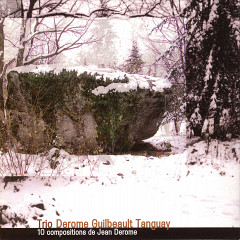
    The official history of jazz, with its New-Orleans-to-swing-to-bop-to-cool-to-fusion-to-free-to-?? continuum, reads like an evolutionary epic, and contemporary fans who like to think of jazz as a living, even controversial art form, rather than a chapter in a high school textbook on American history, might balk at the fact that this French-Canadian trio play swing, play notes, play songs, when that sort of thing went the way of the dinosaur after Ornette Coleman dropped Free Jazz way back in 1960. But on this bare-bones recording, Jean Derome (sax, flutes), Normand Guilbeault (bass) and Pierre Tanguay (drums) prove that a visit to a couple of old forms doesn’t have to rest on a bed of nostalgia, that walking bass and key changes don’t necessarily preclude freer sounds, and, most importantly, that good jazz is less a style than a spirit, a way of interacting and playing that swings, in the most liberal sense of the word.

    Marcher Sur Des Braises starts the album off with a spare shuffle from Tanguay and a little in-joke from Guilbeault, who plucks a rudimentary version of those three chords you can find in every Guide to Playing Rock Guitar under “Blues Chug” or some such heading, as if to say, “Rock can get away with the same thing decade after decade, so why can’t we?” Derome follows up with a low, crystal-clear theme straight from the Coltrane songbook, and when Guilbeault walks away from his blues progression into higher registers, Derome follows with a minimal but hard-hitting solo that touches a few blue notes in between its more refined runs. Both Vérone and Pangolin keep up this hard-boiled, hard-thinking approach to swing, the first with dark and gorgeous open chords from Guilbeault, unassuming melodicism from Derome and a punchy beat with a generous bass end from Tanguay, and the second with Tanguay’s slow and spacious drum work and Derome’s slinky turn on baritone sax, which erupts into a few Dolphy-like squeals near the end of the track. When the trio decide to take on worlds outside the explicit parameters of swing, they take their focus with them and make every exploratory minute worth the trip: refer to the loosely-bound mini-epic L’Africaine, on which Derome takes off for high-altitude abstractions, and Fluide, an exercise in classical serialism.

    In spite of their straight-up beat, rockish bass touches and moments of clear melody, this trio plays anything but NPR jazz. Their approach is hard-hitting and well-versed in the sort of rebellious, free-thinking spirit that infects all types of jazz. As a result, 10 Compositions is an intense success.

    … hard-hitting and well-versed in the sort of rebellious, free-thinking spirit that infects all types of jazz.

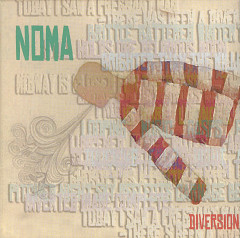
    Diversion dans Vital

    «Review», Dolf Mulder, Vital, no 428, 23 juin 2004
    mercredi 23 juin 2004 Presse

    Diversion is the title of a excellent new work by the Canadian trombonist and composer Tom Walsh. Walsh is a prominent musician in the Canadian avant garde and jazz scene. As a classically trained musician he started his career as trombonist in a Newfoundland symphony orchestra. Later Walsh started to play with a many canadian rock bands. Rock bands became jazz and improv projects. And that’s the context Walsh is working in nowawdays. He played with national (Rene Lussier, Michel F Côté) and international (Bern Nix, Gerry Hemingway, Fred Frith, Iva Bittova, Phil Minton) jazz and improv musicians. Walsh is involved in several groups. With saxplayer Richard Underhill he has a duo, with Pierre Tanguay he takes acoustic and digital adventures as Midi Tapant, etc. etc. In 1988 he started his very own NOMA-project. Jazz is the keyword here. Musicians involved in this project came and went. It was never meant as a permanent group. On the other hand the musicians with their personal possibilities and energy were very important to Walsh, as NOMA is about the energies that everybody brings in. Diversion is played by two small ensembles. Some pieces are played by The Côté Cour ensemble featuring Guy Kaye (el. guitar), Alan Baculis (el. bass) and François Chauvette (drums). Other pieces are played by the Côté Jardin ensemble that has Rainer Wiens on electric guitar, Normand Guilbeault on contrabass plus Pierre Tanguay on drums. Both ensembles have Tom Walsh on trombone and sampler. Recordings were made on two different occasions. But on the CD all is very well edited into one whole. As a composer draws from many different styles and idioms, which explains the title of this CD. The compositions refer to funk, improv, rock, avantgarde jazz, fusion, etc. Some pieces stay within well-known boundaries, at other moments Walsh paints abstract figures with strange colours. Walsh melted these influences together with vision and suppleness into a coherent and well balanced work. Together with convincing and energetic playing Diversion is a very enjoyable listening experience.

    Walsh melted influences together with vision and suppleness into a coherent and well balanced work.

    Puce à l’oreille dans Vital

    «Review», Dolf Mulder, Vital, no 428, 23 juin 2004
    mercredi 23 juin 2004 Presse

    On the compilation CD Sang 9 reviewed for Vital several months ago, the Ambiances Magnétiques label presented new and lesser known talents from Canada on the new music scene. One of them was Mélanie Auclair who now presents her first solo effort. On most of the pieces on this debut she either sings or plays cello. Most pieces have accompanied with another musician. On one piece we hear a trio and in the opening track Auclair plays a solopiece for cello. Auclair started playing cello at the age of 4 and later she was trained in classical singing. Nowadays Auclair likes to play improvised music because of her interest and drive to let emerge music spontaneously. She recorded with Joane Hétu, Bernard Falaise and Klaxon Gueule a.o. Auclair also has some experience in composing for theatre and dance productions. But now she wanted her music to stand on it’s own feet. For this project she asked and received the cooperation of several musicians she admires. We hear Auclair in duo with Vincent Réhel (piano), Guy Thouin (percussion, voice), Eric Auclair (bass, vibraphone), Charles Papasoff (bariton sax), Joane Hétu (voice) and Bernard Falaise (electric guitar). The cd closes with a trio by Eric Auclair and Michel Dubeau (Shakuachi). So it should not surprise that the 8 tracks on this cd make up a varied collection of improvisations. In all these meetings Auclair was interested in letting the improvisations come as spontaneoulsy as possible. If you ask me what they have in common, I would say that most pieces develop in the same slow pace. The intense vocal piece by Auclair and Hétu forms the exception. Because Auclair likes to play the low ranges of the cello most pieces have a dark and melancholic atmosphere, which is escpecially the case for the moving opening track. A common quality is also that most improvisations are textural explorations. Another musician mysterously named Papa Sucreah plays a role here. He seems to involved in most of the tracks doing some electronic extras that I’m unable to identify. Anyway with Puce à l’oreille Auclair delivers a improvised music that is ‘unspectacular’ but of a great emotive quality and honesty.

    Auclair delivers a improvised music that is ‘unspectacular’ but of a great emotive quality and honesty.

    Studio — Analogique — Numérique dans Les Inrockuptibles

    «Critique», Jérôme Provençal, Les Inrockuptibles, no 447, 23 juin 2004
    mercredi 23 juin 2004 Presse

    Triple offensive de deux redoutables poseurs de bombes-platines. Splendide désordre. La dématerialisation ne faisant rlen qu’à gagner du terrain (si l’on peut dire), prenons plaisir à parler d’un disque d’abord en tant qu’objet. Ce plaisir sera d’autant plus vif que l’objet-disque qui nous intéresse présente plusieurs signes ostensibles de non-conformismes: prenant la forme d’un coffret miniature semblable à une boîte à bijoux, il contient trois mini-cd,tous trois glissés dans une feuille de papier gris. Miniature, mini, mince… Cela signifie-t-il qu’ici tout est riquiqui? Pas du tout, mais alors pas du tout! Tout entière composée d’ondes de choc, la chaotique musique que déversent, ensemble ou séparément, Otomo Yoshihide et Martin Tétreault, tendrait plutôt, avec une vigueur vite perceptible, à un ravissement maximal des tympans. Cette saine entreprise de décrassage n’étonne guère de la part de deux trublions notoires, platinistes — un platiniste étant, sachez-le, non pas un disciple de Michel Platini, mais un manipulateur plus ou moins indiscipliné de platine-disques — véhéments, persuadés que le bruit est une aventure que chaque enregistrement réitére. Aprés tout, si ce n’est pas pour chahuter l’inconnu, à quoi bon s’en aller en studio? Studio, tel est d’ailleurs le titre du disque, abrasif exemple de dissiddence sonique, né de la rencontre entre nos chercheurs de noises. De ce Studio en splendide désordre, Tétreault a effectué un remix analogique, tandis que le kamikaze Yoshihide lui faisait subir les derniers outrages numériques. Le tout est à prendre ou à laisser. On prend.

    … la chaotique musique que déversent… Otomo Yoshihide et Martin Tétreault tendrait plutôt, avec une vigueur vite perceptible, un ravissement maximal des tympans.

    Radio Roadmovies dans Vital

    «Review», Frans de Waard, Vital, no 427, 14 juin 2004
    lundi 14 juin 2004 Presse

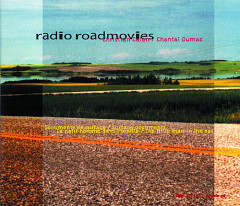
    This is one of those things that fall out of the sky and you have no idea who or what it is about. One Chantal Dumas and one Christian Calon made a trip through Canada, and this double CD is the sort of Hörspiel about it. Recording natural elements on their trip, as well as say rain falling on the tent but also them speaking about places they visit (not always as a clear narration) or the meeting of people, like ‘the chiefs in the Gitskan village of Kispiox’. It’s hard to say wether a lot of post-processing took place. There are moments in there in which I think all the sounds are as they are, but in some cases there might be also some sort of post-processing. Not that’s really important at all, because it’s a fascinating journey to hear. You could wonder if it’s something you’ll find spinning a lot, but in all it’s a captivating recording. On the second CD Documents de surface (Surface Documents) nine tracks are presented of sounds as they actually were but then presented in collage form. Grouped together are various wind sounds or water systems. Here no talking but instead pure soundscapes, which are quite delicate and nice. The narrative aspect is all gone here, but on the other hand I can imagine people playing this disc more often. Quite a surprise this double pack, in a very nice digipack.

    … a captivating recording… in a very nice digipack.

    Tout le monde en place pour un set américain, Kristoff K.Roll dans Signal to Noise

    «Reviews», Nathan Turk, Signal to Noise, no 34, 1 juin 2004
    mardi 1 juin 2004 Presse

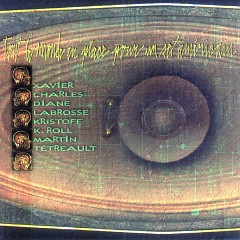
    Attendees of the May 17, 2003 presentation that yielded Tout le monde en place pour un set américain — part of the annual Festival International de Musique Actuelle in the remote Quebec town of Victoriaville — were encouraged to wander around the performers’ stage, which lay in the room’s center with ten loudspeakers surrounding the seats. But even detached from this interactive spatial element, the sound collages of Carole Rieussec and Jean-Christophe Camps (appearing as the duo Kristoff K.Roll), Xavier Charles, Diane Labrosse and Martin Tétreault still captivate. Tous, the first of the disc’s two extended pieces, ruminates over a motive of sinister speaker crackle with metallic scree, the clomping of wood and random blurts from Tétreault’s “dismembered turntables”, which he utilizes both with and without LPs. Samples of children splashing in water eerily juxtapose at one point with rattlesnake percussion, septic bass tones and screams of feedback, while later a sickly harmony sets in among sounds of buzzing conduits and a prepared violin. En place has a similar feel but recasts the first piece’s building blocks — Camps’ and Rieussec’s found-object chatter, Labrosse’s “electric eye” machine (similar to a theremin) and Charles’ ghostly clarinet phrases — in new timbrel contexts. The sonic tapestries of PSI or Martin Archer are a fair reference point for what results, though Tout le monde en place pour un set américain teems with unusual vitality. The ending of En place, for example, winds down like a weather front circa 2340 A.D., with the calm static of a dying amp and subliminal humming returning the disc’s sound storm to rest, just as it began.

    … unusual vitality.
  • 17
  • 18
  • 19
  • 20
  • 21
  • 22
  • 23
  • 24
  • 25