Sauter au contenu principal
actuellecd

Blogue

188 résultats
  • 12
  • 13
  • 14
  • 15
  • 16
  • 17
  • 18
  • 19
  • 20
  • A_dontigny, Coin Gutter, Diane Labrosse, Christof Migone, Martin Tétreault, No Type dans Grooves

    «Mutek 2003 review», Schepper, Grooves, no 11, 1 août 2003
    vendredi 1 août 2003 Presse

    As in previous years, the range of artists and genres represented at Mutek 2003 was considerable. With over 70 artists from around the world appearing, one had the opportunity to see ‘marquee’ acts like Pole, Coil, and Richie Hawtin, as well as uncompromising artists like Pita, Kevin Drumm, and T. Raumschmiere. Unlike past Muteks, DJ sets were almost entirely absent at this year’s festival (although, for the record, past DJ sets had often been used to bridge the gaps between non-DJ performances). And, in comparison to last year’s ambitious potpourri of concerts, panel discussions, films, and design displays, the 2003 incarnation limited itself to concerts and panel discussions, with seven of the latter. In short, this year felt like a satisfying consolidation of past festivals’ strengths instead of grandiose risk-taking.

    There were label showcases by Mego, No Type, and Minus/Plus 8, and sets of dubby microhouse from EGG (Julien Roy and Guillaume Coutu-Dumont), smooth minimal techhouse from Robin Judge and Jeff Milligan (aka Algorithm and Revolver label head), hard-hitting minimal techno by Ototo (Dimitri and Filip), Jeremy Caulfield, and Matthew Dear (aka False), the latter’s music evoking classic Chain Reaction stylings in its treble and bass detailing. Drone and ambient musics were presented, the most notable instance being the appearance by Thomas Köner and Asmus Tietchens (performing as Kontakt Der Jünglinge) who sculpted a slowly unfurling glacial soundscape. Other artists in this genre included Gary Joynes (aka Clinker), who built a singular drone-like piece of slowly metamorphosing waves, and [sic] (Jen Morris), who created ghostly dronescapes against a diptych backdrop of enigmatic photographs. Electroacoustic sets were offered by the nuanced Coin Gutter (Graeme Scott and Michael Hendrix) and sampling artist Diane Labrosse and Aimé Dontigny, whose collaboration resulted in a tactile, improvisatory dialogue. Set Fire to Flames’ member Christof Migone generated a 45-minute stream of body-generated scraping and whirring sounds accompanied by a video triptych that showed a gaping mouth at left, what appeared in the middle to be a tomato encased within a block of ice lodged within a salivating mouth, and, at right, the nighttime silhouette of a cityscape and bridge. There were infectious jazz-inflected funkhouse from Cobblestone Jazz and celebratory Latin techhouse by Mambotur. Chicago-based Telefon Tel Aviv (Joshua Eustis and Charles Cooper) presented a heavy microdub funk of chiming synths and massive bass drum and snare patterns. But, overall, the most memorable performances were turned in by veterans like Pole, Coil, Richie Hawtin, Monolake, and Señor Coconut.

    In a Saturday afternoon performance that paid tribute to turntable pioneer Raymond Gervais, four turntable titans — Philip Jeck, Marina Rosenfeld, Martin Tétreault, and Martin Ng — provided an hypnotic set that included extended group collaboration as well as individual spotlights. Ostensibly, the proceedings were directed by Tétreault but his was certainly a benign dictatorship; if anything, the pieces often evolved with the others responding to Jeck’s looping grounds. They began by constructing a beautifully measured collage of scraping and scratching sounds amidst ghostly strains of melody. Immediately following this auspicious beginning, they created an equally effective second piece of whistling tones and bell-like percussion effects. While the concert predominantly featured the four playing together, there were brief duos, trios, and solos. Naturally, as is to be expected in an improvisatory setting, some tentative moments emerged when it seemed as if each of the four was waiting for someone to take the lead, but these registered as not unwelcome moments of brief stillness. Each took solo turns: Jeck, using two turntables, one for 12 inch lps and the other for 45s, drowned the sitar from Stoked in showers of surface noise; Rosenfeld’s solo offered a turntable adagio of sorts filled with treble glissandoes, looped crackling patterns, and phantom melodies; Tétreault’s initial musical quotation was gradually buried under huge slabs of static and hiss, his turn ending with furious scratching and a physical attack on his lps; finally, Ng’s solo impressed less as an exercise in musicality and more as one of physical athleticism. To close, the four collaborated upon a carefully sculpted elegiac piece. In sum, this session was engrossing and nuanced—a demonstration of sensitive listening and collaboration by its participants.

    Electroacoustic sets were offered by the nuanced Coin Gutter and sampling artist Diane Labrosse and Aimé Dontigny, whose collaboration resulted in a tactile, improvisatory dialogue.

    Télépathie dans wReck thiS MeSS

    «Review», Bart Plantenga, wReck thiS MeSS, 25 juillet 2003
    vendredi 25 juillet 2003 Presse

    Actually one of the best abstract conceptual discs I have received in some while. It seems to regard the unused and discarded noise produced by radios as fine raw material. It is a bit of adventurous sound seeking and giving shape to collections of sound found in the cracks between frequencies like there is some possibility for communicating with spirits to be found there.

    … giving shape to collections of sound found in the cracks between frequencies…

    Télépathie, liberum arbitrium dans Absurdities

    «Review», Nicolas, Absurdities, no 8, 19 juillet 2003
    samedi 19 juillet 2003 Presse

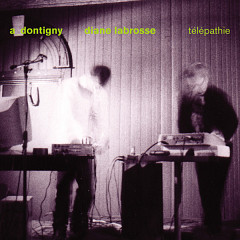
    No Type has started its own label too, besides the well known mp3 site they offer and to be honest they offer us some really cool musics for our listening pleasure. The first of the couple I checked is the A_dontigny, Diane Labrosse Télépathie CD, recorded live at the “Casa del Popolo” (guess somewhere in Québec? Or so in Canada). Within its 4 tracks (& its nearly 50 minutes) we can get electroacoustic to ambient soundscapes to more experimental noisy tunes as well that made me like a lot the rich flavours of this surprisingly good encounter. The second was the morceaux_de_machines liberum arbitrium CD, coming in the typical empreintes DIGITALes packaging (actually they house the No Type editions), a really phrenetic CD. Unfortunately don’t know much about this project besides the infos and mp3s that are available on No Type but this CD made me curious to check out their work. A kind of really “broken” sound but not with the meaning of hiss, crackle, scratch whatever. On the contrary, a kind of more noisy/frenzy Christian Marclay-like stuff. There were moments that I thought I was listening to a more noisy version of the impressive Marclay/Mueller More Encores CD. Truly impressive the way they treat & create their soundscapes & certainly a not so easy listening experience. Check it out!

    … electroacoustic to ambient soundscapes to more experimental noisy tunes… made me like a lot the rich flavours of this surprisingly good encounter.

    Prairie orange dans CHOQ

    «Les Poules de DAME», Simon Vézina, CHOQ, 15 juillet 2003
    mardi 15 juillet 2003 Presse

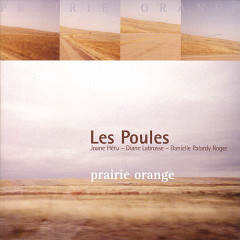
    Jeudi soir dernier, le trio féminin les Poules se réunissait à la Casa del Popolo pour le lancement d’un nouvel enregistrement: Prairie Orange. Voilà un second disque pour elles qui déphase de leur premier réalisé 15 années auparavant. Peut-être l’ignoriez-vous? Les Poules ne font plus dans la chanson. Je suis assis dans le sofa rétro de la Casa del Popolo. J’observe les murs de granges, les vieux tuyaux, le plafond imparfaitement parfait et l’éclairage de salon. Quels fabuleux contrastes avec le théâtre moderne, néonisé, et d’apparence cartésienne qui lui fait face. Je me considère chanceux d’être dans un endroit aussi sain et Saint que la Casa del Popolo. Je dis bien Saint car c’est en ses lieux que les Poules ressusciteront après 15 années. Plus que quelques minutes encore et ça y est… les Poules, Joane Hétu, Diane Labrosse et Danielle Palardy Roger, montent sur le surélevé. Ce trio nous présente alors leur nouvel album en donnant une prestation dans l’intimité du lieu. Les membres du trio sont toutes très reconnus dans l’univers de la musique actuelle montréalaise. Ses femmes nous ont offert une solide performance à la hauteur de leur réputation. Les poules nous font traverser Prairie Orange d’un seul élan. Le paysage sonore se compose de sons électroniques et acoustiques, de crépitements, de bruissements et de jeux buccaux. Avec un saxophone, un drum et un échantillonneur, les matériaux n’impressionnent pas. Par contre, ces trois femmes-là savent au moins quoi en faire. Wow! J’oublie que Joane se joue dans la bouche pour produire ses sons et me voilà transcendé. Les Iktus de Diane ouvre la marche vers un climax sonore surréaliste. Le jeu de Danielle aux percussions teint les décors et modère la progression. Les commentaires au saxe de Joane donnent parfois dans l’humour, mais sont de bon goût. Le tout se retrouve sur un autre excellent disque de l’étiquette DAME.

    Les poules ne font plus dans la chanson. À en juger par le nombre de gens sortant avant même la moitié de la prestation, cela a probablement déplu à plusieurs. Un fan possible de leur premier album est demeuré lui jusqu’à la fin et a risqué de demander en rappel la Ballade du pain. La demande fut ignorée. Par contre, le touriste belge de ma droite et les trois suffragettes de ma gauche semblaient eux comblés de bonheur. Moi de même par ailleurs.

    Merci aux Poules pour cette soirée unique et fabuleuse.

    Ses femmes nous ont offert une solide performance à la hauteur de leur réputation. Les poules nous font traverser Prairie Orange d’un seul élan.

    Asymétries dans Ici Montréal

    «Compact!», François Couture, Ici Montréal, no 6:40, 10 juillet 2003
    jeudi 10 juillet 2003 Presse

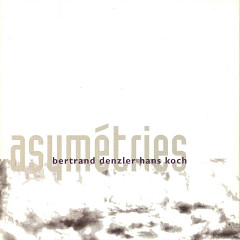
    Voilà une rareté: un disque d’Ambiances Magnétiques sans musicien québécois. Denzler (saxo ténor) et Koch (clarinette basse et saxo soprano) sont deux improvisateurs suisses que la recherche d’un nouveau vocabulaire musical a poussés aux limites de l’expression sonore. Rendant floue la frontière entre le corps et l’instrument, leur musique consiste en un tissu de gargouillis, de cliquetis et de cris retenus. Aride, vous dites? Absolument; le genre de disque qui fera dire à plusieurs que «c’est pas d’ia musique, ca». Mais la créativité et le niveau d’écoute entre les deux improvisateurs captiveront quiconque se donne la peine d’écouter avec l’esprit ouvert. 9/10

    … les deux improvisateurs captiveront quiconque se donne la peine d’écouter…
    9/10

    Télépathie dans Blow Up

    «Recensione», Nicola Catalano, Blow Up, no 62-63, 1 juillet 2003
    mardi 1 juillet 2003 Presse

    Registrato dal vivo sulle assi dell’attivissimo club Casa del Popolo, il disco è un incontro impro-telepatico tra il computer di A_dontigny (Napalm Jazz e morceaux_de_machines) e il campionatore di Diane Labrosse (un passato in gruppi art-rock al femminile nonchè frquenti collaborazioni con Ikue Mori, Zeena Parkins, Martin Tétreault etc.), scuro e pastoso sound design elettro-acustico sotterrato da brute valanghe di interferenze e disturbi.

  • 12
  • 13
  • 14
  • 15
  • 16
  • 17
  • 18
  • 19
  • 20